


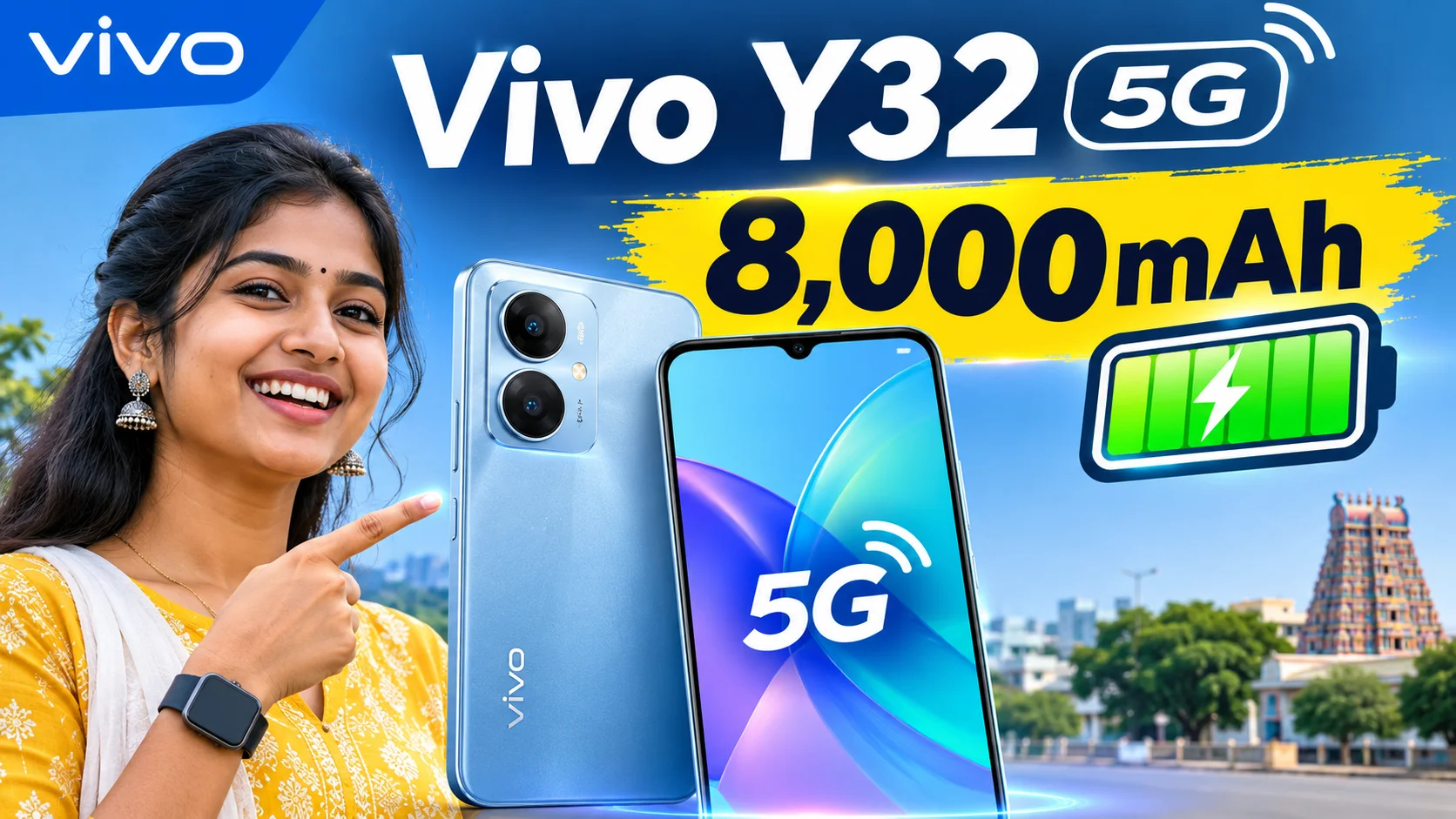
The group chat screenshot is a battery number, and for once the number is the story. Business Today Desk, updated 6 November 2026 at 4:50 PM IST, walked through the Vivo Y32 5G as a five-slide spec sheet. The headline cell is 8,000mAh. Around it: 44W charging, 7.5W reverse charging, IP68 and IP69, MIL-STD-810H, an SGS five-star drop rating, a 6.87-inch 120Hz LCD, Snapdragon 4 Gen 2, 6GB RAM and a 50MP camera. Then the last slide lands the part the headline calls a surprise. The big, smooth screen is only HD+, not Full HD+. And Vivo has not revealed the price, or wider availability.
That missing price is why I am not calling this a “best budget phone” yet. An 8,000mAh pack in a phone that looks affordable is interesting. A phone you cannot buy, at a price nobody has printed, is a spec leak with a brand name on it. If a shop link in your chat already has a rupee figure, that figure is not in this report.
What 8,000mAh does and does not promise
Business Today frames the Y32 5G for people who are tired of reaching for a charger every evening. The cell supports 44W fast charging and 7.5W reverse charging, so it can power compatible devices. Vivo claims the battery can retain over 80 percent of its health after 1,500 charging cycles. Read that as a claim. The article does not show a lab sheet, a temperature, or what “health” means on Vivo’s meter. It also does not say how many hours of screen time you get. The gallery itself asks how much longer the phone could last between charges, and then does not answer. I will not invent a two-day or three-day figure to fill that hole.
Reverse charging at 7.5W is the practical Indian footnote. That is earbuds, a watch, maybe a friend’s phone in a slow pinch. It is not a power bank you take to a wedding. Forty-four watts is also not the 80W or 120W bricks flagships brag about. A huge cell and a mid-speed charger can still mean a long sit next to the socket. The article does not say how many minutes 0 to 100 takes. Anyone who puts “fully charges in 30 minutes” under this phone is writing fan fiction.
The display is the actual surprise
Slide four is the one to read twice. The panel is 6.87 inches, LCD, 120Hz, up to 1,300 nits of peak outdoor brightness, and TÜV Rheinland low-blue-light certified. Smooth scrolling and a bright outdoor panel are the sales pitch. The compromise, in Business Today’s words, is that despite the size and the refresh rate, the display is only HD+ rather than Full HD+.
On a 6.87-inch panel, HD+ is not a footnote. It is fewer pixels stretched across a large sheet. Text, maps and long Tamil news articles are where you will notice it, not in a YouTube thumbnail. A 120Hz refresh makes motion look smoother. It does not add sharpness. If you are coming from a Full HD phone of the last three years, this is the trade you are being asked to accept in exchange for the battery. The article does not give the exact pixel count, so I will not type 1600-something and pretend it was printed.
The toughness line is a rating, not a dare
Slide one stacks four credentials: IP68, IP69, MIL-STD-810H, and an SGS five-star drop resistance rating. Business Today says these suggest the phone is built for tougher conditions than many conventional phones. The next sentence is the one shops will crop out. Military-grade testing does not make a device indestructible. The gallery even asks how much protection it really offers, and does not run a drop test of its own.
IP68 and IP69 are dust and water ratings as stated. They are not a promise that a phone survives a washing machine, a beach holiday, or a monsoon left on a scooter seat. MIL-STD-810H is a certification label in this article, not a list of which of the standard’s methods Vivo actually ran. SGS five-star drop resistance is likewise a cited rating, not a height in this report. I am not going to turn any of those into “drop it from a balcony.” If you buy this later, a case is still a case.
Storage looks generous until you read the chip
Built-in storage is 128GB. The card slot goes further: microSD cards up to 2TB. That is the line that matters if your phone is a wedding archive. Photos and videos can move off the internal chip. Apps and the system still live with that 128GB, and the article does not say whether apps can be moved to the card.
The processor is Qualcomm’s Snapdragon 4 Gen 2. There is 6GB of physical RAM, plus support for another 6GB of virtual RAM. The software is OriginOS 6 based on Android 16. Virtual RAM is storage borrowed to look like memory. It is not a second 6GB chip, and it will not make a heavy game feel like a flagship. Business Today asks whether this combination can deliver the everyday performance buyers expect, and leaves it open. Everyday WhatsApp, maps, UPI and video are the job a Snapdragon 4-series phone is usually bought for. The article does not benchmark it. Neither will I.
There is also no update promise in the gallery. Android 16 as the base is not the same sentence as four or five years of patches. If a listing adds “7 years of OS updates,” that listing is not this article.
The camera is a 50MP headline and a 2MP neighbour
The rear setup is dual: a 50MP primary sensor and a 2MP auxiliary camera. The front camera is 8MP, for selfies and video calls. A 2MP helper is the familiar budget tell. It is not an ultrawide you take to a family function, and the article does not call it one. No aperture, no video resolution, no night mode claim. Stereo speakers, NFC and a side-mounted fingerprint sensor are the other extras on the last slide. NFC is worth noting because a lot of phones in this conversation still skip it, but the article does not say which Indian transit or payment setups it has been tested with.
What you still cannot do
You cannot compare it honestly on price, because Vivo has not revealed pricing. You cannot check a delivery date, because wider market availability is also unrevealed. The report does not say “India launch on this date,” does not name a colour, and does not give weight or thickness. An 8,000mAh phone can be a brick. This article does not tell you whether it is.
So the honest status on 6 November 2026 is a spec portrait, not a shopping recommendation. The battery claim is large, the charger is 44W, the toughness ratings are stacked, the screen is big and only HD+, the chip is a Snapdragon 4 Gen 2 with 6GB of real RAM, and the camera is 50MP plus 2MP. Hold the rupee posts until Vivo prints a price. Until then the surprise is not a secret feature. It is the resolution they put on an 8,000mAh phone.





Comments (0)
Be the first to comment!