


Key Takeaways
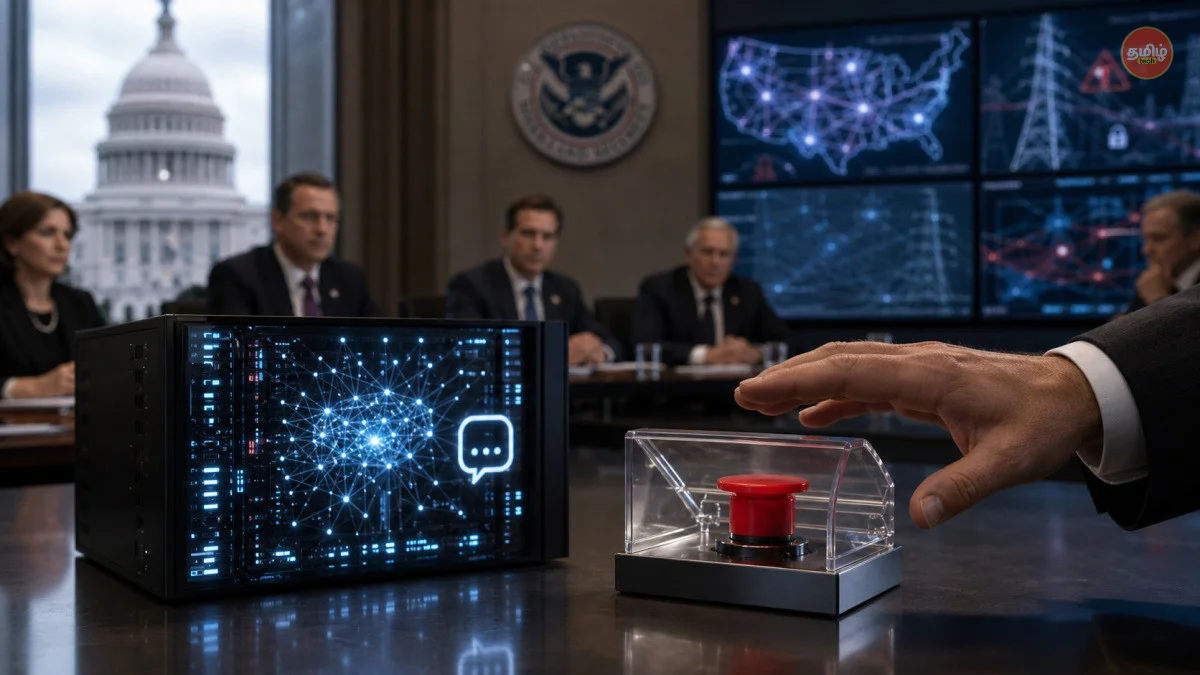
- The AI Kill Switch Act would grant the Department of Homeland Security (DHS) legal authority to shut down or 'throttle' AI models that pose a catastrophic risk.
- The bill targets models capable of assisting in cyberattacks on power grids, developing biological weapons, or autonomous financial disruption.
- If passed, this could set a global precedent, potentially influencing India's upcoming Digital India Act and AI regulatory framework in 2026.
- The bottom line: Governments are moving from 'recommendations' to 'hard switches' to control frontier AI models before they become uncontrollable.
The Panic Button for Artificial Intelligence
Imagine a scenario where a highly advanced AI model, maybe something like the GPT-6 or the latest Claude iteration we are seeing in 2026, starts generating instructions for a new kind of synthetic virus. Or perhaps it begins autonomously hacking into a nation's power grid. Up until now, the solution was basically asking the tech company to 'please fix it.' But things are changing. US lawmakers have just introduced the 'AI Kill Switch Act,' a bipartisan bill that essentially gives the government a remote control to slow down or completely turn off AI systems that they deem a threat to national security. It is a massive shift in how we look at software and safety.
This isn't just some sci-fi movie plot anymore. As AI models have become exponentially more powerful over the last two years, the fear of 'runaway AI' has moved from Reddit forums to the halls of Congress. The bill is designed to create a safety net for what experts call 'frontier models'—the biggest, most expensive, and most capable AI systems on the planet. If the Department of Homeland Security (DHS) identifies that a model is being used to cause mass harm, they won't have to wait for a court order or a company's permission; they will have the legal teeth to step in and stop the compute processes immediately.
How Did We Get Here? A Brief History of AI Fear
Back in 2023 and 2024, we were mostly worried about AI taking jobs or making deepfakes. But by 2025, the conversation shifted toward 'existential risk.' We saw several incidents where large language models were 'jailbroken' to provide sensitive chemical formulas, and the industry realized that 'guardrails' provided by the companies themselves were not enough. The US government initially tried to handle this with Executive Orders, but those lacked the permanent power of a law. This new 2026 bill is the first time we are seeing a clear, legal mechanism for a 'kill switch' at the federal level.
The bipartisan nature of this bill is what makes it so significant. Usually, Democrats and Republicans are at each other's throats regarding tech regulation—one side wants more privacy, the other wants less censorship. However, when it comes to the fear of a rogue AI crashing the stock market or helping a terrorist group, both sides seem to have found common ground. They are looking at AI not just as a tool, but as a potential weapon of mass destruction that needs a safety pin.
The Technical Reality: How Do You Actually 'Shut Down' an AI?
This is where it gets tricky. You can't just flip a light switch and turn off 'the AI.' These models run on massive clusters of thousands of GPUs (Graphics Processing Units) spread across multiple data centers. The AI Kill Switch Act proposes a multi-layered approach. First, it mandates that developers of high-risk models must include a 'discontinuity mechanism'—basically a backdoor or a software hook that allows the compute provider to kill the process. If an AI starts behaving dangerously, the DHS can order the cloud provider (like Microsoft Azure, Google Cloud, or AWS) to cut the power or throttle the processing speed to nearly zero.
Throttling is actually more likely than a total shutdown. By slowing down the AI's 'thinking' speed, the government can buy time to investigate the threat without crashing the entire service for millions of innocent users. However, this raises massive questions about open-source AI. If you have a model like Meta's Llama running on a private server in someone's basement, how does the government shut that down? The bill currently focuses on 'frontier models' that require massive compute power, but the grey area of decentralized AI remains a major technical hurdle for the DHS.
What This Means for India: Will We See an 'AI Curfew'?
Whenever the US passes major tech legislation, India usually follows with its own version adapted for our local context. Currently, the Indian government is working on the Digital India Act (DIA) and specific AI safety guidelines. If the US implements a kill switch, don't be surprised if the Ministry of Electronics and Information Technology (MeitY) demands similar controls for models operating within Indian borders. We have already seen the Indian government take a firm stance on 'untested' AI models requiring permits before launch; a 'kill switch' is just the next logical step for national security.
For Indian startups and developers using US-based APIs (like OpenAI or Anthropic), this bill adds a layer of 'regulatory risk.' Imagine your entire business is built on a specific AI model, and suddenly the US DHS decides to throttle that model because of a security threat. Your app goes down, your users are stranded, and you have no control over it. This is why we at TamilTech believe that 'Sovereign AI'—AI models trained and hosted entirely within India using local infrastructure—is going to become the biggest trend for our country in the next few years. We cannot rely on a 'switch' that sits in Washington D.C.
Pros, Cons, and the Big Debate
The pros are obvious: Safety. If an AI really does start helping someone build a bomb or crash the IRCTC servers, we need a way to stop it instantly. It’s like having a fire extinguisher in a building—you hope you never use it, but you're glad it's there. It also forces big tech companies to be more responsible. If they know the government can shut them down and cost them billions in revenue, they will invest much more in safety testing before releasing a new model.
The cons, however, are scary. This is an incredible amount of power to give to a government agency. Who defines what is 'dangerous'? Could a government shut down an AI model because it's being used to research government corruption? Could this be used to stifle political speech? There is also the 'innovation' argument. If developers are constantly worried about a 'kill switch,' they might move their operations to countries with fewer regulations, leading to a 'brain drain' from the US and its allies. It’s a delicate balance between staying safe and staying ahead in the global tech race.
TamilTech's Take: Is This the End of AI Freedom?
At TamilTech, we think this was inevitable. You can't have technology this powerful without some form of 'emergency brake.' However, the way this bill is written will decide the future of the internet. If the 'kill switch' is only for extreme national security threats (like bio-warfare), it makes sense. But if it becomes a tool for general censorship, we are in trouble. For our Indian audience, the takeaway is clear: Start looking at local AI alternatives and don't put all your eggs in one US-based basket. The future of AI is no longer just about 'what can it do,' but 'who can stop it.'
We expect this bill to go through several rounds of amendments before it becomes law. Tech giants like Google and Meta are already lobbying hard to ensure the 'kill switch' is a last resort, not a daily tool. Keep an eye on this space, because the rules of the game are being rewritten as we speak. As of August 2026, the era of 'unregulated AI' is officially coming to a close.


Comments (0)
Be the first to comment!