


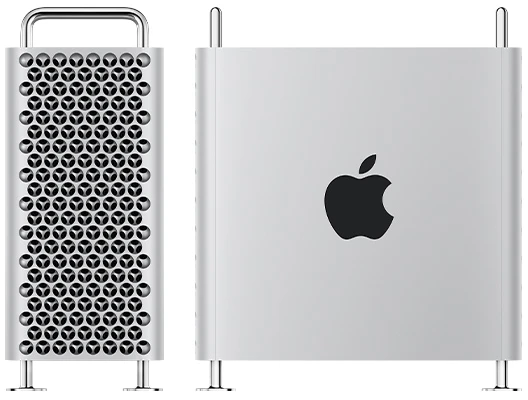
Apple pulled the Mac Pro from its website — and confirmed it's not coming back
On March 26, 2026, Apple quietly removed the Mac Pro from its online store. The product page now redirects to the Mac lineup homepage. No farewell announcement, no press release, no tribute video. Just gone.
Apple confirmed what the removal meant: the Mac Pro is discontinued, and the company has no plans to build another one. After 20 years — from 2006 to 2026 — Apple's most powerful, most expandable, most expensive desktop computer is over.
If you went to Apple's website looking to spend $6,999 on a tower workstation with PCIe expansion slots, that option no longer exists. Apple's current desktop lineup is now three machines: the 24-inch iMac with M4, the Mac mini with M4 and M4 Pro, and the Mac Studio with M4 Max and M3 Ultra.
A quick history of why the Mac Pro was always complicated
The Mac Pro replaced the Power Mac G5 in 2006 when Apple switched from PowerPC to Intel processors. For most of its early life, it was genuinely the right tool for the right professionals — music producers, video editors, visual effects artists, architects, scientists who needed raw compute power, lots of RAM, and the ability to add specialized expansion cards.
Then things went sideways. In 2013, Apple released what became known as the "trash can" Mac Pro — a stunning cylindrical design that was genuinely beautiful and genuinely terrible from a professional standpoint. Apple had designed it around dual GPUs in a compact thermal core, but the industry moved toward single large GPU cards. The design physically couldn't accommodate them. Apple ended up openly apologizing for it in 2017, admitting they had "designed themselves into a thermal corner."
The comeback came in 2019 with the return of the tower design — the "cheese grater" with its distinctive perforated aluminum exterior. It had PCIe slots, massive expandability, and prices that started at $5,999. Apple clearly built it for the professionals who had been waiting through the trash can era.
Then Apple Silicon happened. In 2020, Apple started transitioning from Intel processors to its own M-series chips, and the Mac Pro was suddenly in an awkward position. The M-series chips are exceptional but they don't support add-in GPU cards the way Intel Macs did. The entire PCIe expansion promise of the cheese grater tower became hollow when the most powerful thing you could slot into those PCIe bays was not a GPU.
The M2 Ultra Mac Pro launched in June 2023. By that point, the Mac Studio — a much smaller, much cheaper machine — offered similar or better performance for most professional workloads, for $3,000 less. The Mac Pro's PCIe slots could hold things like specialized video capture cards, network adapters, and audio interfaces. For the professionals who needed exactly that, the Mac Pro was irreplaceable. For everyone else, it was a very expensive tower that did the same thing as a Mac Studio in a fraction of the space.
What killed it — the technical and strategic reasons
The Mac Studio didn't just offer better value — it exposed the Mac Pro's fundamental problem in the Apple Silicon era. Apple's M-series chips use unified memory architecture, which means RAM is integrated directly into the chip package. You can't add RAM by plugging in a DIMM. You can't upgrade the GPU by swapping a card. The expansion slots in the Mac Pro tower became progressively less useful as Apple Silicon matured.
Apple added a feature called RDMA over Thunderbolt 5 in macOS Tahoe 26.2, which lets you connect multiple Macs together with low latency for distributed workloads. This gave ultra-high-end users another path to scaling performance — one that didn't require a tower with PCIe slots. Another nail in the Mac Pro's coffin.
The NVIDIA situation also never resolved. Professional users in film, visual effects, and machine learning had been asking Apple to support NVIDIA GPUs for years. In 2018, a Red Digital Cinema executive literally stopped mid-speech at an event to tell an Apple employee directly: "We need NVIDIA support." Apple never delivered it. With Apple Silicon, the question became moot in the wrong direction — not "which external GPU can I add" but "you can't add one at all."
And then there's the price. $6,999 for a machine running a chip from 2023, while the Mac Studio ran newer chips at $3,999. The Mac Pro was being sold at a premium for a form factor whose advantages had been significantly eroded by the platform it ran on. Continuing to sell it that way was a disservice to anyone who might have been considering it.
What replaces it — and what the Mac lineup looks like now
The Mac Studio is Apple's answer to professional desktop computing in the Apple Silicon era. The current lineup includes M4 Max and M3 Ultra configurations, with the M3 Ultra offering a 32-core CPU, 80-core GPU, up to 256GB of unified memory, and up to 16TB of SSD storage. An M5 Ultra Mac Studio is widely expected later this year, which should widen the performance gap with the now-discontinued Mac Pro even further.
For professionals who absolutely need PCIe expansion — specialized broadcast hardware, high-channel audio interfaces, specific video capture setups — the Mac Studio with Thunderbolt 5 daisy-chaining is the current answer. It's not the same as internal PCIe slots, but it covers most use cases.
Apple's full desktop lineup now is actually quite clean: iMac for everyday users and creative professionals, Mac mini for developers and budget-conscious buyers, Mac Studio for serious pro work. Three distinct tiers with clear differences. The Mac Pro was blurring into Mac Studio territory at double the price — its absence makes the lineup simpler to navigate.
The Pro Display XDR went too
Worth noting: the Pro Display XDR — Apple's 6K reference monitor that launched alongside the 2019 Mac Pro at $4,999 (plus $999 for the stand) — was discontinued earlier in March. The Mac Pro's companion display is already gone. They left together, in a way.
What this means for Indian Mac users
The Mac Pro was never a mainstream product in India — at ₹6 lakh plus (the approximate INR equivalent at Apple India's pricing), it was relevant only to high-end production studios, post-production houses, music studios, and universities with research computing needs. Very few individuals bought one.
For those buyers in India, the Mac Studio is the legitimate successor. The M3 Ultra Mac Studio configured for serious professional work runs approximately ₹3.5-4.5 lakh in India — significantly less than what a Mac Pro would have cost, with comparable or better chip performance for most workloads.
Indian video production companies and music studios that had been considering a Mac Pro investment can now plan around the Mac Studio instead, and actually get a better chip in a more sensible form factor. The Mac Studio's compact design also works better in India's typically smaller studio and office spaces.
TamilTech's take
The Mac Pro's discontinuation was overdue and arguably the right move. A machine frozen at M2 Ultra while the Mac Studio moved to M3 Ultra was already an awkward product to recommend. Apple let it sit there for three years without an update — that's not how you treat your flagship pro desktop. Pulling it cleanly and acknowledging no successor is coming is more honest than letting it linger.
The Mac Studio is genuinely excellent. An M5 Ultra version later this year will be exceptionally powerful. For the narrow category of professionals who truly needed PCIe expansion for specialized hardware, the loss is real — but that category has been shrinking as Thunderbolt connectivity has improved.
Twenty years is a good run. The Mac Pro defined what professional desktop computing could look like at multiple points in its history. The current Mac lineup without it is cleaner, more focused, and honestly stronger. That's not a bad legacy.






Comments (0)
Be the first to comment!