


Apple finally made a Mac that regular Indians can actually buy
For years, the standard answer to "should I buy a Mac?" in India was: "only if you can afford Rs 1 lakh+." The entry price for a MacBook Air hovered stubbornly above that barrier, and Windows laptops — even mediocre ones — cleaned up the sub-80K market purely on price.
Apple just changed that equation. The MacBook Neo launched in India at Rs 69,900, and it is not a stripped-down, compromised product designed to hit a number. It's a real Mac with a proper display, Apple silicon performance, and all-day battery life — at a price that now directly competes with the HP Spectres and Dell XPS 13s that Windows users typically consider at this budget.
This is the most significant Mac launch for Indian buyers in years. Here's everything you need to know.
What exactly is the MacBook Neo?
The MacBook Neo is Apple's first laptop powered by an A-series chip — specifically the A18 Pro, which is the same processor that runs inside the iPhone 16 Pro. Before this, every Mac ran on M-series chips (M1, M2, M3, M4). The Neo takes the mobile silicon from Apple's flagship phone and puts it inside a laptop.
This is a meaningful distinction. The A18 Pro is a genuinely fast chip for most tasks — single-core performance is comparable to the M4, meaning everyday work like browsing, document editing, spreadsheets, video calls, and even photo editing feels snappy. Where it shows its mobile chip heritage is in sustained heavy workloads — long video exports, heavy multitasking, complex coding compiles. For those tasks, an M4 MacBook Air is the better tool. For everything else most people actually do, the A18 Pro is more than enough.
The specs that matter
Display: 13-inch Liquid Retina at 2408x1506 resolution, 219 PPI, 500 nits brightness, 1 billion colors. No notch. The bezels are thicker than the current MacBook Air — noticeably so — but the screen itself is genuinely excellent. For India's climate specifically, 500 nits means the display stays readable outdoors and under harsh artificial lighting, which is a real practical advantage.
Chip: A18 Pro — 6-core CPU (2 performance + 4 efficiency), 5-core GPU, 16-core Neural Engine. Handles Apple Intelligence features natively.
RAM: 8GB unified memory. Cannot be upgraded — this is the one spec that gives us pause. 8GB is fine for students and light professional users. If you routinely run 20+ browser tabs, heavy creative apps, or multiple virtual machines, you'll want more. Apple's M4 MacBook Air starts at 16GB RAM for Rs 99,900 — that extra Rs 30,000 buys you meaningfully better headroom for power users.
Storage: 256GB base (Rs 69,900) or 512GB with Touch ID keyboard (Rs 79,900). The base model does not include Touch ID — that's a genuine inconvenience, and for Rs 10,000 extra the 512GB + Touch ID variant is worth considering.
Battery: Up to 16 hours claimed. Real-world usage — mixed work, YouTube, some coding — lands closer to 12-14 hours comfortably. That easily covers a full Indian work or college day without hunting for a power outlet.
Ports: Two USB-C ports. One supports USB 3 (10Gbps, DisplayPort). The other is USB 2.0 speed only (480Mbps) — significantly slower. No MagSafe. No Thunderbolt. No SD card slot. For most users this is fine. For anyone with a lot of peripherals, you'll need a hub.
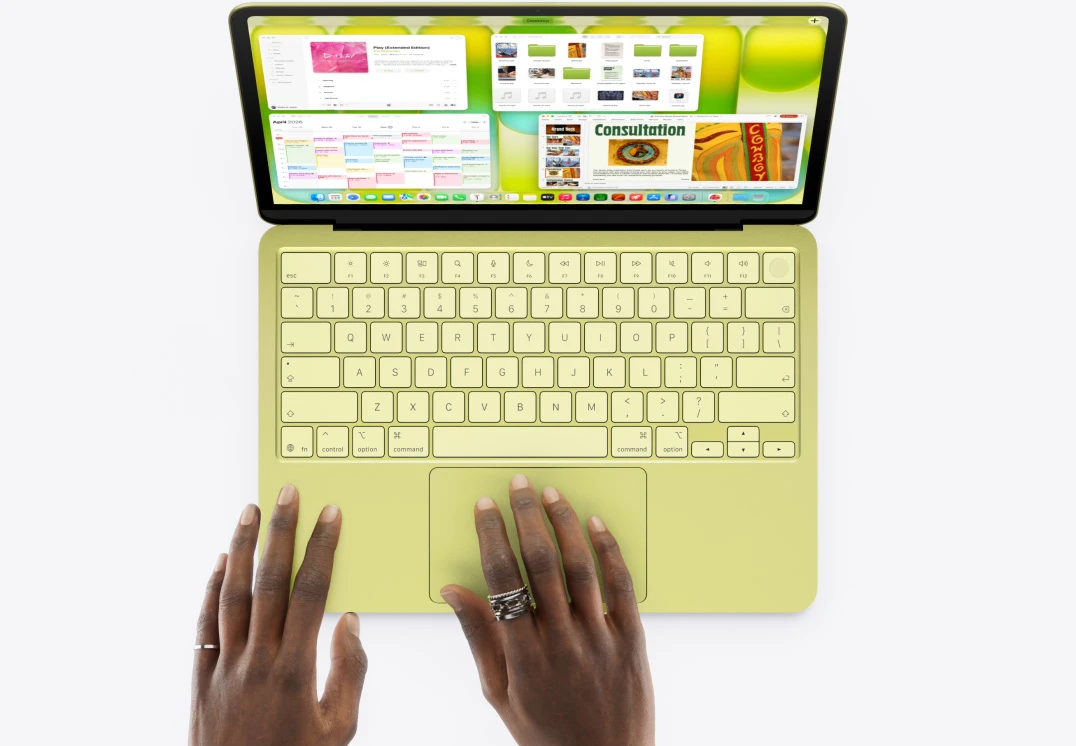
Colors: Silver, Indigo, Blush, Citrus. The Blush and Indigo are clearly aimed at younger buyers, and they look genuinely good — not gimmicky.
Weight: 1.23 kg. That's lighter than most 13-inch Windows laptops at this price.
How it compares to Windows at this price
At Rs 69,900, your Windows alternatives are mostly in the Rs 60,000-80,000 range. The HP Pavilion Plus 14, Asus VivoBook 14X OLED, Lenovo IdeaPad Slim 5, and Dell Inspiron 14 5445 are the typical contenders. Some of these have OLED displays (which the Neo doesn't), more RAM options, and better port selection. But they run on AMD Ryzen or Intel Core mid-range processors, and their battery life typically runs 6-9 hours under real-world conditions — not 12-14.
The macOS ecosystem advantage is harder to quantify but very real for Indian users. If you already use an iPhone — and hundreds of millions of Indians do — the handoff between iPhone and MacBook Neo is seamless. AirDrop, iMessage on the laptop, unlocking the Mac with your iPhone, copy-paste between devices, Hotspot that just works without configuring anything. These daily friction removals add up over time in ways that pure spec comparisons miss.
Apple Intelligence — Apple's on-device AI features — runs on the A18 Pro's 16-core Neural Engine. Writing tools, photo cleanup, notification summarization, and the smarter Siri are all available. These features are live in macOS 26 Tahoe which ships on the Neo.
The honest tradeoffs — don't ignore these
No backlit keyboard. This is a strange omission for a laptop in 2026 at any price. Evening work in dim lighting becomes genuinely annoying. Apple should have included this.
8GB RAM ceiling. You cannot upgrade later. If you're a student today but a working professional in two years running heavier workloads, 8GB may start pinching. Buy with your future needs in mind, not just your current ones.
USB 2.0 on one port. Transferring large files through the second port will be painfully slow. External SSDs, large photo libraries, video files — use the USB 3 port, not the USB 2.0 one. Label it mentally before you start.
No MagSafe. The magnetic charging connector that protects your laptop when someone trips on the cable is absent. The 20W charger in the box is also slow — a 35W or 67W USB-C charger charges considerably faster.
Thicker bezels. Compared to the current MacBook Air, the bezels around the display are noticeably thicker. Functionally irrelevant — the screen itself is excellent — but if aesthetics matter to you, the Air looks more premium.
Who should buy the MacBook Neo?
Students — this is the obvious home run. Rs 69,900 (educational pricing reportedly lower) for a Mac that handles Word, Excel, PowerPoint, Google Workspace, Canva, video streaming, and light photo editing is exceptional value. Battery life that genuinely lasts a full day of college means not carrying a charger everywhere.
First-time Mac buyers who've been waiting for the price to come down. The MacBook Neo is the entry point to the ecosystem — iPhone users who've always wanted their laptop to actually work with their phone rather than alongside it.
Content consumers and light professionals. Writers, journalists, marketers, teachers — anyone whose work is primarily documents, research, communication, and presentations will find the Neo more than sufficient and genuinely better than Windows alternatives at this price.
Who should NOT buy it: video editors, 3D designers, heavy coders, data scientists, anyone running virtual machines or doing sustained compute-heavy work. Spend the extra Rs 30,000 and get the M4 MacBook Air. The RAM and sustained performance difference is meaningful for those use cases.
TamilTech's take
The MacBook Neo is the best thing to happen to the Mac in India in years. Not because it's the best Mac — it clearly isn't — but because it finally makes Mac ownership accessible to the market that's been buying Windows by default, not by preference. Rs 69,900 for a device with this build quality, this display, this battery life, and the full macOS ecosystem is genuinely competitive. The 8GB RAM ceiling and missing backlit keyboard are real complaints. But for students, young professionals, and iPhone users who've been on the fence? The fence just got a lot easier to climb over.



Comments (0)
Be the first to comment!