


Key Takeaways
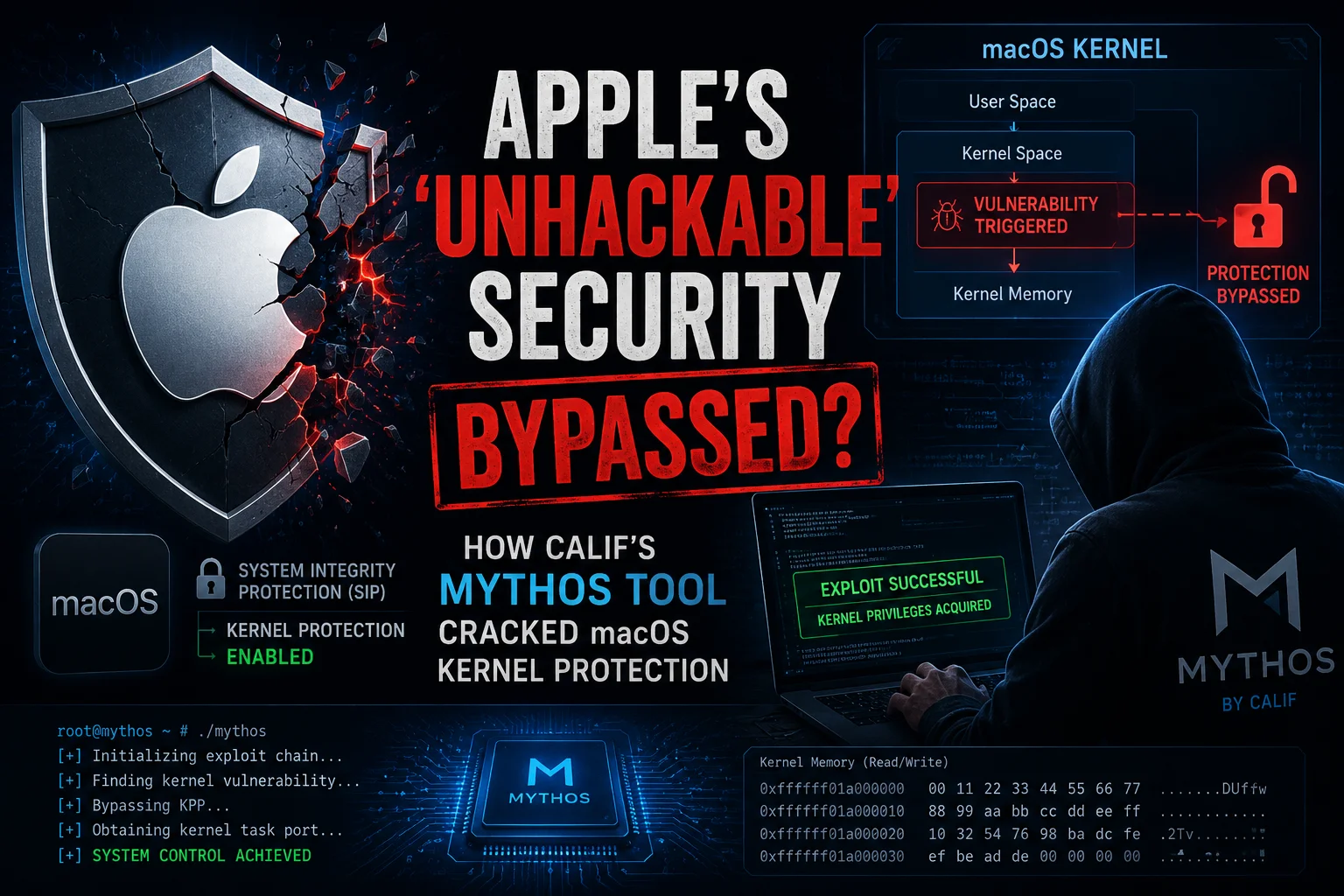
- Security firm Calif developed a tool named Mythos to achieve kernel memory corruption on macOS in 2026.
- The exploit successfully bypasses Apple's Memory Integrity Enforcement (MIE), a core hardware security feature of M-series chips.
- This vulnerability allows attackers to gain deep system-level access, potentially compromising all user data on a Mac.
- While Apple is expected to release a patch soon, this research proves that even hardware-level protections have gaps.
- Mac users in India should immediately update to the latest macOS version as soon as a security patch is announced.
The Myth of the Unhackable Mac
For years, Apple has built its reputation on a single, powerful promise: 'Macs don't get viruses.' While we know that's not entirely true, their hardware-level security on M-series chips (like the M3, M4, and the latest M5) has been incredibly tough to crack. But in 2026, things just got real. A security research firm called Calif has done what many thought was impossible—they've bypassed Apple's most advanced defense, the Memory Integrity Enforcement (MIE). They didn't just find a small bug; they built a tool called Mythos specifically to tear down the walls Apple built around the macOS kernel. This isn't just a technical glitch; it's a wake-up call for every Mac user who thought their machine was an impenetrable fortress.
If you are using a MacBook for work, banking, or storing sensitive data, you need to understand what's happening. The kernel is the heart of your computer's operating system. It controls everything from your keyboard to your files. Usually, Apple's MIE acts like an elite team of bodyguards, ensuring that no one can mess with the kernel's memory. If someone can 'corrupt' this memory, they basically own your computer. Calif's research shows that with Mythos, they found a way to distract those bodyguards and slip through the back door. It’s a sophisticated attack that proves no matter how much you spend on a premium Apple device, software and hardware are never 100% foolproof.
What is Memory Integrity Enforcement (MIE) Anyway?
To understand why this is a big deal, we have to talk about how Apple protects its silicon. Starting with the M-series chips, Apple introduced hardware-based security features like Pointer Authentication Codes (PAC) and Memory Integrity Enforcement. Think of MIE as a system that constantly checks if the instructions being sent to the processor are legitimate. It’s designed to prevent 'memory corruption'—a common trick hackers use where they overflow a buffer or misdirect a pointer to execute their own malicious code. In simple terms, MIE is the 'final boss' of macOS security. If a hacker can't get past MIE, their exploit won't work, even if they find a bug in the software.
However, Calif's Mythos tool didn't try to break MIE with brute force. Instead, it used a highly sophisticated method to find 'logic gaps' in how the hardware and software talk to each other. By exploiting these gaps, Mythos was able to corrupt the kernel memory without triggering the MIE alarms. This is what makes it so dangerous—the system thinks everything is fine while an attacker is gaining full control. For a tech giant like Apple, which has invested billions in making their own chips specifically for security, this is a significant blow. It shows that as hardware gets smarter, the tools used by researchers (and hackers) are evolving even faster.
How the Mythos Exploit Actually Works
Calif didn't just stumble upon this; they engineered a systematic way to find these vulnerabilities. Mythos is a framework that automates the discovery of memory corruption bugs. It looks for specific patterns in the macOS kernel that shouldn't be there. Once it finds a weak spot, it crafts a precise 'payload' that can bypass the hardware checks. The researchers focused on the way the macOS kernel handles memory allocation. By tricking the system into thinking a piece of memory was free when it was actually still in use (a classic 'Use-After-Free' bug), they were able to inject their own code into the most sensitive part of the OS.
The scary part is that this exploit happens at the kernel level. In the world of cybersecurity, 'Kernel Level' means 'God Mode.' Once an attacker has kernel access, they can bypass your password, read your encrypted files, record your screen, and even access your webcam without the green light ever turning on. Apple’s MIE was supposed to be the technology that made kernel exploits a thing of the past. By proving that Mythos can circumvent this, Calif has shown that the 'walled garden' has a secret tunnel underneath it. This isn't just about one bug; it's about a fundamental shift in how we view hardware security in 2026.
The India Impact: Why Indian Mac Users Should Care
In India, the MacBook has become the go-to machine for developers, startup founders, and creative professionals. With the M3 and M4 models being top sellers on Flipkart and Amazon India, there are millions of high-value targets in cities like Bengaluru, Chennai, and Hyderabad. Many Indian users assume that because they are on a Mac, they don't need additional security layers or even to be quick with updates. This mindset is exactly what attackers exploit. If you are using your Mac for UPI transactions, managing a corporate server, or storing Aadhaar-related data, a kernel exploit like the one Mythos enables could be devastating.
Furthermore, the cost of Apple hardware in India is significantly higher due to import duties. When you pay ₹1,50,000 for a laptop, you expect the best security in the world. Knowing that a research firm has already cracked the core protection of these expensive machines is frustrating. While we haven't seen this exploit being used in the wild by criminals yet, history shows that once researchers publish these findings, it's only a matter of time before bad actors try to replicate it. For the Indian tech community, this is a reminder that 'security through obscurity' is not a strategy. We need to be proactive about our digital safety.
Step-by-Step: How to Secure Your Mac Right Now
While we wait for Apple to release a definitive patch for this specific Mythos-based exploit, there are several steps you can take to harden your macOS security. Don't wait for the 'Update' notification to pop up next week; take action now. Here is what we recommend at TamilTech:
- Check for macOS Updates: Go to System Settings > General > Software Update. Even if there isn't a major version change, look for 'Security Response' updates. These are smaller patches Apple sends out specifically to fix bugs like this.
- Enable Lockdown Mode: If you are a high-risk individual (like a journalist or a developer), go to Settings > Privacy & Security > Lockdown Mode. It limits certain features but makes it significantly harder for kernel exploits to work.
- Use a Non-Admin Account: For daily browsing, create a standard user account. Most kernel exploits need to start with some level of user privilege. By not using an Admin account for everything, you add an extra hurdle for the attacker.
- Review Installed Apps: Kernel exploits often need a 'path' to get into the system. Uninstall any apps you don't use, especially those from outside the App Store.
- Keep System Integrity Protection (SIP) On: Never disable SIP (which requires going into Recovery Mode). SIP is a massive part of what MIE tries to protect, and turning it off is like leaving your front door wide open.
Is macOS Still Safer Than Windows?
Whenever a big exploit like this hits the news, the inevitable question arises: Should I switch to Windows? The honest answer is: No, not necessarily. While Calif has cracked the MIE, macOS still has a much smaller 'attack surface' than Windows. Windows has to support thousands of different hardware configurations, which naturally leads to more holes. Apple, by controlling both the hardware (M-series) and the software, can patch these things much more effectively. However, the gap is closing. With the rise of AI-driven hacking tools in 2026, the 'platform war' is becoming less about which OS is better and more about who updates their system faster.
The pros of macOS remain its tight integration and the fact that most malware is still built for Windows. The cons, however, are becoming clearer: when a bug is found in Apple's 'secret' hardware, it takes longer for the community to understand it because the hardware is closed-source. In contrast, the Linux and Windows worlds have more eyes on the code. At TamilTech, we still believe macOS is a very secure choice for the average Indian user, but the 'invincibility' tag is officially gone. You need to be as cautious on a Mac as you would be on any other device.
TamilTech's Take: What to Expect Next
Honestly, we aren't surprised. Security is a cat-and-mouse game. Apple builds a taller wall, and firms like Calif build a better ladder. The Mythos tool is a masterpiece of engineering, and while it’s being used for 'good' (to help Apple fix the bug), it’s a stark reminder that no system is 100% secure. We expect Apple to release a massive security update within the next few days. This update will likely involve a 'microcode' change to the way M-series chips handle memory pointers. It might slightly impact performance, but that's a small price to pay for security.
What's next? We will likely see more research into 'Hardware-Software Co-design' flaws. As chips get more complex with AI NPU cores and advanced security layers, the number of logic bugs will only increase. Our advice is simple: Stay informed, don't skip updates, and stop believing that your brand-new M5 MacBook is unhackable. The world of tech moves fast, and in 2026, even the best of the best can be compromised. Keep following TamilTech for the latest updates on this story and we will let you know as soon as the patch is live!




Comments (0)
Be the first to comment!