


Key Takeaways
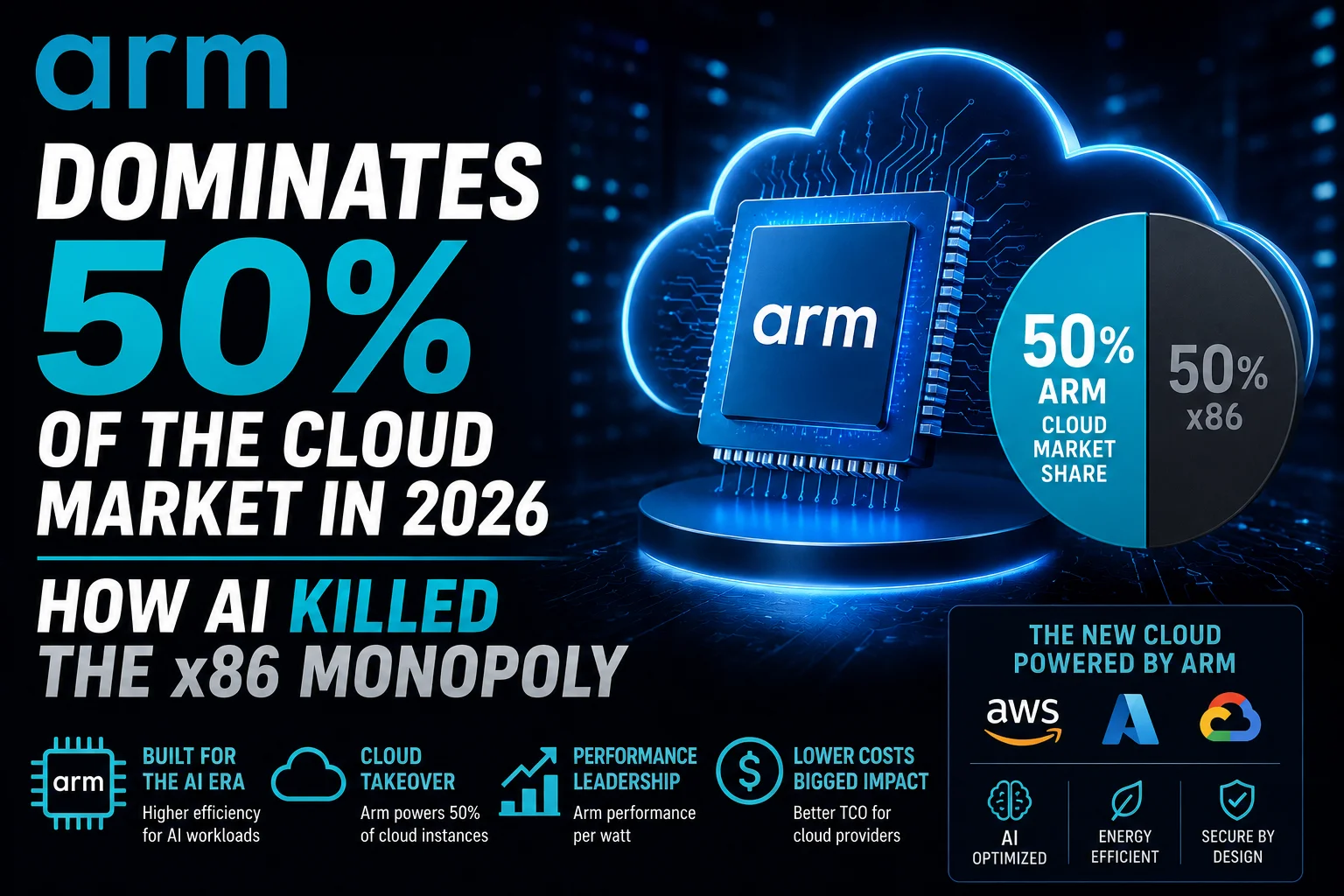
- Arm architecture now powers over 50% of the global hyperscale cloud computing market as of June 2026.
- Major players like AWS, Google, and Microsoft have shifted to custom Arm-based silicon (Graviton, Axion, Cobalt) to handle AI workloads efficiently.
- Arm-based servers offer up to 40% better price-performance ratios compared to traditional x86 chips for Indian startups and enterprises.
- The transition is driven by the urgent need for energy efficiency in data centers struggling with AI's massive power consumption.
- For the average user, this means faster AI apps and potentially lower subscription costs for cloud-based services.
The Great Shift: How Arm Conquered the Data Center
For decades, the world of servers and data centers was a playground for x86 architecture, dominated almost entirely by Intel and AMD. If you were running a website or a massive database in 2018, chances are it was running on an Intel Xeon processor. But as we stand here in June 2026, the landscape has flipped completely. Arm EVP Mohamed Awad recently confirmed what many of us in the industry have been tracking: Arm now accounts for more than half of the hyperscale cloud market. This isn't just a small victory; it is a total regime change in how the internet is powered. The primary catalyst for this massive shift? The insatiable demand for Artificial Intelligence (AI).
When we talk about 'hyperscale' cloud providers, we are talking about the giants—Amazon Web Services (AWS), Google Cloud, and Microsoft Azure. These companies operate millions of servers across the globe. In the past, they bought off-the-shelf chips. Today, they are designers. By using Arm’s flexible architecture, these giants have built their own custom processors like AWS Graviton4, Google Axion, and Microsoft Cobalt 100. These chips are specifically tuned for the way modern software and AI models work, leaving traditional general-purpose chips in the dust. At TamilTech, we’ve been watching this trend closely, and it’s clear that the 'one size fits all' era of computing is officially dead.
Why AI Demand Changed Everything
AI is a power-hungry beast. Training a Large Language Model (LLM) or running real-time AI inference requires an incredible amount of computational energy. Traditional x86 chips, while powerful, were not originally designed with this level of energy efficiency in mind. They generate a lot of heat and consume massive amounts of electricity. In 2026, data centers are facing a global 'power crunch.' There simply isn't enough electricity in some regions to keep expanding. This is where Arm stepped in. Because Arm was born in the world of smartphones where battery life is everything, its DNA is built around 'performance per watt.'
Cloud providers realized that by switching to Arm, they could pack more processing power into the same physical space without melting their hardware or bankrupting themselves on electricity bills. Mohamed Awad highlighted that the transformation of the data center industry is no longer just about faster CPUs; it’s about specialized silicon. Every major AI breakthrough you’ve seen this year—from hyper-realistic video generation to real-time language translation—is likely running on an Arm-based instance in the cloud. It’s the only way to scale these services to millions of users without the grid collapsing.
The India Impact: What This Means for Us
You might be wondering, 'How does a chip in a US data center affect me in India?' The answer is: significantly. India is currently one of the fastest-growing markets for cloud services. With the government’s push for data localization and the massive rise of Indian AI startups, the infrastructure we use matters. Most Indian developers and startups rely on AWS or Google Cloud. Since Arm-based instances (like AWS Graviton) are significantly cheaper to run than their Intel counterparts, Indian companies are saving up to 30-40% on their cloud bills. This allows a small startup in Bengaluru or Chennai to compete globally because their operational costs are lower.
Furthermore, we are seeing a massive boom in local data center construction in India by groups like Adani, Reliance, and Yotta. As these companies build out 2026-grade infrastructure, they are heavily leaning towards Arm architecture to manage cooling costs in our tropical climate. Lower cooling requirements mean cheaper data center operations, which eventually trickles down to the end-user. Whether you are using a UPI app, streaming 4K content, or using a government digital service, the backend is becoming 'Arm-powered,' making the digital India dream more sustainable and affordable.
Comparing the Giants: Arm vs x86 in 2026
Let’s look at the numbers. In a head-to-head comparison for cloud workloads, Arm-based processors are now delivering roughly 50-60% better energy efficiency than the latest x86 alternatives. While Intel and AMD have made strides with their own high-efficiency cores, the 'customizability' of Arm is the deciding factor. When Google builds the Axion chip, they can decide exactly how many AI accelerators to include on the die. When Microsoft builds Cobalt, they can optimize it specifically for Microsoft 365 and Teams workloads.
The pros of Arm in 2026 are clear: lower cost, lower heat, and better AI integration. The only remaining 'con' used to be software compatibility, but that hurdle has been cleared. Almost every major Linux distribution, database engine, and coding language now runs natively on Arm. In fact, many developers now prefer Arm because the environment matches the Apple Silicon MacBooks they use for coding. The ecosystem is finally unified from the laptop to the massive cloud server.
TamilTech’s Take: The Road Ahead
At TamilTech, we believe this 50% milestone is just the beginning. We expect Arm to hit 70% of the cloud market by the end of 2028. Why? Because the 'AI PC' and 'AI Server' are merging. We are moving toward a world where every piece of hardware is an AI-first device. Intel and AMD are not sitting still, but they are fighting an uphill battle against an architecture that was literally designed for the mobile, efficient, and modular future we are now living in.
If you are a student or a tech professional in India, our advice is simple: Get comfortable with Arm-based environments. Whether it's learning to deploy on Graviton instances or understanding how to optimize code for ARM64 architecture, this is where the jobs and the money are going to be. The monopoly has been broken, and for the first time in decades, the cloud is truly diverse. Stay tuned as we continue to track how this chip war evolves throughout 2026!



Comments (0)
Be the first to comment!