


Key Takeaways
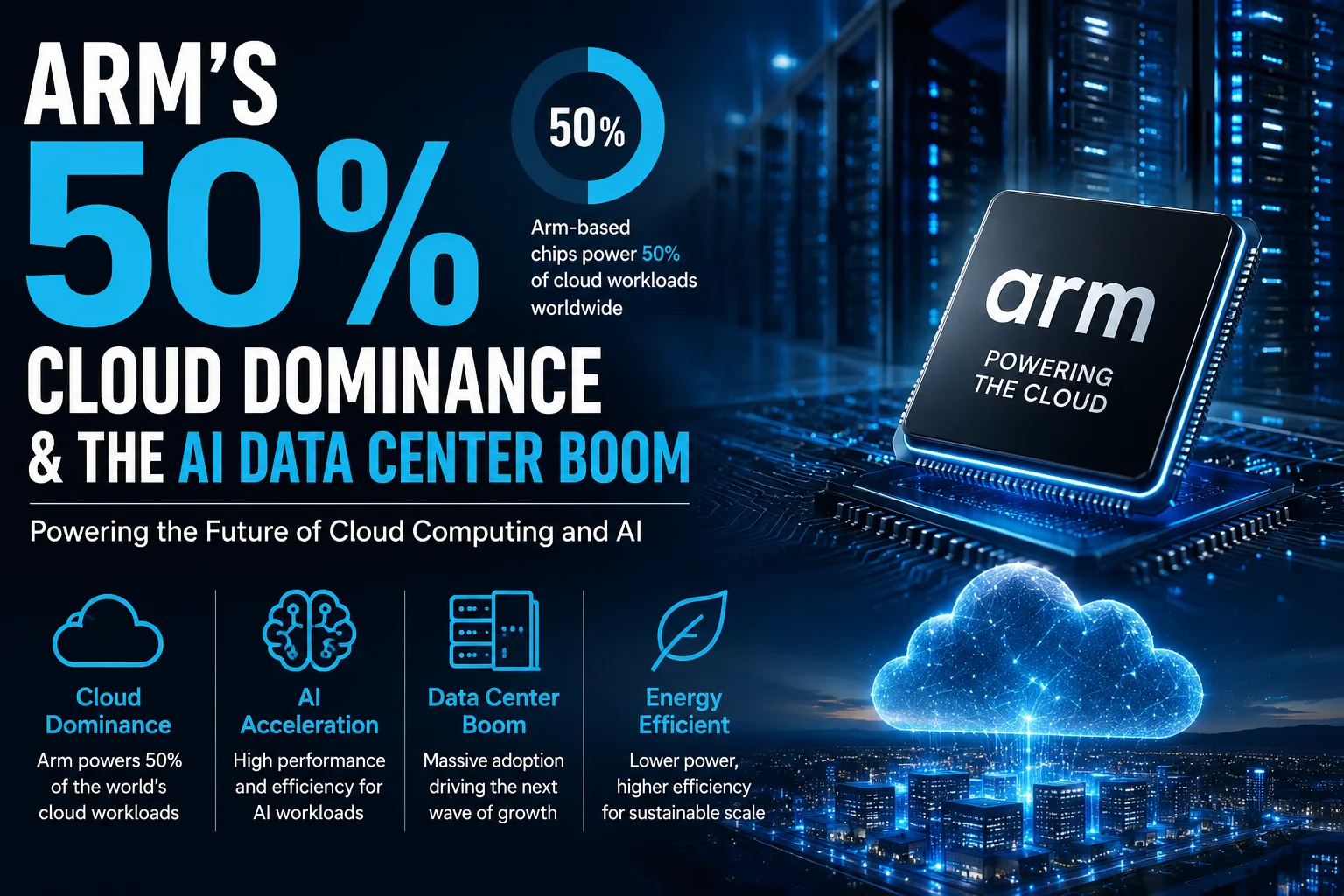
- Arm's architecture now controls over 50% of the hyperscale cloud computing market, a massive milestone in data center chip design.
- This surge is entirely driven by the massive computational demands of modern AI and Large Language Models (LLMs).
- Hyperscalers are aggressively shifting from traditional x86 servers to highly efficient, custom Arm-based servers.
- India's massive cloud and digital public infrastructure (like UPI) are perfectly positioned to leverage this highly efficient computing paradigm.
- This shift promises significantly lower Total Cost of Ownership (TCO) for data centers, reducing both power consumption and hardware costs.
What's the news
In a stunning revelation that signals a permanent shift in the server computing landscape, Arm executive vice president Mohamed Awad has announced that Arm's chip architecture now accounts for more than 50% of the hyperscale cloud computing market. This isn't just a minor milestone; it's a full-blown architectural revolution. For decades, the data center world was dictated by x86 processors from Intel and AMD. Today, Arm's low-power, highly scalable design is the undisputed king of cloud infrastructure, fueled by an insatiable global demand for Artificial Intelligence (AI).
Details
So, what exactly is driving this massive shift? The answer is AI. Training and running massive AI models, especially Large Language Models (LLMs) like ChatGPT, requires an astronomical number of calculations. Traditional x86 servers, while powerful, are often inefficient for these specific, highly parallelized workloads. Arm processors, on the other hand, excel at handling massive amounts of data with minimal energy consumption.
Hyperscale cloud providers like Amazon Web Services (AWS), Google Cloud, and Microsoft Azure have been quietly rolling out massive fleets of custom Arm-based servers. By moving to Arm, these tech giants can pack more compute power into the same physical space, drastically cutting down on electricity bills and cooling costs. Mohamed Awad's statement confirms that this transition is no longer just a pilot project or a niche experiment. It is the new standard. The data center industry is undergoing a fundamental transformation, moving away from the brute-force x86 model to a smarter, more sustainable Arm-based ecosystem.
India impact
How does this global shift impact India, a rapidly growing digital powerhouse? The impact is profound and multifaceted. First, India's massive digital public infrastructure, including the UPI payments system and the Aadhaar database, generates petabytes of data daily. As Indian enterprises and startups race to build their own AI models, they will rely on cloud infrastructure. Arm-based data centers offer these Indian businesses a much cheaper way to access high-performance computing.
Furthermore, India's push for a sovereign AI and the establishment of domestic AI compute clusters mean that local data centers will be built using these highly efficient Arm architectures. This reduces reliance on expensive, imported x86 hardware, saving valuable foreign exchange. Companies like Reliance Jio and Tata Communications are already heavily invested in building out their cloud capacities. Adopting Arm architecture allows them to offer competitive, cost-effective cloud services to the millions of Indian startups and MSMEs entering the AI race.
Use cases
Beyond just training LLMs, Arm-based servers are unlocking new use cases across various sectors. In healthcare, hospitals can run complex genomic sequencing and medical imaging AI locally on Arm servers without massive power bills. In retail, platforms like Flipkart can process billions of transactions and run real-time recommendation engines using highly efficient Arm-based edge servers, improving the user experience for millions of Indian shoppers. Even in agriculture, where precision farming and drone analytics are becoming popular, Arm's low-power chips make it feasible to deploy AI at the edge in rural areas with limited power supply.
Honest take
Let's be real for a second. While the shift to Arm is fantastic for efficiency, it's not a magic bullet. The transition from x86 to Arm requires massive software rewrites. Many traditional enterprise applications and legacy systems were built specifically for Intel and AMD architectures. While the open-source community is doing a phenomenal job building Arm-compatible Linux distributions and compilers, the compatibility issue remains a hurdle for some businesses. Additionally, the dominance of a single architecture, even if it's Arm's, raises concerns about supply chain monopolies. However, given the sheer economic and environmental benefits, the industry's pivot is a necessary and exciting evolution. For India, it means a faster, cheaper, and greener path to becoming a global AI leader.




Comments (0)
Be the first to comment!