


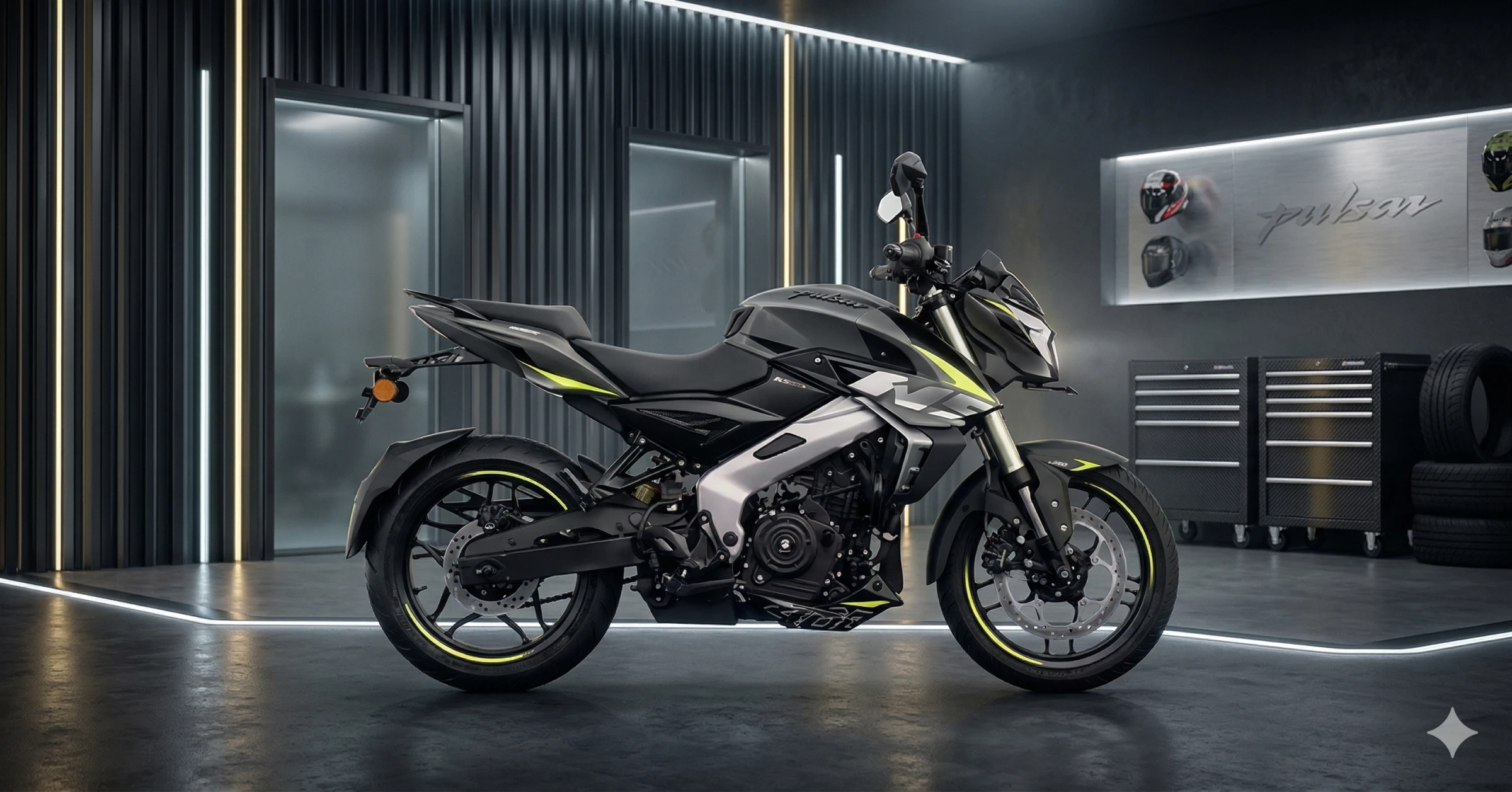
Bajaj is downsizing the Pulsar — and the reason is India's GST structure
This isn't about engineering. It's about tax brackets.
India's GST 2.0 framework has a specific threshold that's been causing headaches for motorcycle manufacturers: bikes with engines above 350cc attract a 40% tax rate. Bikes at 350cc or below are taxed at 18%. That's a 22 percentage point difference — which, on a ₹1.8 lakh motorcycle, works out to a meaningful chunk of money either sitting in the government's pocket or yours.
Bajaj has been quietly absorbing this higher GST rate on the Pulsar NS400Z and Dominar 400, essentially eating the difference to keep prices competitive. But that's not a long-term strategy. The fix: shrink the engine to 349cc, slip under the threshold, and pass the savings to customers while maintaining roughly the same riding experience.
Pre-launch engine specifications have now leaked, and they tell an interesting technical story.
The leaked 350cc engine specs — what's actually changing
The new engine displaces exactly 349.13cc. Bajaj has kept the bore at 89mm — the same as the current 400cc motor — but reduced the stroke from 60mm down to 56.1mm. For the non-engineers: bore is the diameter of the cylinder, stroke is how far the piston travels. Reducing stroke is how you bring displacement down without changing the fundamental architecture of the engine. The pistons, cylinders, and much of the bottom end can remain largely similar.
Power output: 40.6 PS at 9,000 RPM. Torque: 33.2 Nm at 7,500 RPM.
Compare that to the current 400cc numbers: 43 PS and 35 Nm. So yes, you're losing 2.4 PS and 1.8 Nm. That's the honest trade-off of going 350cc.
How significant is that loss? In practical terms, 2.4 PS on a highway cruiser or naked streetfighter is something experienced riders will feel under hard acceleration, but the average daily commuter doing Chennai's Kathipara flyover or Bengaluru's Outer Ring Road probably won't notice. The torque loss of 1.8 Nm is more relevant — torque is what you feel in the low-to-mid range grunt that makes city riding effortless. But 33.2 Nm is still strong.
Everything else stays the same: single-cylinder liquid-cooled configuration, single spark plug, slip and assist clutch, wet sump forced lubrication, 6-speed sequential gearbox. The fundamental character of the engine — rev-happy, smooth, well-refined — should remain intact.
What else carries over?
On the equipment side, both the 2026 Pulsar NS400Z (which will keep the NS400Z name despite the 350cc engine) and the 2026 Dominar 400 (same deal — keeping the name) are expected to carry over the full feature set from the current models.
That includes USD (upside-down) front forks — which provide better feedback and handling compared to conventional forks. Sintered brake pads. Perimeter frame. Disc brakes front and rear with dual-channel ABS. Riding modes. And importantly, a Bluetooth-enabled instrument cluster with turn-by-turn navigation.
The Bluetooth navigation feature is genuinely useful in India — pairing with Google Maps or Zomato navigation directly on the instrument cluster means you don't need to glance at your phone mounted on the handlebar. For delivery riders, weekend tourers, and daily commuters in unfamiliar routes, this is a practical convenience.
Colours should remain similar to current offerings. Design carries over without changes.
What about pricing?
This is the most interesting part. The current Pulsar NS400Z is priced around ₹1.85 lakh ex-showroom. The Dominar 400 sits around ₹2.30 lakh ex-showroom depending on variant and city.
Bajaj has reportedly been absorbing the higher 400cc GST bracket for a while — meaning the actual cost to produce and tax these bikes was higher than what customers were paying. With the move to 350cc, Bajaj drops into the lower 18% GST bracket. The expectation is that prices remain roughly similar to the current models, possibly with marginal reductions, because Bajaj is essentially normalising its cost structure rather than passing a dramatic saving.
What this means for buyers: you're not going to see a ₹20,000 price cut overnight. But the bikes become more sustainable products to produce and sell, which typically means better availability, more variant options over time, and Bajaj not having to make uncomfortable decisions about whether to keep selling them at a loss-absorbing price.
Why are the bikes keeping the 400cc names?
Good question. Pulsar NS400Z with a 350cc engine. Dominar 400 with a 350cc engine. That's technically misleading — and Bajaj knows it.
The answer is brand equity. NS400Z and Dominar 400 are established names with significant recognition among Indian buyers. Changing the name to NS350Z or Dominar 350 would mean restarting brand-building from scratch, losing years of search engine presence, dealership familiarity, and buyer word-of-mouth. Bajaj is betting that most buyers won't be bothered by the displacement mismatch — and historically, motorcycle companies have done this before. The Royal Enfield Bullet 350 held that name through multiple engine generations and displacement tweaks without losing its identity.
Should Pulsar NS400Z or Dominar 400 buyers wait for the 350cc version?
If you're actively shopping right now for a Pulsar NS400Z or Dominar 400, here's the honest advice: yes, probably wait. The launch is expected within weeks. The price is likely to be similar or marginally better. You get a fresher engine that Bajaj has optimised for the long term, with the same features, same frame, same everything else. The 2.4 PS loss is real but minor in practical use.
The only reason to buy the current 400cc version right now is if dealers are offering significant clearance discounts to move existing stock before the 350cc models arrive. In that case, ₹10,000-₹15,000 off a proven engine might be worth taking over waiting for the newer 350cc unit.
TamilTech's take
The story here is really India's tax policy driving product decisions at one of the country's biggest motorcycle brands. When a 22-percentage-point GST gap forces an engineering decision, that's the government shaping the product lineup of an industry. Bajaj is doing the right thing — adapting to the tax reality rather than continuing to absorb it. The 350cc Pulsar NS400Z will be a better commercial product even if it's marginally down on peak power. For the Pulsar faithful — and there are millions of them in Tamil Nadu alone — this isn't a crisis. It's a sensible evolution.



Comments (0)
Be the first to comment!