


முக்கிய விஷயங்கள்
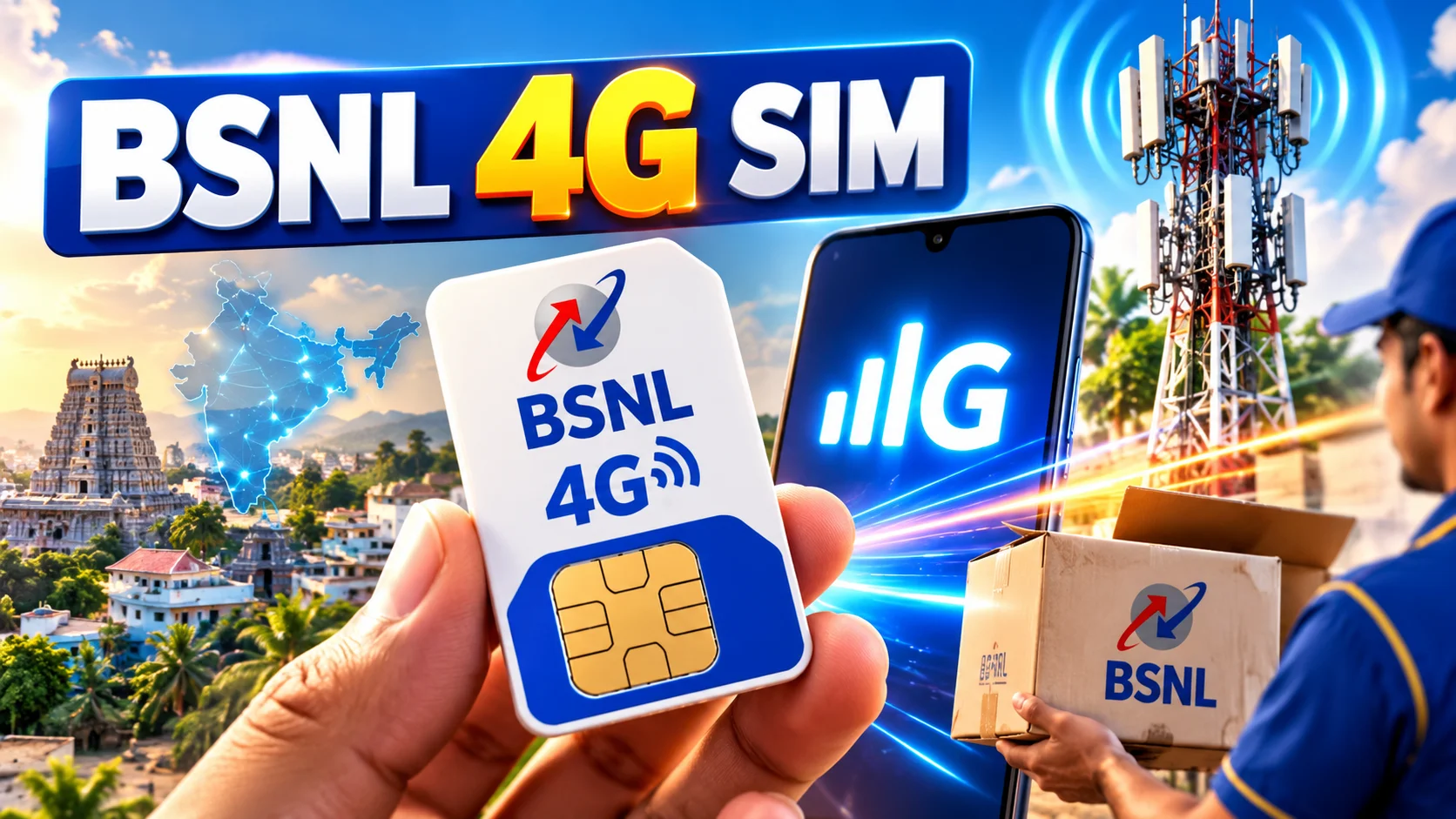
- BSNL 4G SIM cards are now sold through BSNL stores, franchise retailers, and the BSNL Selfcare App, running on India's own Swadeshi 4G network built with C-DOT, TCS, and Tejas Networks.
- Entry-level recharges start around ₹107-₹147 for short validity, while long-validity plans stretch close to ₹997 for a full year of unlimited calling.
- Coverage and speed in Tamil Nadu are improving town by town, but BSNL still lags Jio and Airtel in dense urban 4G speed and in several rural pockets.
- It suits people who want a cheap backup SIM with strong validity for unlimited calls, not someone who streams or games on mobile data all day.
- You can port in from Jio, Airtel, or Vi to BSNL using MNP and keep your existing number.
What is BSNL 4G and why is everyone talking about it again?
If you've typed "bsnl 4g sim plans" into Google, you already know the short answer. BSNL now runs its own 4G network across most Indian circles, built using homegrown Indian telecom tech instead of foreign gear, and it sells SIM cards and recharge plans just like Jio or Airtel does.
The buzz is simple. BSNL plans are cheaper than private telcos for basic unlimited calling and modest data, and the government-backed operator has been rolling out new towers steadily in Tamil Nadu districts, not just big cities.
That said, BSNL 4G isn't trying to beat Jio on raw data speed. It's trying to win on price and validity, especially for people who don't burn through 2GB a day on Reels and YouTube.
How do you actually get a BSNL 4G SIM?
First option, walk into any BSNL customer service centre or an authorised BSNL retailer near you. Carry Aadhaar for eKYC, and you'll get a 4G SIM activated within a few hours in most cases.
Second option, if you already have a BSNL number on an old 2G or 3G SIM, you don't need a new connection. Just ask the retailer for a free or low-cost 4G SIM swap and your number stays the same.
Third option, if you're fed up with your current operator's pricing, you can port in. Send a simple SMS request for MNP, get the porting code, submit it with your BSNL SIM request, and your number moves over in a few days without any downtime drama.
One practical tip, before you commit, check BSNL's network bars in your exact street or office, not just your city name. BSNL coverage can be strong in one lane and weak two streets away, especially in smaller Tamil Nadu towns.
BSNL 4G plans - how much do they actually cost?
Here's where BSNL genuinely undercuts the competition. BSNL has always kept a ladder of plans from very short validity to a full year, and the per-day cost drops sharply as you go up.
| Plan Type | Price | Validity | Data | Voice |
|---|---|---|---|---|
| Basic Unlimited STV | ₹107 - ₹147 | ~15-24 days | 1-2GB/day | Unlimited local + STD |
| Mid Combo Pack | ~₹197 | ~45-54 days | 2GB/day | Unlimited calls + 100 SMS/day |
| Quarterly Combo | ~₹247 - ₹399 | ~80-90 days | 2GB/day | Unlimited calls |
| Half-Yearly Plan | ~₹666 | ~180 days | 2GB/day | Unlimited calls |
| Annual Plan | ~₹997 | ~365 days | 2GB/day | Unlimited calls |
These are the usual slabs BSNL offers, but telcos tweak STVs often and prices can shift slightly by circle. Always confirm the exact current price and benefits on the BSNL Selfcare App or official site before you recharge, don't go purely by what a shop agent tells you.
The annual plan is the one that gets people talking, because nothing from Jio or Airtel comes close to ₹997 for a year of unlimited calling, even with modest data. For someone mainly using WhatsApp and calls, that's a real saving stacked up over 12 months.
Mistakes people make when buying a BSNL SIM
Biggest mistake, buying BSNL purely on price and assuming 4G speed will match Jio in your area. Test the signal at your home and workplace with a friend's BSNL number first if you can, before you port your primary SIM.
Second mistake, picking the cheapest short-validity plan and forgetting to recharge on time. BSNL numbers go into a grace period and then get deactivated just like any operator, and reactivating a BSNL number can take longer than private telcos.
Third mistake, assuming every BSNL plan comes with daily data rollover or 5G-like speeds. BSNL 4G is still 4G, not 5G, and data benefits usually don't carry over unused quota the next day.
Who should actually use BSNL 4G?
It suits people who want a second SIM mainly for calling, parents or elders who don't stream much, and anyone in a town where BSNL coverage has visibly improved lately. It also suits budget-conscious students who mainly need WhatsApp, calls, and light browsing.
It doesn't suit someone whose work depends on fast, consistent mobile data all day, or gamers and heavy streamers who need stable high-speed connections in crowded areas. For them, BSNL still works best as a backup, not the main driver.
What should you do now?
Check BSNL's coverage at your exact location using the signal in a nearby BSNL SIM or ask around your street, since word of mouth is still the most reliable BSNL coverage check in Tamil Nadu. If signal looks decent, get a BSNL 4G SIM as a backup first, run it for a month, then decide if it's worth porting your main number.
If you mainly call and don't chew through gigabytes, the long-validity BSNL plans genuinely save money over a year compared to constantly recharging Jio or Airtel. Just keep your expectations realistic on data speed, and always verify the live plan price on the BSNL app before you pay, since rates do get revised.
What's the real India context behind BSNL's 4G push?
BSNL's 4G rollout matters beyond just cheap recharges, because it's tied to India's push for a homegrown telecom stack after years of relying on Nokia, Ericsson, and Huawei gear. The network uses equipment from C-DOT, TCS, and Tejas Networks, which means every new BSNL tower that goes live in a Tamil Nadu village is also a small proof point for Indian-made telecom tech on a national scale. That's a bigger story than most recharge comparisons let on, and it's part of why the government keeps backing BSNL's expansion even though Jio and Airtel dominate subscriber numbers.
For everyday users this translates into something simple: more towers means better coverage, slowly. BSNL has been adding sites in district towns and rural belts across Tamil Nadu, places private telcos sometimes deprioritise because the return on investment is thinner. If you live in a smaller town or near the outskirts of a city, you may actually notice BSNL's signal getting stronger month by month, even while friends in dense urban pockets still complain about patchy 4G.
The limitation is pace. Building towers, getting spectrum optimised, and tuning network software take time, and BSNL is doing this while juggling legacy 2G and 3G infrastructure. So don't expect a sudden jump from weak signal to Jio-level speed overnight in your area. What you can expect is gradual, visible improvement if BSNL has already started work in your circle, and that's worth checking before you write the operator off completely based on an old experience from a couple of years back.

Comments (0)
Be the first to comment!