


Key Takeaways
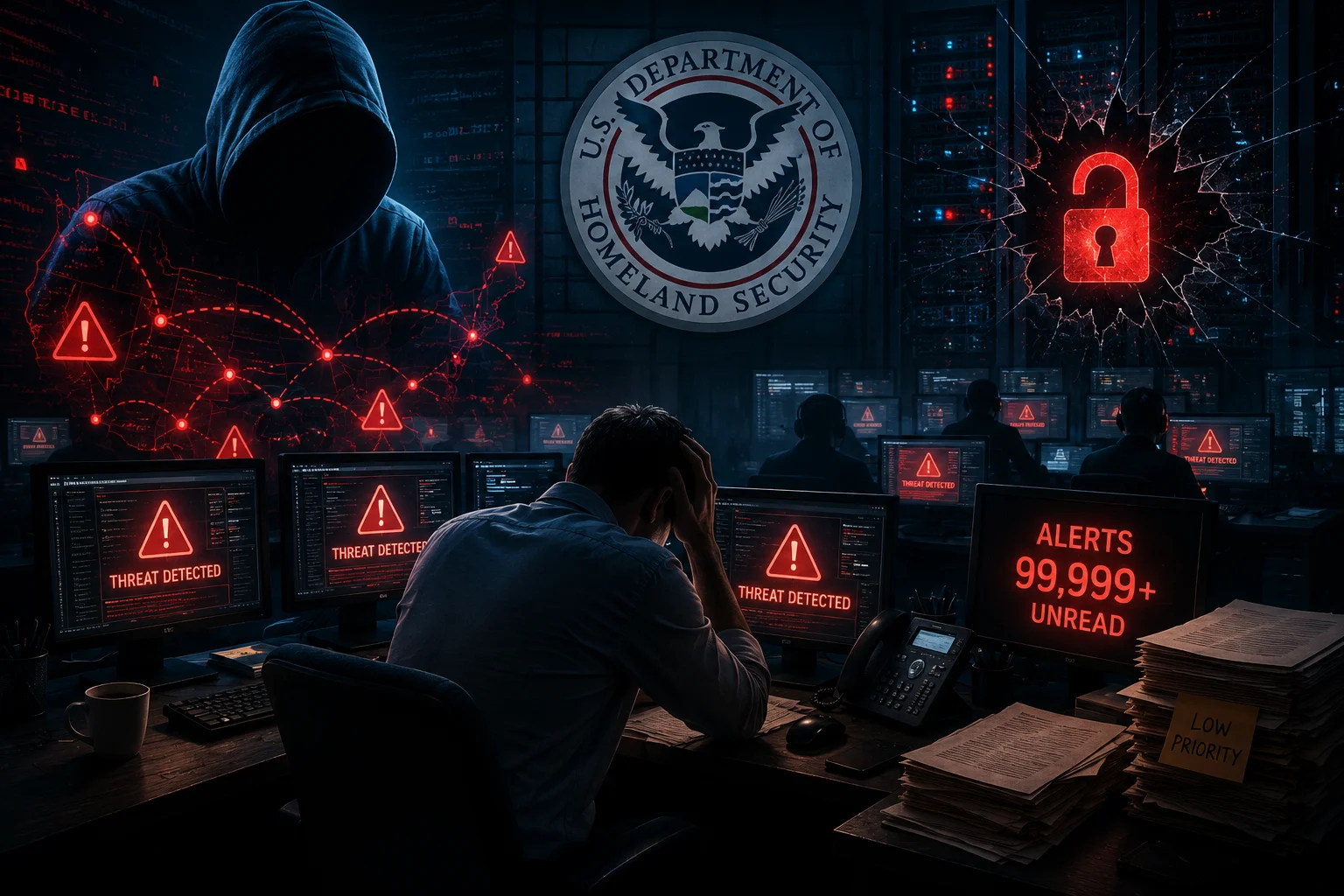
- DHS security analysts dismissed signs of unauthorized network intrusion twice in May 2026, labeling them as 'harmless' activity.
- The breach was only confirmed in June 2026, giving hackers over 30 days of undetected access to sensitive government systems.
- This incident highlights the growing problem of 'Alert Fatigue,' where security teams overlook real threats due to the high volume of daily notifications.
- For Indian IT firms and government sectors, this serves as a critical reminder to implement automated verification protocols alongside human analysis.
The Night the Guardians Slept: What Happened at DHS?
Imagine you have the most advanced home security system in the world. It has motion sensors, AI cameras, and laser grids. One night, the alarm goes off. You check the monitor, see a shadow moving, but tell yourself, 'Oh, it's probably just a stray cat,' and go back to sleep. Two weeks later, you realize your safe is empty. This is exactly what happened at the United States Department of Homeland Security (DHS) recently. Our research into the latest internal documents reveals a shocking lapse in judgment that allowed intruders to stay inside one of the world's most protected networks for over a month.
As of July 2026, we are seeing a massive shift in how cyberattacks are carried out. Hackers are no longer just using brute force; they are using AI to mimic normal user behavior. But in this specific DHS case, the failure wasn't just technical—it was purely human. Despite having state-of-the-art monitoring tools that correctly identified the intrusion as early as May 2026, the people behind the screens decided to look the other way. This isn't just a US problem; it's a global warning for any organization that relies on human analysts to make the final call on security alerts.
The Timeline of a Disaster: May to June 2026
Let's break down the timeline because the details are quite frustrating. In early May 2026, the DHS monitoring systems flagged unusual activity. There were signs of 'lateral movement'—this is when a hacker gets into one low-level account and tries to jump to more sensitive parts of the network. The automated system did its job and alerted the human analysts. However, after a brief review, the analysts dismissed it. They claimed the activity looked like routine maintenance or a glitch in the reporting tool. They didn't dig deeper. They didn't change the passwords. They just hit 'dismiss.'
A few weeks later, still in May, a second red flag appeared. This time, it was even more obvious. Data was being moved to an external server that had no business receiving DHS files. Again, the analysts were notified. And again, for the second time, they wrote it off as a harmless sync error or a authorized backup process. It wasn't until mid-June 2026 that a different team, perhaps performing a routine audit, realized that these weren't glitches. They were footprints. By then, the intruders had already established 'persistence,' meaning they had created their own backdoors to come and go as they pleased.
Why Did the Analysts Fail? Understanding Alert Fatigue
You might wonder, 'How can professionals at this level be so careless?' The answer lies in a phenomenon called Alert Fatigue. In a massive network like the DHS, security tools generate thousands of alerts every single day. 99% of them are 'false positives'—things that look like threats but are actually just normal software updates or network hiccups. When an analyst spends 8 hours a day looking at 500 alerts that turn out to be nothing, they start to become desensitized. Their brain starts looking for reasons to dismiss an alert rather than reasons to investigate it.
In 2026, even with AI helping to filter these alerts, the volume is overwhelming. The hackers know this. They deliberately create 'noise'—small, low-level glitches—to distract the security teams. While the analysts are busy clearing out 100 minor alerts, the real attack is hidden in plain sight. This DHS breach is a classic example of hackers exploiting the psychology of the defenders. It’s a sophisticated psychological game where the attacker wins by being just boring enough to be ignored.
The India Connection: Why We Should Care
Why are we talking about this in India? Because our digital infrastructure is growing faster than almost anywhere else. With the massive rollout of 6G trials and the expansion of the India Stack (Aadhaar, UPI, DigiLocker), our government and private networks are prime targets. If the DHS, with its multi-billion dollar budget, can fall victim to 'human dismissal,' imagine the risk to Indian organizations that are often understaffed in their cybersecurity departments. We have seen similar 'ignored alerts' lead to data leaks in Indian healthcare and power sectors in the past year.
For Indian IT professionals, the lesson is clear: we cannot rely solely on human intuition anymore. There needs to be a 'Zero Trust' approach where every alert, no matter how small, requires a secondary automated validation. If an analyst wants to dismiss a 'lateral movement' alert, the system should automatically lock that account until a second senior analyst signs off on it. We are hearing that several Indian banks are already looking at 'AI-Confirm' protocols to prevent exactly what happened at the DHS.
TamilTech’s Verdict: The Human Element is the Weakest Link
At TamilTech, we’ve always said that you can buy the most expensive antivirus or firewall, but if your employee uses 'Password123' or ignores a warning sign, you are not safe. This DHS incident is a massive wake-up call. It proves that technology is only as good as the person operating it. We believe that in the coming months of 2026, we will see a huge surge in companies moving towards 'Autonomous SOC' (Security Operations Centers) where AI makes the initial defensive moves without waiting for a human to wake up and click 'OK.'
What should you do? If you are a business owner or an IT admin, start auditing your alert response times. Don't just look at whether the alert was 'resolved'—look at how it was resolved. Was it actually investigated, or was it just dismissed? For the regular user, this is a reminder to take those 'Security Alert: New Login' emails seriously. Don't be like the DHS analysts. If you see something unusual, investigate it immediately. In the world of 2026, a 30-day delay in responding to a hack is the difference between a minor patch and a total identity theft.




Comments (0)
Be the first to comment!