


Key Takeaways
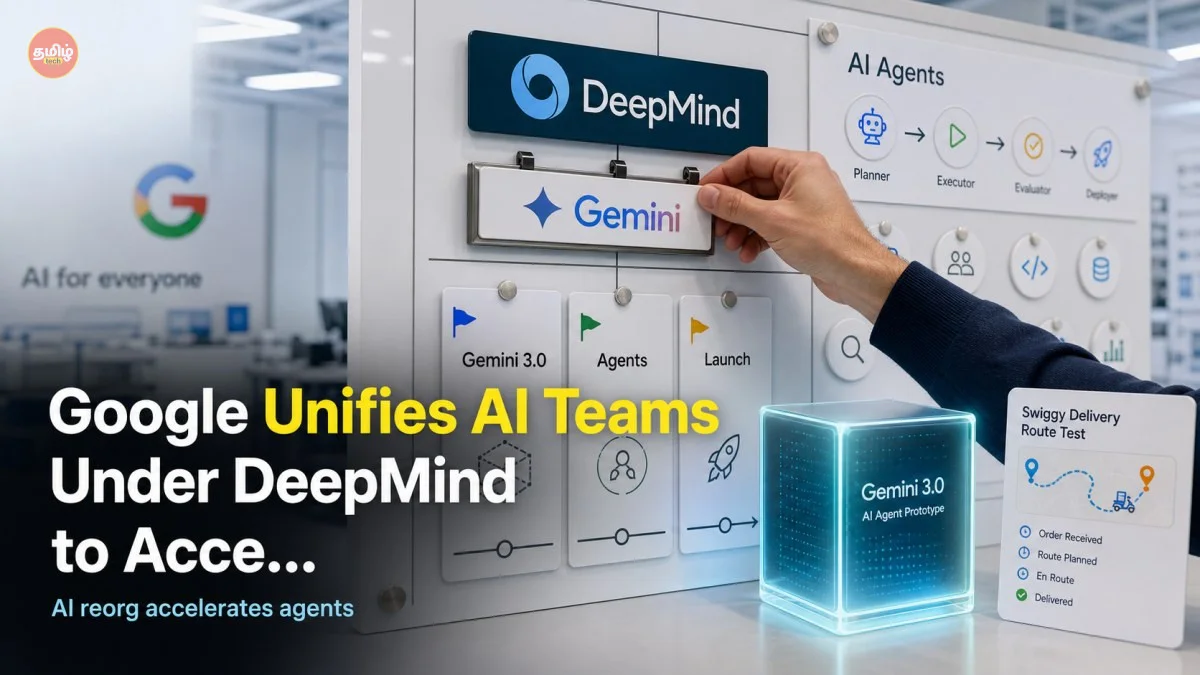
- Google has officially moved the entire Gemini app team under the DeepMind umbrella to unify research and consumer products.
- Demis Hassabis now holds total control over Google’s AI roadmap, ending the internal friction between research and product teams.
- The move is designed to accelerate the rollout of 'AI Agents' that can perform tasks like booking IRCTC tickets or ordering Swiggy without user intervention.
- For Indian users, this means faster integration of local languages in Gemini and better performance on budget Tensor-powered devices.
The Big News: Google is Cleaning House
Google just hit the reset button on how it builds AI. If you’ve been following tech lately, you know that the race between Google, OpenAI, and Apple has reached a boiling point in 2026. To win this, Google has decided to stop playing nice with its internal divisions. They’ve announced a massive leadership shakeup where the Gemini app team—the people who actually build the interface you use on your phone—is moving directly into Google DeepMind. This isn't just a small office move; it’s a total shift in power. For years, Google had different teams working on the 'brain' (the models) and the 'body' (the apps). Now, they are one single unit.
Why should you care? Because up until now, Google has been criticized for being too slow. While OpenAI drops new features every other month, Google sometimes feels like a giant ship trying to turn in a narrow canal. By putting the Gemini team under Demis Hassabis at DeepMind, Google is saying they want to move at startup speed again. They are cutting the red tape and the corporate layers that have been slowing down AI integration into Android 17 and Chrome. If you’ve felt that Gemini was a bit 'clunky' compared to other assistants, this move is exactly what Google thinks will fix it.
How We Got Here: The Battle of the Labs
To understand why this is happening now in 2026, we have to look back at the mess Google created for itself. Back in the day, Google had two separate AI powerhouses: Google Brain in California and DeepMind in London. They were like two rival siblings competing for the same toys. In 2023, Google finally forced them to get married, creating 'Google DeepMind.' But even after that, the team making the actual Gemini app was still separate, sitting under the Search and Ads division. This created a huge gap between the scientists inventing the AI and the engineers putting it in your pocket.
Over the last year, we saw the consequences of this split. Feature releases were delayed, and sometimes the AI felt disconnected from the rest of the Google ecosystem. Now, Sundar Pichai has finally pulled the trigger. By moving the consumer-facing Gemini team into the research lab, there is no more 'us vs. them.' The people who understand the math behind the AI are now sitting next to the people who design the buttons you click. This is Google’s way of ensuring that their next big model, Gemini 3.0, isn't just a smart chatbot, but a functional part of your digital life.
What This Means for Your Android Phone and GPay
Let’s talk about the real-world impact here in India. We know that Google is heavily betting on the Indian market with localized AI. This leadership change is specifically aimed at speeding up 'Agentic AI.' Imagine this: instead of you opening the IRCTC app, searching for a train, and entering your details, you just tell Gemini, 'Book me a window seat on the Brindavan Express for Friday.' With the new unified team, the AI will have the permissions and the 'hooks' into the OS to actually execute these tasks. This is where the future is headed, and Google wants to be the one to lead it.
Also, think about GPay. We’ve been hearing rumors about AI-powered personal finance management for a while. With the DeepMind team taking over the product side, we expect Gemini to become much more deeply integrated into GPay India. It could analyze your spending patterns across UPI transactions and give you real-time advice or even automate bill payments based on your bank balance. Since the hardware team (Pixel) and the AI team are now working closer than ever, the upcoming Pixel 11 and even budget-friendly Tensor-powered phones will see massive performance boosts in AI tasks that used to require a cloud connection.
The 'TamilTech' Take: Is This a Win or a Desperate Move?
At TamilTech, we’ve been tracking Google’s AI journey since the early days of Assistant. Honestly, we think this move was long overdue. Google’s biggest enemy hasn’t been OpenAI; it’s been Google’s own bureaucracy. They have the best data, the best chips (TPUs), and some of the smartest people on the planet, but they’ve been tripping over their own feet. This shakeup tells us that Sundar Pichai is tired of the 'slow and steady' approach. He wants results, and he wants them now.
However, there is a risk. DeepMind is a research-heavy organization. Their goal has always been 'Artificial General Intelligence' (AGI)—essentially building a god-like computer brain. The Gemini app team, on the other hand, is used to building products for billions of regular people. Merging these two cultures could be messy. If the researchers focus too much on the 'science' and forget about the 'user experience,' Gemini could become too complex for the average user. But if they get the balance right, the integration between Android and AI will be so seamless that you won't even realize you're using a separate app. It will just be 'The Phone' doing things for you.
What’s Next for Google?
In the coming months, keep a close eye on the Gemini updates. We expect a major refresh of the Gemini interface on Android by late 2026. You’ll likely see more 'System-wide' AI features where Gemini can see what’s on your screen and help you in real-time. Also, watch out for the next Google I/O. Now that Hassabis is in charge of the whole stack, the demos we see won't just be 'coming soon'—they will likely be ready for your phone immediately. Google is finally acting like the tech giant it is, and for us users, that usually means better features and more competition in the market.


Comments (0)
Be the first to comment!