


Key Takeaways
- KEO priced at ₹9,999, making AI accessible to Indian students and developers
- Karnataka government aims to create 10,000 AI developers through this initiative
- Device runs on ARM architecture with 8GB RAM and 128GB storage
- Includes pre-loaded AI models and development tools
- Available through government educational institutions starting September 2026
What's the news
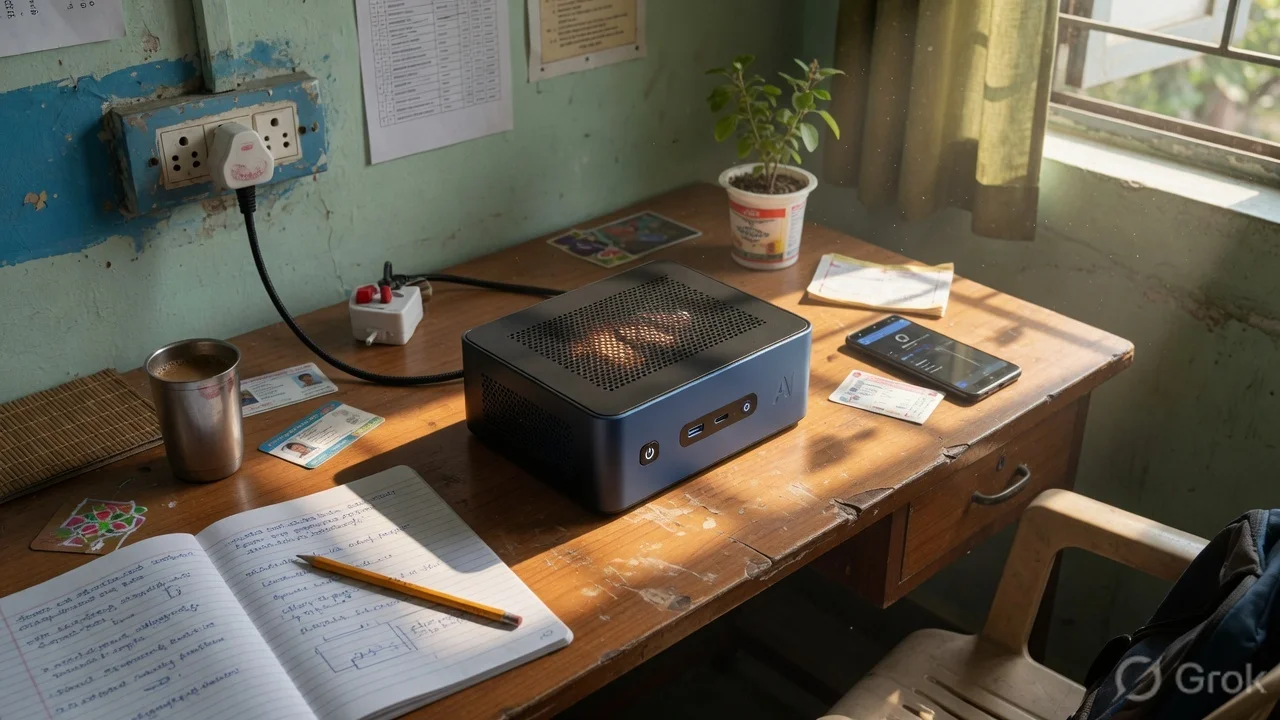
Karnataka has just dropped a bombshell in the AI hardware space. The state government has launched KEO, a low-cost AI computing device priced at just ₹9,999. This move is significant because it brings AI capabilities that were previously the domain of expensive cloud services and high-end hardware into the hands of regular Indian students and developers. The initiative, announced by Karnataka's IT department, is part of their broader vision to establish the state as India's AI hub.
KEO isn't just another budget laptop with some AI software thrown in. It's specifically designed from the ground up to handle AI workloads efficiently. The device comes with 8GB of RAM, 128GB of storage, and runs on an ARM-based processor optimized for machine learning tasks. What's particularly interesting is that it includes a dedicated Neural Processing Unit (NPU) that can handle up to 40 TOPS of AI computations, which is impressive for this price point.
Details
Let's dive into the specs that make KEO special. The device features a 10.1-inch display with 1920x1200 resolution, making it suitable for both coding and AI model visualization. It runs on a custom ARM-based processor developed in collaboration with a Bengaluru-based chip design firm. The 8GB of RAM is LPDDR5, and the 128GB storage is eMMC 5.1, which is decent for an AI device at this price.
What really sets KEO apart is its software stack. It comes with a pre-installed suite of AI development tools including TensorFlow Lite, PyTorch Mobile, and ONNX Runtime. The device also ships with 50+ pre-trained AI models for common tasks like image recognition, natural language processing, and speech recognition. These models are optimized to run efficiently on KEO's hardware, allowing developers to experiment without needing to train models from scratch.
The battery life is another highlight - KEO can run for up to 12 hours on a single charge, which is crucial for students and developers who might be working on AI projects for extended periods. It also includes multiple connectivity options including Wi-Fi 6, Bluetooth 5.2, and two USB-C ports for connecting external displays or storage devices.
India impact
This launch could be a game-changer for India's AI ecosystem. For years, the barrier to entry for AI development has been the high cost of hardware and cloud computing resources. KEO changes this equation dramatically. At ₹9,999, it's roughly 1/10th the price of similar AI-capable devices in the market.
The Karnataka government has ambitious plans. They aim to distribute 100,000 KEO devices to engineering colleges, polytechnics, and vocational training centers across the state over the next year. The goal is to create a pipeline of 10,000 AI developers who can contribute to India's growing AI industry. This initiative aligns with the central government's IndiaAI Mission, which aims to make India a global AI powerhouse by 2030.
What's particularly exciting is how this could democratize AI education in smaller cities and towns. Students in Tier-2 and Tier-3 cities who previously had to rely on expensive cloud services or travel to metro cities for AI education now have access to dedicated AI hardware. This could potentially unlock a new wave of AI innovation from regions that have been underrepresented in India's tech scene.
Use cases
The versatility of KEO opens up numerous possibilities across different sectors. In education, it can be used for teaching AI concepts hands-on rather than just theoretically. Students can train their own models, experiment with neural networks, and understand AI optimization techniques without worrying about computational costs.
For startups and small businesses, KEO offers an affordable way to develop AI-powered applications. A local retailer could use it to develop an inventory management system with computer vision, or a healthcare provider could create a diagnostic tool using the pre-trained medical imaging models. The low cost means they can experiment without significant upfront investment.
In agriculture, KEO could power AI solutions for crop monitoring, pest detection, and yield prediction. Farmers or agricultural startups could use these devices to process satellite imagery or sensor data locally, reducing dependence on cloud services and improving data privacy. This is particularly relevant for Karnataka, which has a strong agricultural sector.
The device also has potential in smart city initiatives. Municipalities could deploy multiple KEO units for traffic management, waste monitoring, or public safety applications. The compact size and low power consumption make it suitable for deployment in kiosks or small form factor deployments across urban areas.
Honest take
While KEO's launch is exciting, it's important to be realistic about its limitations. The 128GB storage might feel restrictive for developers working with large datasets, and the ARM processor, while efficient for AI tasks, might not match the performance of x86 chips for general computing tasks. However, for its target audience - students and developers focused on AI - these compromises are acceptable given the price point.
What I find most impressive is the strategic thinking behind this initiative. Instead of just subsidizing existing hardware, Karnataka has developed a purpose-built device that addresses the specific needs of AI development in the Indian context. The inclusion of pre-trained models and optimized software stack shows they understand that many Indian developers are just starting their AI journey and need guidance.
The success of KEO will ultimately depend on the ecosystem that develops around it. If educational institutions embrace it, if there's good community support, and if the device proves reliable over time, it could indeed catalyze a new wave of AI innovation from India's smaller cities and towns. This is exactly the kind of bottom-up approach that could make India a genuine AI leader rather than just a consumer of AI technology.
Frequently Asked Questions
Q: When will KEO be available for purchase?
A: KEO will be available through government educational institutions starting September 2026. Individual purchases might be available later through select retailers.
Q: Can KEO run complex deep learning models?
A: KEO is optimized for lightweight and medium-complexity AI models. For training large models from scratch, you might still need more powerful hardware, but it's excellent for inference and fine-tuning existing models.
Q: Is KEO compatible with popular AI frameworks?
A: Yes, KEO supports TensorFlow, PyTorch, and other popular AI frameworks. The pre-installed software stack includes these frameworks optimized for the device's hardware.
Q: Does KEO require internet connectivity to function?
A: While internet connectivity is recommended for downloading additional models and updates, KEO can run most pre-installed AI models offline, making it suitable for areas with limited connectivity.





Comments (0)
Be the first to comment!