


Key Takeaways
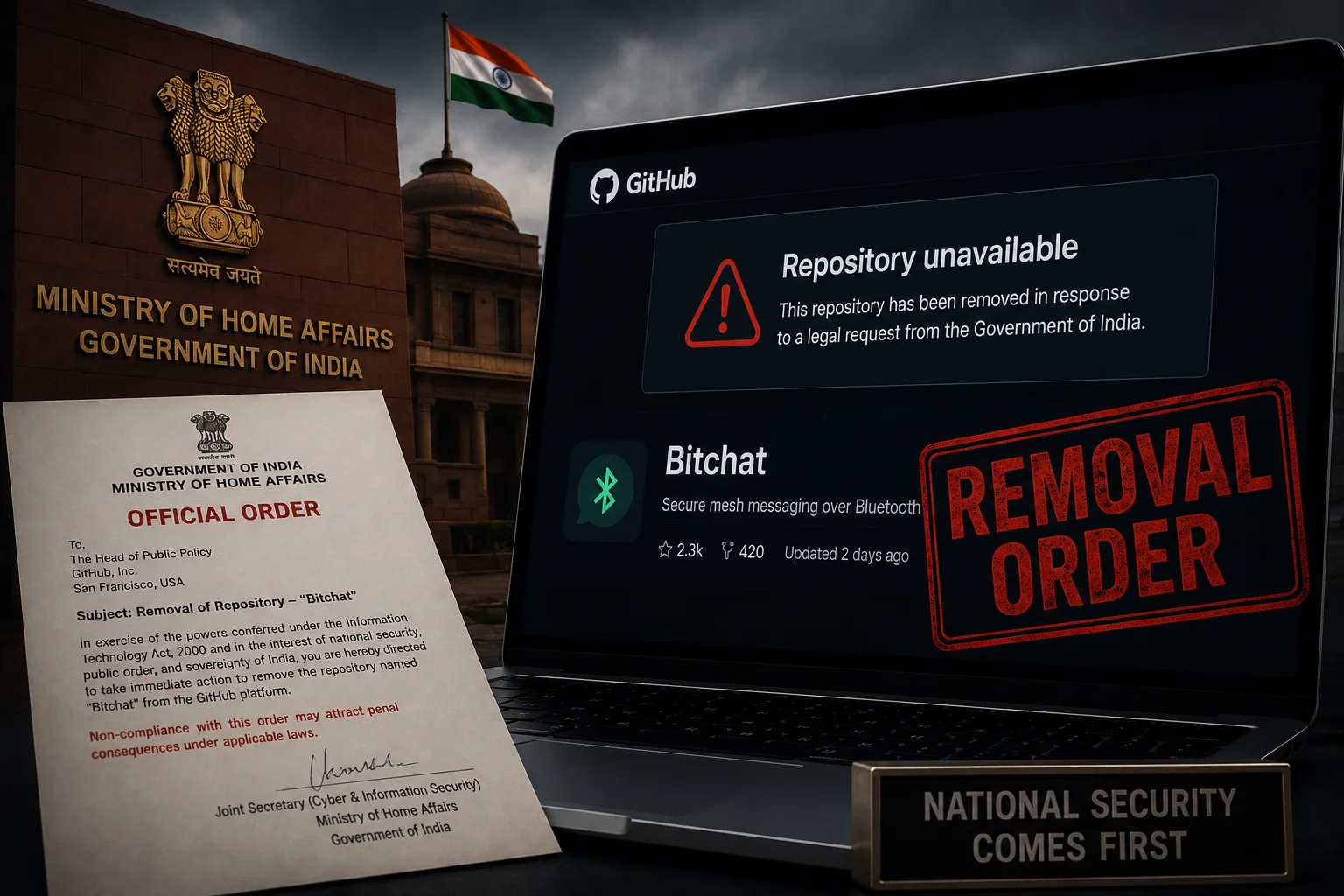
- The Ministry of Home Affairs (MHA) has issued a legal notice to GitHub under Section 69A of the IT Act to take down the Bitchat repository.
- Bitchat is a decentralized, peer-to-peer (P2P) messaging protocol that offers extreme anonymity, making it nearly impossible for law enforcement to trace message originators.
- The takedown affects Indian developers and users, as the repository will be geo-blocked or removed entirely from the platform in the Indian region.
- This move highlights the ongoing 2026 tension between the Indian government's traceability requirements and the global push for decentralized, private communication tools.
The News: MHA Targets Decentralized Messaging
In a major move that has sent ripples through the Indian developer community this July 2026, the Ministry of Home Affairs (MHA) has officially sent a takedown notice to GitHub. The target? A repository known as 'Bitchat'. If you haven't heard of it yet, Bitchat is a decentralized messaging protocol that has been gaining traction among privacy enthusiasts. The government isn't happy about it, and they've invoked Section 69A of the IT Act to get it removed. This isn't just about one app; it’s a clear signal that the Indian government is doubling down on its 'traceability' mandate for all communication tools operating within its borders.
So, what exactly triggered this? Sources suggest that security agencies flagged Bitchat after noticing its use in encrypted communications that bypassed traditional surveillance methods. Unlike WhatsApp or Telegram, which have central entities you can send a legal notice to, Bitchat is built on a framework that doesn't have a 'boss'. This makes it a nightmare for the MHA, which has been strictly enforcing the 2026 updated Digital India Act rules. The notice sent to GitHub basically says that the hosting of this code poses a threat to national sovereignty and public order.
What is Bitchat and Why Does it Matter?
To understand why the government is so bothered, we need to look at what Bitchat actually does. Bitchat isn't your average chatting app. It’s a peer-to-peer (P2P) protocol. In simple terms, when you send a message on Bitchat, it doesn't go to a server owned by a company like Meta or Google. Instead, it travels directly from your device to the recipient's device, often hopping through other users' nodes in an encrypted fashion. It uses decentralized identifiers (DIDs) and doesn't require a phone number or an email ID to sign up. For anyone looking for 100% anonymity, it’s a dream come true.
However, for the Indian government, this 'dream' is a security loophole. Since there is no central server, there are no logs. If a malicious actor uses the platform to coordinate something illegal, the police can't just serve a warrant to a company to get the chat history or the IP address of the sender. In 2026, where digital security is synonymous with national security, the MHA views such 'untraceable' platforms as a high-risk factor. The Bitchat repository on GitHub contains the source code that allows anyone to build their own version of this untraceable chat system, which is why the government wants the source suppressed at the root.
The Legal Tussle: Section 69A and GitHub's Dilemma
The legal weapon of choice here is Section 69A of the Information Technology Act. This is the same law that was used to ban TikTok and hundreds of other apps over the last few years. Under this section, the government can order the blocking of any information that it deems a threat to the country's integrity, defense, or public order. GitHub, being a platform owned by Microsoft, usually complies with local laws to avoid being blocked entirely in a massive market like India. We've seen this happen before with other repositories, where GitHub applies a 'geo-block', making the code invisible to Indian IP addresses while keeping it available for the rest of the world.
But here is where it gets tricky for the developer community. GitHub is the holy grail of open-source collaboration. By forcing a takedown of a protocol's source code, critics argue that the government is essentially 'banning math' or 'banning logic'. If the code is already out there, forks (copies) of the repository likely already exist on other decentralized hosting platforms like IPFS or Radicle. The MHA's notice might stop the casual user from finding Bitchat, but it won't stop a determined developer. This highlights the cat-and-mouse game between regulators and decentralized tech in 2026.
How Bitchat's P2P Technology Works
Let's dive a bit into the tech. Bitchat operates on a gossip protocol. Imagine you are in a crowded room and you whisper a secret to one person, who whispers it to another, until it reaches the person you intended. Except, in Bitchat's case, every whisper is wrapped in multiple layers of high-grade encryption that only the final recipient can unlock. This is called Onion Routing, similar to how the Tor browser works. It makes it nearly impossible for anyone watching the network to know who the original sender was or who the final recipient is.
For a developer in India, accessing this code on GitHub was a way to learn about advanced cryptography and decentralized networking. By removing it, the government is effectively putting a barrier on learning certain types of privacy-preserving technologies. While the government's intent is to stop crime, the collateral damage is the restriction on open-source research. This is a recurring theme we've seen throughout 2026—the balance between 'Safety' and 'Innovation' is becoming increasingly lopsided in favor of state control.
India Impact: What Happens to the Users?
If you are a user of an app built on the Bitchat protocol in India, you might start seeing connectivity issues soon. When the MHA issues a takedown for a repository, it's usually followed by ISPs (Internet Service Providers) being ordered to block the underlying communication ports or bootstrap nodes that the app uses to find other peers. This means your 'untraceable' app might just stop working unless you use a high-end VPN or a proxy, which the government is also heavily monitoring these days.
For the average Indian user, this is a wake-up call. It shows that even 'decentralized' apps aren't immune to government intervention. If the source code is removed from GitHub, the app won't receive updates, security patches will stop, and eventually, the software will become vulnerable or obsolete. It also means that Indian startups looking to build privacy-first tools might think twice before hosting their code publicly, fearing a similar fate. The 'chilling effect' on the Indian tech ecosystem is real and palpable.
Alternatives: Privacy Apps Still Standing
If Bitchat goes down, what are the alternatives for those who value privacy? Currently, Signal remains the gold standard for encrypted messaging, though it is centralized and requires a phone number (unless you use their newer username feature). Then there’s Session, which is also decentralized and doesn't require a phone number. However, the MHA has been keeping a close eye on Session as well. Matrix (Element) is another robust alternative that allows for self-hosting, which is much harder for a government to shut down because anyone can run their own server.
The problem with these alternatives is that they all eventually face the same 'Traceability' hurdle. The Indian IT Rules of 2021 (and the 2026 amendments) are very clear: if you provide messaging services, you must be able to identify the first originator of a message. Since P2P apps like Bitchat and Session are designed specifically NOT to know who the sender is, they are fundamentally at odds with Indian law. This is why we expect more such takedown notices for similar apps throughout the rest of the year.
TamilTech's Take: Security or Privacy?
Look, we get it. The government has a responsibility to keep the country safe. In an era of deepfakes, AI-generated misinformation, and organized cybercrime, having 'dark' channels where no one can be tracked is a genuine security risk. We've seen how fake news on WhatsApp has led to real-world violence in India. From that perspective, the MHA's move to block Bitchat is a proactive step to prevent untraceable platforms from being misused. They want to ensure that if something goes wrong, there is a way to hold someone accountable.
But on the other hand, we at TamilTech believe that privacy is a fundamental right. When you start banning the source code of a protocol, you are entering dangerous territory. It’s a slippery slope from banning a niche P2P app to restricting any form of strong encryption that the state can't break. For developers, this is a huge blow to the 'Open Source' spirit. Our take? The government should focus on better policing and cyber-investigation techniques rather than just banning the tools. Banning Bitchat won't stop criminals; they will just move to the next obscure protocol. It only inconveniences law-abiding citizens and developers who want to push the boundaries of technology. What do you think? Is this move necessary for India's safety, or is it a blow to our digital freedom? Let us know in the comments.




Comments (0)
Be the first to comment!