


Key Takeaways
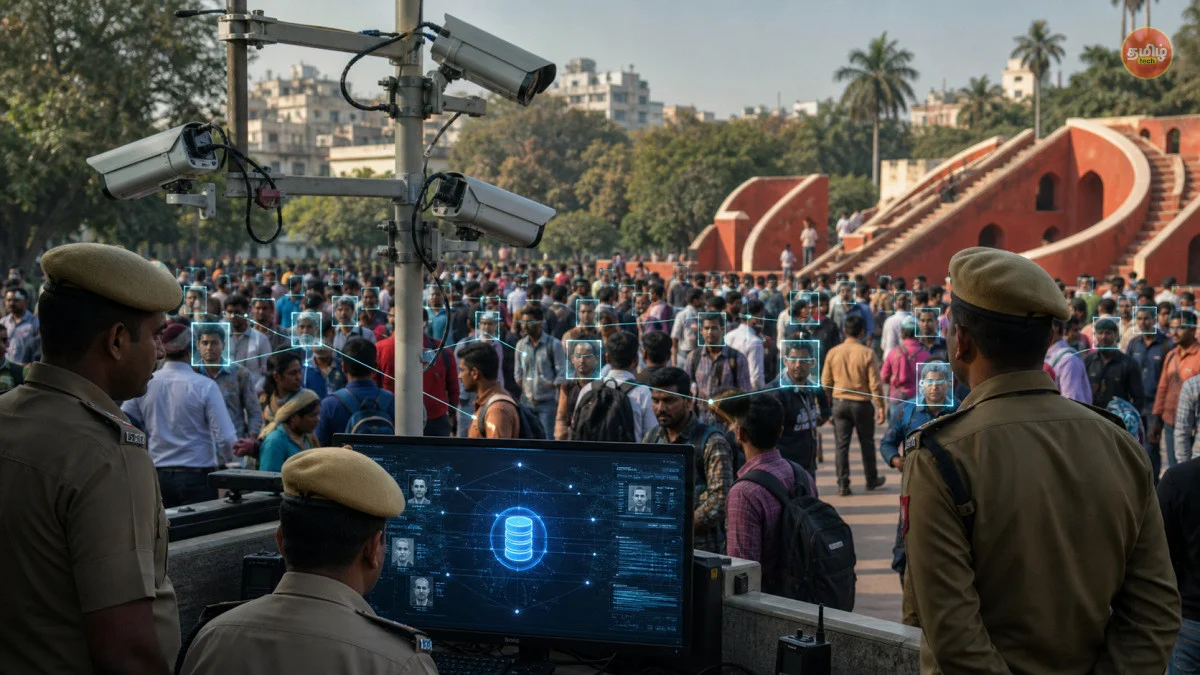
- Delhi Police has deployed 4K AI-powered CCTV cameras at Jantar Mantar that perform Live Facial Recognition (LFR) as of July 2026.
- The system can identify individuals in a crowd of thousands within 1.5 seconds by matching faces against a massive central database.
- New 2026 AI algorithms allow the police to identify protesters even if they are wearing surgical masks, sunglasses, or mufflers.
- There is currently no specific Indian law that strictly regulates the real-time use of facial recognition in public protest zones.
- TamilTech's verdict: While it boosts security, the lack of transparency on data storage poses a massive risk to citizen privacy.
The New Reality at Jantar Mantar: Cameras are Watching
If you have visited Jantar Mantar in Delhi recently, you might have noticed a lot more cameras than usual. It is not just about recording video anymore. As of July 2026, the Delhi Police has fully integrated Live Facial Recognition (LFR) into their surveillance grid at this iconic protest site. For decades, Jantar Mantar has been the heart of Indian democracy, where people from all over the country come to raise their voices. But now, every face in that crowd is being scanned, analyzed, and cross-checked against a police database in real-time. It is like having a digital shadow following you the moment you step into the zone.
We at TamilTech have been tracking this development for a while. What started as a pilot project a few years ago has now become a permanent fixture. This isn't just a simple CCTV setup; it is a high-tech net designed to identify 'troublemakers' or 'history sheeters' before they even start a protest. But the big question we need to ask is: where does security end and stalking begin? When the state knows exactly who is protesting against them in real-time, the very nature of a 'free protest' changes. Let’s dive deep into how this tech works and why it matters to you.
How the 2026 Live Facial Recognition Tech Works
The technology used by the Delhi Police in 2026 is light-years ahead of what we saw back in 2021 or 2022. They are using high-resolution 4K PTZ (Pan-Tilt-Zoom) cameras equipped with Edge-AI chips. This means the 'thinking' happens right inside the camera. Instead of sending raw video to a server and waiting for a match, these cameras convert your face into a unique mathematical code (a faceprint) instantly. This code is then compared against the National Automated Facial Recognition System (NAFRS) which contains millions of records, including criminal databases and missing person reports.
What is truly wild about the 2026 update is the 'Occlusion Handling' feature. Earlier, if you wore a mask or a scarf, the AI would fail. But now, the algorithms focus on the periocular region—the area around your eyes and the bridge of your nose. Even with a COVID-style mask or heavy sunglasses, the system has an accuracy rate of over 92%. They also use 'Gait Analysis' now, which means even if you hide your face, the way you walk can be used to tag you in the system. This level of tracking was once limited to sci-fi movies, but it is the reality in Delhi today.
The Database and the 'Watchlist'
So, who exactly are they looking for? The Delhi Police states that the primary goal is to identify known criminals, terrorists, and missing children. However, the 'Watchlist' is a bit of a grey area. Reports suggest that the database also includes 'repeat protesters' or individuals previously detained during civil unrest. Once the camera spots a match, an instant alert is sent to the handheld devices of police officers on the ground at Jantar Mantar. Within seconds, they can approach a person, knowing their entire history, address, and past activities.
This creates a massive 'Chilling Effect'. If you know that your face is being linked to a police file just for standing at a protest site, would you still go? Most people wouldn't. This is where the technology stops being a security tool and starts becoming a tool for social control. The data is stored in centralized servers, and as of now, we don't have clear information on how long this data is kept. Is your face stored forever just because you attended a farmers' protest or a student rally? The lack of a 'Right to be Forgotten' in the Indian surveillance context is a major red flag.
India's Legal Vacuum: Is this Legal?
You might be wondering, "Isn't there a law against this?" Well, it’s complicated. While India passed the Digital Personal Data Protection (DPDP) Act, it provides wide exemptions for government agencies in the interest of 'public order' and 'national security'. This 'National Security' tag is often used as a blanket permit to deploy invasive tech like LFR without specific judicial oversight. Unlike the European Union, which has strictly banned Live Facial Recognition in public spaces under the AI Act, India has taken the opposite route, embracing it as a 'Modernization' step for the police force.
There is no specific 'Facial Recognition Act' in India that defines what the police can and cannot do with your face data. Without such a law, the police are basically writing their own rules. They argue that it helps in maintaining law and order in a sensitive zone like Delhi. But critics and legal experts point out that this violates the 'Right to Privacy' which the Supreme Court of India declared as a Fundamental Right in the Puttaswamy judgment. The reality in 2026 is that the tech has moved much faster than our legal system.
The Global Context: India vs The World
If we look at the global stage, the world is divided on this. In China, this kind of surveillance is everywhere—used for everything from catching criminals to shaming jaywalkers. In the US, several cities like San Francisco and Boston actually banned the police from using facial recognition because it was found to be biased against certain ethnicities. In the UK, the London Metropolitan Police uses it, but they have to put up massive signs warning people that LFR is in operation. In Delhi, however, you won't find many warning signs; the surveillance is often invisible until you are stopped.
The Indian implementation is unique because of the scale. With over 1.4 billion people, the potential for 'False Positives' is huge. A false positive is when the AI incorrectly matches your face with a criminal's face. In a crowded place like Jantar Mantar, a 1% error rate could lead to dozens of innocent people being harassed or detained by mistake every single day. As the technology becomes more widespread across other Indian cities like Hyderabad and Chennai, this risk only grows.
TamilTech's Honest Take: What We Think
At TamilTech, we love technology that makes life easier, but we are very skeptical of tech that takes away our freedom. Using AI to find missing children is a great use case. But using Live Facial Recognition to monitor peaceful protesters at Jantar Mantar feels like an overreach. We believe that if the government is going to use such powerful tools, there must be a 'Transparency Portal' where citizens can see what data is being collected and why. You shouldn't be treated like a suspect just for exercising your democratic rights.
What should you do? Well, in 2026, it's getting harder to stay anonymous. While some people use 'AI-masking' makeup or infrared-reflecting caps to confuse the cameras, these are not practical for everyone. The best way forward is to demand a stronger legal framework for AI and surveillance in India. Security is important, yes, but it shouldn't come at the cost of our soul. Stay tuned to TamilTech for more updates on how technology is changing our lives in India—both for the better and the worse.





Comments (0)
Be the first to comment!