


Key Takeaways
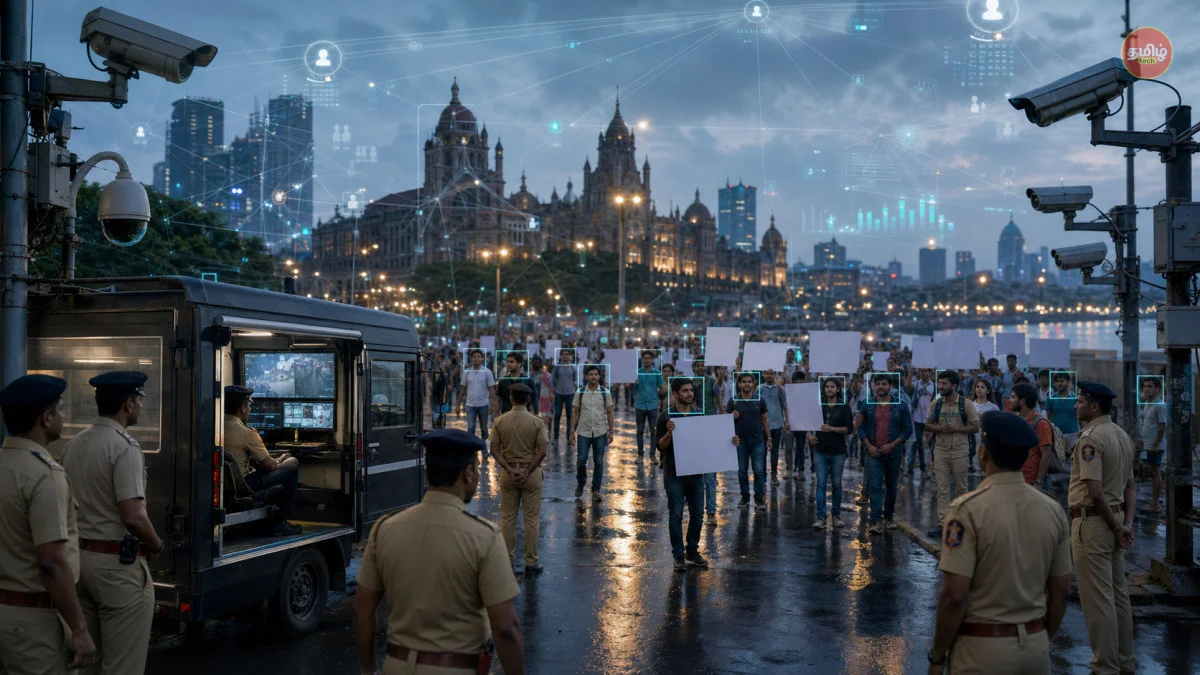
- Mumbai Police has integrated over 15,000 AI-enabled CCTV cameras across the city as of 2026.
- The Automated Facial Recognition System (AFRS) can now match faces in real-time even with masks or scarves.
- Social media monitoring tools track specific hashtags and keywords to identify protest organizers before they reach the venue.
- Digital footprints are being used to issue preventive notices under Section 149 of the BNS (formerly IPC).
- TamilTech's verdict: While tech helps in law and order, the lack of a strong data protection law makes this a massive privacy risk for the youth.
The Silent Eye: Mumbai's Digital Transformation
Imagine you are planning to join a small peaceful gathering at Azad Maidan or Gateway of India. You haven't even reached the spot yet, but your phone pings with a warning message from the local police station. This isn't a scene from a sci-fi movie; this is the reality in Mumbai in 2026. The city's police force has moved far beyond lathis and barricades. Today, the primary weapon is data. The Mumbai Police has quietly built one of the most sophisticated surveillance networks in South Asia, specifically targeting how the youth organize and execute protests. They aren't just reacting to crowds anymore; they are predicting them.
We have been tracking this shift for a while, and it's honestly mind-blowing how much tech is involved. In 2026, being a 'digital citizen' means you are constantly being mapped. Whether you are posting a reel about a social cause or just walking past a high-definition camera near a college campus, the system is watching. The goal is simple: stop the protest before it starts. By identifying 'influencers' and 'organizers' through digital footprints, the police can neutralize potential unrest without ever firing a tear gas shell. But at what cost to our privacy? Let's dive deep into the tech stack that's running behind the scenes.
How We Got Here: From CCTV to AI Brains
A few years ago, Mumbai's surveillance was just a bunch of cameras recording footage that nobody watched unless a crime happened. That changed drastically between 2024 and 2025. The city upgraded its 'Safe City' project into an 'Intelligent City' initiative. They didn't just add more cameras; they added 'brains' to them. By early 2026, the Command and Control Centre (CCC) in South Mumbai became the heart of an AI ecosystem that processes millions of data points every second. It's no longer about just seeing; it's about recognizing patterns.
The shift happened because traditional policing was failing to keep up with the speed of the internet. In the past, a protest would take days to organize via posters and meetings. Now, a single viral WhatsApp message or a trending hashtag on X (formerly Twitter) can bring thousands of students to the streets in two hours. To counter this 'flash mob' culture, the police realized they needed to be faster than the algorithm. They started investing in Social Media Intelligence (SOCMINT) tools that scan public profiles and group chats to gauge the 'vibe' of the city's youth population.
The Tech Stack: FRS, Drones, and Sentiment Analysis
Let's talk about the actual hardware and software. The backbone of this system is the Automated Facial Recognition System (AFRS). Unlike older versions, the 2026 model used by Mumbai Police uses deep learning to identify individuals even if they are wearing sunglasses, masks, or have grown a beard. These cameras are placed at every major railway station like CSMT and Dadar, and near all major educational hubs. If you have ever been booked in a previous protest or have a record, the system flags your presence the moment you enter a 'sensitive zone'.
Then comes the drone fleet. These aren't your average photography drones. These are high-end surveillance UAVs equipped with thermal imaging and crowd-counting algorithms. During any gathering, these drones hover at an altitude where they are barely visible but can zoom in to read the text on a protestor's placard. More importantly, they use 'Gait Analysis'—a tech that identifies people based on the way they walk. So even if you hide your face, your body movement might give you away. This data is fed back to the central server which cross-references it with Aadhaar-linked databases and social media profiles.
India Impact: Section 144 in the Digital Age
In India, the legal landscape has also evolved to support this tech. With the implementation of new criminal laws, the police have more power to use digital evidence. When a protest is anticipated, the police use 'Geo-fencing'. They can virtually 'fence' an area like Marine Drive. Anyone whose mobile phone pings a tower inside that fence during a prohibited time can be identified. In 2026, we are seeing a rise in 'Preventive Digital Notices'. Instead of coming to your house, the police send a legal notice via WhatsApp or Email based on your online activity, warning you of the consequences of joining an illegal assembly.
This has a massive impact on the youth, especially students looking for jobs or planning to study abroad. A single FIR or even being 'flagged' in a surveillance database can show up during background checks. In Mumbai, many HR tech companies are now reportedly using third-party services that scrape police 'incident' data. So, a protest you joined in college could literally cost you a job at a top IT firm five years later. This 'digital scarring' is the biggest deterrent the police are using today, and it's working better than any physical barrier.
Step-by-Step: How a Protester is Tracked
Ever wondered how the police actually catch up to someone? Here is the workflow they use in 2026. First, the Social Media Lab identifies a 'Spark'. This could be a rising keyword like #SaveOurCampus or #MumbaiProtest. The AI analyzes the sentiment—is it just talk, or is there an 'intent to gather'? Once the intent is confirmed, the system identifies the 'Lead Nodes'—the people who are sharing the location and time. Their digital profiles are immediately mapped to find their physical addresses and phone numbers.
Next, as the day of the protest approaches, the AI-CCTV network is put on high alert for these specific individuals. If a Lead Node is spotted moving towards the protest site, field officers receive an alert on their handheld devices with the person's photo and current GPS location. Simultaneously, the police might use 'IMSI Catchers' (often called Stingrays) in the protest area to identify every active mobile phone in the vicinity. This creates a ready-made list of everyone who attended, which is later used to send out bulk notices or for future 'monitoring'.
Safety vs. Privacy: The Comparison
On one hand, the Mumbai Police argues that this tech keeps the city safe from riots and ensures that traffic isn't disrupted—a major pain point for Mumbaikars. They claim that AI reduces human bias; the machine doesn't care about your religion or caste, it only looks at 'suspicious behavior'. For a city that has seen major terror attacks and civil unrest in the past, this level of security feels like a necessary evil to many residents who just want to get to work on time.
On the other hand, privacy advocates point out the 'Chilling Effect'. When you know you are being watched by an invisible AI, you stop speaking your mind. This kills the spirit of democracy. There is also the huge risk of 'False Positives'. What if the AI misidentifies you as a protester just because you were wearing a similar t-shirt and happened to be at the wrong place at the wrong time? In India, getting your name cleared from a police database is a nightmare that can take years. The power imbalance here is staggering—the police have all the data, and the citizen has no way to know what's being stored about them.
TamilTech's Take: What You Should Know
So, what do we think about all this? At TamilTech, we always say 'Technology is a double-edged sword.' While we appreciate the Mumbai Police for using modern tools to maintain peace, the lack of transparency is worrying. In 2026, we still don't have a clear law that tells us how long this facial recognition data is stored or who has access to it. If this data falls into the wrong hands or is used for political profiling, it's a disaster waiting to happen.
Our advice to the youth is simple: Be digitally literate. Understand that your 'private' social media isn't really private. Everything you post, like, or share contributes to your digital persona which the authorities can access. If you are participating in a protest, know your rights, but also know the risks. In this era of AI surveillance, your face is your ID card, and your phone is a tracking chip. The 2026 version of Mumbai is a tech-marvel, but it's also a place where your privacy is thinner than ever. Stay safe, stay informed, and always double-check your privacy settings!



Comments (0)
Be the first to comment!