


54 years is a long time to wait
The last time humans flew to the Moon, Richard Nixon was US President, Rajiv Gandhi was a teenager, and the internet didn't exist. That was December 1972 — Apollo 17. And then, for reasons that are complicated and mostly political, humanity just... stopped going.
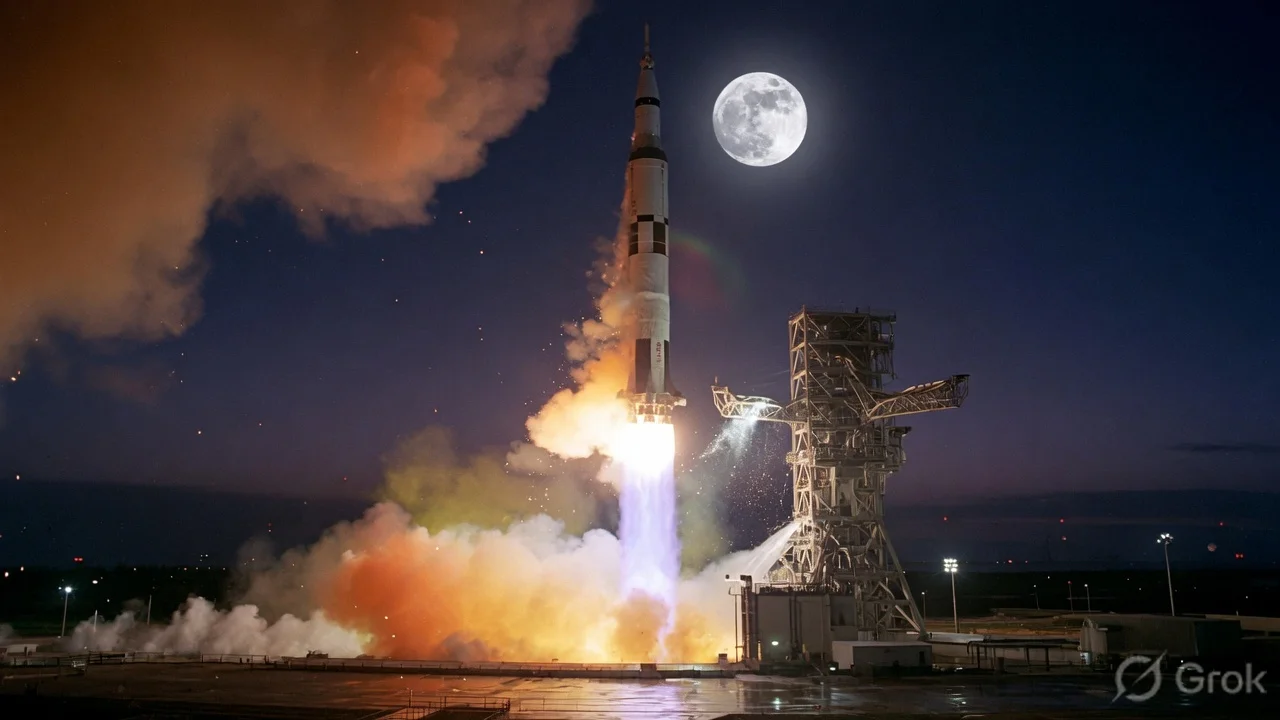
On April 1, 2026, that changed. NASA's Artemis II mission lifted off from Kennedy Space Center in Florida at 6:35 PM Eastern Time, carrying four astronauts aboard the Orion crew capsule on a 10-day journey that will take them around the Moon and back. No Moon landing this time — but the first crewed lunar voyage in more than half a century is genuinely happening right now.
The timing of an April 1st launch was not lost on anyone. NASA's social media spent the morning reassuring people that this was, in fact, a real launch and not an elaborate prank. It was real.
Who's on board?
Four astronauts are making this trip, and the crew composition itself is historic in multiple ways.
Reid Wiseman is the Commander — a veteran NASA astronaut and former chief of the astronaut office. Victor Glover is the Pilot, and he's making history as the first African American to travel beyond low Earth orbit. Christina Koch is a Mission Specialist, and she becomes the first woman to voyage to the Moon. Jeremy Hansen rounds out the crew as a Mission Specialist from the Canadian Space Agency — making him the first Canadian to travel to lunar distance.
Every single crew member on this flight is setting a record of some kind. The symbolism is deliberate — NASA has been very clear that the Artemis program is about returning to the Moon with a more representative crew than the all-male, all-white Apollo missions of the 1960s and 70s.
What will they actually do up there?
Artemis II is fundamentally a test flight. The crew will not be landing on the Moon — that's Artemis IV's job, currently planned for 2028. What Artemis II is doing is proving that the whole system works with humans aboard before NASA commits to actually putting boots on the lunar surface.
The 10-day mission profile goes like this: after launch, the Orion capsule (riding the massive Space Launch System rocket) will orbit Earth twice to check all systems. Then a trans-lunar injection burn sends the crew on a trajectory toward the Moon. They'll swing around the far side of the Moon — reaching a point approximately 8,000 kilometers beyond the lunar surface, further from Earth than any human has ever traveled — before the return journey begins, ending with a splashdown in the Pacific Ocean.
During the trip, the crew is testing something crucial: Orion's life support systems. This is the first time these systems — the ones that will keep astronauts alive in deep space — are being tested with actual humans inside the capsule rather than just sensors and dummies. If something goes wrong with life support on Artemis II, the crew needs to be able to identify and fix it. Finding out on a 10-day orbit mission is far safer than discovering a problem mid-landing on Artemis IV.
They're also testing communications at lunar distance, navigation accuracy, and the overall performance of the SLS rocket — the most powerful rocket NASA has ever built, more powerful even than the Saturn V that took Apollo astronauts to the Moon.
What happened to the Moon landing?
Here's where it gets complicated. The original Artemis roadmap had Artemis III landing on the Moon in 2027. NASA has since pushed that back — Artemis III is now a crewed test flight in lunar orbit rather than a landing, and the actual Moon landing has moved to Artemis IV in 2028.
The delay is partly technical — the SpaceX Human Landing System (the modified Starship variant that will actually take astronauts from lunar orbit to the surface) needed more time. It's also partly budget-related. NASA has been navigating uncertain funding from the current administration, and the Artemis program has faced repeated questions about whether the timeline is achievable.
But here's the thing: Artemis II launching successfully is the crucial proof point. An uncrewed Orion flew around the Moon in 2022 (Artemis I). Now a crewed Orion has launched toward the Moon. The hardware works. The question now is execution — can NASA land on the Moon by 2028 as planned? Artemis II's success makes that more plausible, not guaranteed.
Why this matters for India
India isn't just a passive observer in the new space race. ISRO's Chandrayaan-3 successfully landed on the Moon's south pole in August 2023 — a mission that made India only the fourth country to soft-land on the Moon and the first to reach the south pole. That achievement put India firmly in the premier league of space-faring nations.
The context matters because there's a parallel Moon race happening. China has its own lunar program and has announced plans to land taikonauts on the Moon before 2030. The US is accelerating Artemis partly as a response to that timeline. India and the US have a growing space cooperation agreement — ISRO and NASA have been deepening collaboration, and there's a real possibility of Indian involvement in future Artemis missions or the Lunar Gateway space station project.
For Indian students watching Artemis II today: this is what Chandrayaan-3's success opened the door to. India is now a credible partner in deep space exploration, and the generation growing up watching both ISRO and NASA missions is the generation that will actually work on the Moon base.
There's also the direct inspiration angle. ISRO's annual recruitment for scientists and engineers consistently draws massive interest — the organization gets lakhs of applications for limited positions. Every major space mission, whether ISRO's own or a NASA achievement like this, drives applications upward. Kids who watched Chandrayaan's lunar landing on their phone screens are now making career choices. Artemis II is another moment that feeds that pipeline.
The road ahead
Assuming Artemis II goes smoothly — and right now, as the Orion capsule travels away from Earth, all systems are reportedly nominal — NASA's timeline looks like this:
Artemis III in late 2026 or early 2027 will be a crewed mission to lunar orbit. No landing, but extended time in the lunar environment testing more systems. Artemis IV in 2028 is the mission where astronauts are supposed to actually land on the Moon's south pole for the first time — close to the region where water ice deposits have been detected, and potentially where a future lunar base would be built.
After that, the Lunar Gateway — a small space station in lunar orbit that NASA is building with international partners including Canada, Europe, Japan, and potentially India — is supposed to become the hub for sustained lunar operations. The vision is that by the early 2030s, humans will be making regular trips to the Moon much the way astronauts currently rotate through the International Space Station.
It's an ambitious timeline. These things always are. But Artemis II launching successfully on April 1, 2026, means the first major piece of that puzzle is in place.
TamilTech's take
Watching a rocket carrying four humans toward the Moon is genuinely moving, no matter how many times you've seen launches on YouTube. There's something about the scale of it — 250,000 miles from Earth, in a capsule the size of a large SUV, for 10 days — that puts smartphone specs and app updates in perspective. This is what humans can do when the goal is ambitious enough. For the generation of Indian students currently choosing between engineering streams, watching Artemis II is a reminder that aerospace is one of the most extraordinary fields humans have ever created. ISRO proved India belongs in this conversation. Artemis II is proof the conversation is just getting started.




Comments (0)
Be the first to comment!