


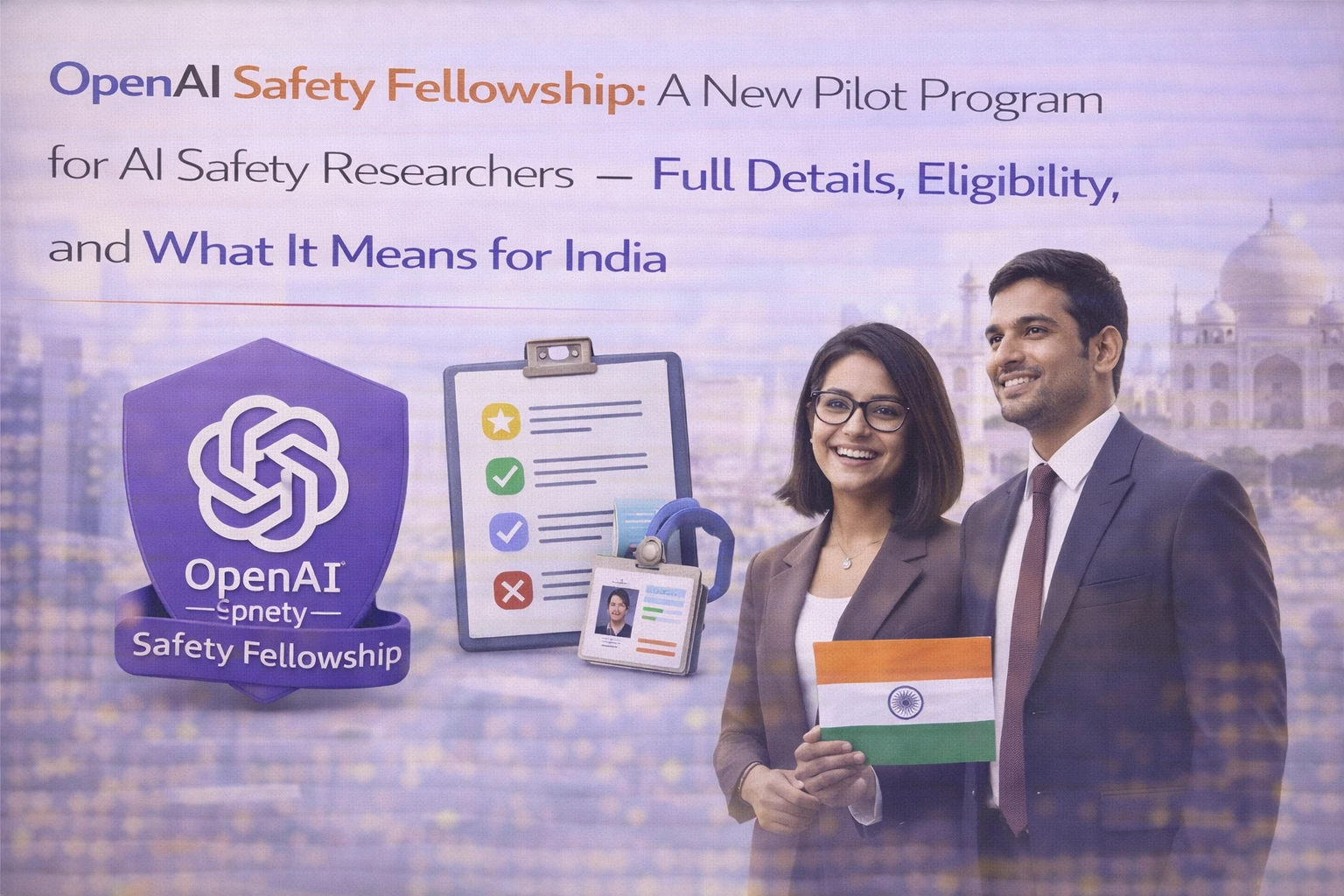
OpenAI Safety Fellowship — Building the Next Generation of AI Safety Talent
On April 6, 2026, OpenAI announced a new pilot program called the OpenAI Safety Fellowship, aimed at developing the next generation of AI safety talent. The program provides external researchers with funding, compute resources, and mentorship to conduct independent research on some of the most pressing challenges in AI safety and alignment.
The announcement comes at a particularly interesting time. The same day, a major New Yorker investigation by Ronan Farrow described how OpenAI had dissolved its superalignment and AGI-readiness teams. Multiple observers noted the strategic timing of this fellowship announcement. Regardless of the optics, the fellowship itself represents a meaningful step toward supporting external safety research.
What Does the Fellowship Offer?
| Feature | Details |
|---|---|
| Duration | September 14, 2026 – February 5, 2027 (~5 months) |
| Stipend | Monthly stipend (exact amount undisclosed) |
| Compute | API credits and resources (no internal system access) |
| Mentorship | Collaboration with OpenAI mentors + peer cohort |
| Workspace | Berkeley, California (remote option available) |
| Expected Output | Research paper, benchmark, or dataset |
| Application Deadline | May 3, 2026 |
| Notification | July 25, 2026 |
Who Can Apply?
OpenAI emphasizes research ability, technical judgment, and execution over specific academic credentials. You don't necessarily need a PhD. The fellowship welcomes applicants from diverse backgrounds:
- Computer Science — ML researchers, software engineers working on alignment
- Social Sciences — researchers studying AI's societal impact
- Cybersecurity — red-teaming and adversarial testing specialists
- Privacy — researchers working on privacy-preserving AI methods
- HCI (Human-Computer Interaction) — studying how humans interact with AI
Letters of reference are required. Applications should be submitted by May 3, 2026 through OpenAI's official portal. Contact: [email protected]
Research Areas Covered
The fellowship prioritizes proposals in these critical safety areas:
- Safety Evaluation — Testing and measuring AI system safety systematically
- Alignment — Ensuring AI systems behave as humans intend
- Scalable Oversight — Using AI to help humans supervise more capable AI systems
- Interpretability — Understanding what happens inside neural networks
- Robustness — Making AI resistant to adversarial inputs and edge cases
- Agentic Oversight — Safety of autonomous AI agents
- Ethics — Ethical frameworks for AI development
- High-Severity Misuse — Preventing catastrophic misuse of AI capabilities
- Red Teaming — Adversarial testing of AI systems
- Privacy-Preserving Methods — Protecting user data in AI systems
How It Compares to Other AI Safety Programs
| Program | Organization | Duration | Focus |
|---|---|---|---|
| Safety Fellowship | OpenAI | 5 months | Broad safety research |
| Alignment Finetuning | Anthropic | Ongoing | Constitutional AI, RLHF |
| Safety Research | DeepMind | Varies | Scalable oversight, interpretability |
| MATS | Independent | 3 months | Technical alignment research |
| AI Safety Camp | Community | 1 week intensive | Entry-level safety research |
Controversy and Context
The timing of this announcement has raised eyebrows. On the same day OpenAI published the fellowship announcement, the New Yorker published a detailed investigation alleging that OpenAI had:
- Dissolved its superalignment team led by Ilya Sutskever and Jan Leike
- Dissolved its AGI-readiness team
- Removed "safety" as a significant activity from its IRS filings
- Leadership allegedly prioritized product development over safety research
Critics view the fellowship as a PR move. Supporters argue that regardless of internal politics, funding external safety research is inherently valuable. The truth likely lies somewhere in between — the program itself has merit, but the organizational commitment to safety remains under scrutiny.
What This Means for Indian AI Researchers
The fellowship appears open to international applicants, and the remote participation option makes it particularly accessible for Indian researchers. Here's why this matters for India:
- IIT and IISc researchers working on AI safety can apply without relocating to the US
- Indian AI safety community is growing — organizations like MIRI India and various IIT research groups focus on alignment
- Compute access is a major barrier for Indian researchers. OpenAI's API credits could enable research that wouldn't be possible otherwise
- Career opportunities — a fellowship at OpenAI is a strong credential for researchers entering the AI safety field
India currently has a National AI Mission with ₹10,000 crore allocated, but safety research gets a tiny fraction. Programs like this OpenAI fellowship can complement government efforts.
Should You Apply?
If you're working on or interested in AI safety research, this is a strong opportunity. The combination of stipend, compute, mentorship, and the prestige of an OpenAI affiliation makes it competitive. The May 3, 2026 deadline gives you about a month to prepare your proposal.
Tips for a strong application:
- Focus on a specific, tractable safety problem rather than broad theoretical concerns
- Show evidence of technical execution — code, papers, or projects you've completed
- Propose a clear deliverable (paper, benchmark, dataset) achievable in 5 months
- Get strong reference letters from researchers who can speak to your technical abilities
The AI safety field is rapidly growing, and programs like this fellowship — despite the controversy — represent concrete steps toward building the talent pipeline needed to ensure AI development goes well for everyone.





Comments (0)
Be the first to comment!