


Key Takeaways
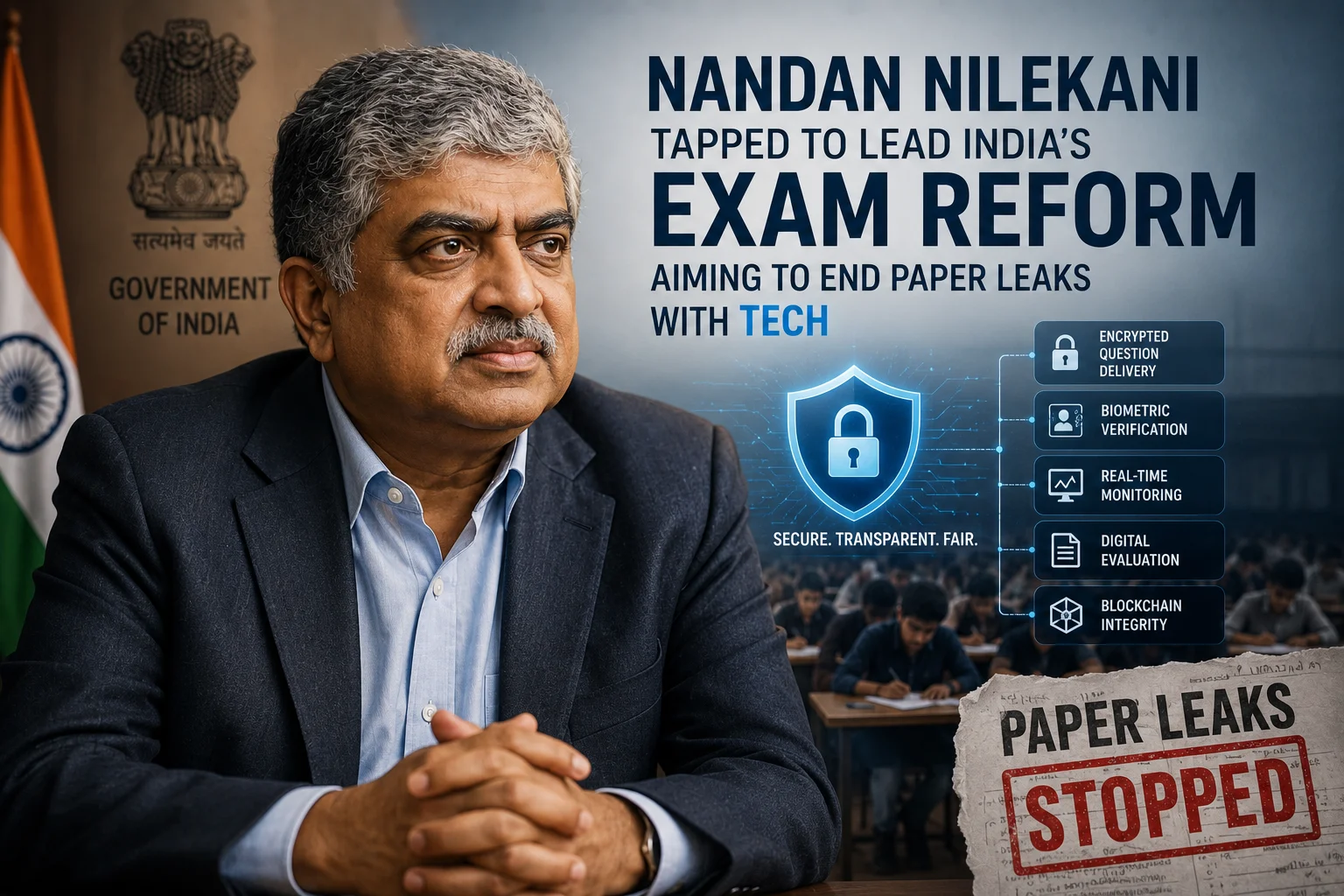
- Nandan Nilekani will lead a 12-member high-level task force to overhaul the National Testing Agency (NTA) and national exam protocols.
- The reform focuses on a 'Digital-First' approach, utilizing Blockchain for certificate verification and AI-driven proctoring to prevent cheating.
- The task force aims to implement a decentralized question paper delivery system that remains encrypted until 5 minutes before the exam starts.
- Implementation of these new tech-heavy protocols is expected to begin with the 2026-27 academic cycle for major exams like NEET and JEE.
Let’s be real—the last few years have been a nightmare for students in India. From paper leaks to server crashes, our national examination system has been under fire. But now, it looks like the government is finally bringing in the 'Big Guns' to fix the plumbing. Prime Minister Narendra Modi has officially roped in Nandan Nilekani, the man who gave us Aadhaar and revolutionized UPI, to lead a specialized task force on exam reforms. This isn't just another committee; this is a tech-heavy rescue mission to save the future of millions of students. In 2026, we are seeing a massive shift in how the government views 'security'—it’s no longer about armed guards outside centers, it’s about encrypted bits and bytes.
The Backstory: Why Nilekani and Why Now?
To understand why this is such a big deal, we have to look at the mess we've been through. Remember the 2024 and 2025 exam seasons? They were riddled with controversies that shook the trust of every aspirant. We saw the National Testing Agency (NTA) struggling to keep papers secure, leading to cancellations and re-exams that cost taxpayers billions and students their mental peace. The traditional method of printing papers, storing them in bank vaults, and transporting them in trucks is officially outdated. It’s a 20th-century solution for a 21st-century problem.
Nandan Nilekani was the obvious choice because of his track record with 'Digital Public Infrastructure' (DPI). He doesn't just build apps; he builds ecosystems. Just like he did with Aadhaar for identity and UPI for payments, the goal here is to create an 'Exam-as-a-Platform' model. The government realized that they needed someone who understands scale. We are talking about exams where 25 lakh students sit at the same time across thousands of centers. You can't fix that with a simple software patch; you need a fundamental architectural redesign of the entire testing process.
The Tech Stack: How the New System Will Actually Work
So, what is Nilekani actually bringing to the table? Based on early reports of the task force’s roadmap, we are looking at a three-layered security approach. First is 'Confidential Computing.' This means the question papers won't even exist as a full file on any single server. They will be fragmented and encrypted, only 'assembling' themselves inside a secure virtual environment on the student’s terminal minutes before the exam begins. This eliminates the 'middleman' leak—the stage where a physical copy or a PDF is intercepted during transit.
Second, the task force is pushing for AI-based behavioral analytics. Currently, proctoring is done by humans who might get distracted or be part of the scam. The new system uses AI to monitor eye movements, keyboard patterns, and even ambient noise at the center in real-time. If the AI detects a pattern of cheating, it flags the student immediately. Third, and perhaps most importantly, is the use of Blockchain for the 'Post-Exam' phase. Every marksheet and certificate will be issued as a verifiable credential on a public-private blockchain, making it impossible for anyone to forge results or use fake degrees for jobs.
The India Impact: What This Means for Students and Rural Areas
The biggest question we get at TamilTech is: "Will this work in rural India?" It’s easy to talk about AI and Blockchain in Bengaluru or Chennai, but what about a small center in rural Bihar or Tamil Nadu? Nilekani’s team is reportedly working on an 'Offline-First' digital model. This involves ruggedized, low-power servers placed at exam centers that can sync with the central cloud via a 5G or satellite link (like Starlink or Jio’s satellite tech) only for the initial handshake and final submission. This ensures that even if the internet goes down mid-exam, the student isn't affected.
In terms of pricing, while the initial infrastructure cost is high, the government expects the cost per student to drop in the long run. No more printing millions of pages of paper, no more massive logistics costs for physical transport, and fewer legal battles over leaks. For the average Indian student, this means a fairer playing field. Whether you are studying in a top coaching hub or in your village, the security of your exam paper will be identical. This is the 'democratization of integrity' that India has been waiting for.
Step-by-Step: Your Future Exam Experience
If you are appearing for an exam in late 2026 or 2027, here is how your day might look. 1. You will likely use an Aadhaar-linked biometric check at the entrance (Face ID or Iris scan). 2. You will be assigned a terminal that is part of a 'Zero Trust' network—meaning it has no access to the outside web. 3. The question paper will be decrypted using a multi-sig key (one part held by the center head, one by the NTA central office). 4. As you answer, your progress is saved locally and encrypted every 30 seconds. 5. Once you finish, your encrypted response is uploaded to a secure vault, and you get a digital 'receipt' on your phone immediately. No more waiting for weeks to know if your OMR sheet was even scanned correctly.
Pros and Cons: The Honest Truth
The pros are obvious: massive reduction in leaks, faster results, and higher transparency. However, we have to talk about the cons. The main concern is 'Digital Exclusion.' If the tech is too complex, students who aren't tech-savvy might feel intimidated. There's also the privacy aspect—AI monitoring eye movements sounds a bit like 'Big Brother' is watching. Nilekani’s task force needs to ensure that the data collected during exams is deleted immediately after the results are processed to maintain student privacy.
TamilTech’s Verdict: Is This the Solution?
Here’s what we think at TamilTech. Technology is a tool, not a magic wand. While Nandan Nilekani is probably the best person in the world to design this system, the success depends on the ground-level officials. If the people running the centers are corrupt, they will find ways to bypass tech. However, by removing the human element from the 'Paper Delivery' phase, we are cutting out 90% of the risk. This is a massive win for the Indian education system. We expect the first pilot projects to roll out by December 2026. If you're a student, don't be afraid of the tech—embrace it, because it’s the only thing standing between your hard work and a paper leaker's greed.




Comments (0)
Be the first to comment!