


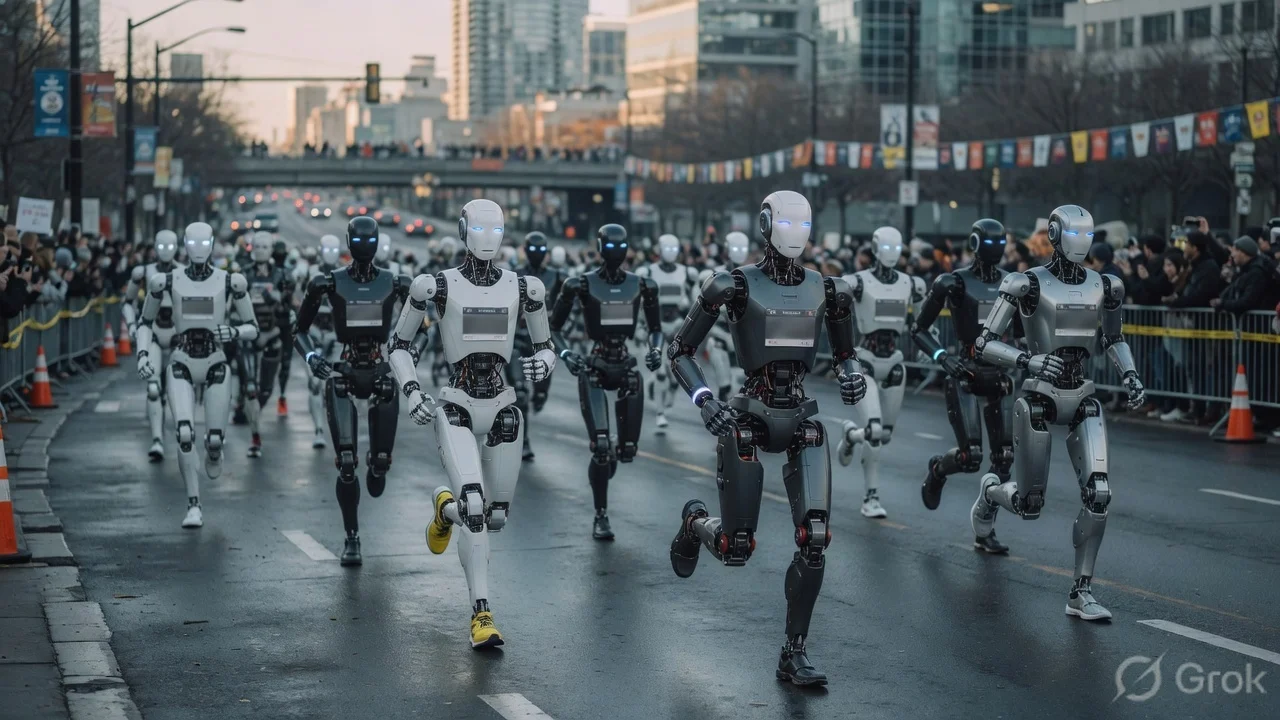
What happened in Beijing?
Last weekend the Beijing International Half‑Marathon turned into a tech showcase. Ten humanoid robots, built by a Chinese robotics firm and a separate team from Honor, lined up at the start alongside the world’s best long‑distance runners. When the gun went off, the bots didn’t just keep pace – they sprinted ahead and crossed the 21.1 km line more than ten minutes before the fastest human, Jacob Kiplimo’s 58:42 world‑record time.
How did the robots manage it?
Each robot is essentially a lightweight exoskeleton with electric actuators that mimic human muscle movement. The Honor model, nicknamed “Runner‑X”, uses a combination of AI‑driven gait optimization and real‑time terrain sensing. A suite of LiDAR and high‑speed cameras feeds data to an onboard Nvidia Jetson module, which constantly tweaks stride length, foot‑strike angle and energy recovery. The result? A steady 5.5 m/s pace with less fatigue than a human could sustain.
Numbers that speak for themselves
- Finish time: 48 minutes 12 seconds – 10 minutes 30 seconds faster than the human world record.
- Average speed: 5.5 m/s (≈19.8 km/h).
- Energy consumption: 1.8 kWh per race, equivalent to running a 1‑kW home appliance for two hours.
- Battery weight: 12 kg, 30 % of the robot’s total mass.
In contrast, the top human runner burned roughly 2,300 kcal, which translates to about 2.7 kWh of metabolic energy – a lot more waste heat.
Why should Indian readers care?
First, the tech stack behind these bots is already available in India. Nvidia’s Jetson series, LiDAR modules from LeddarTech, and high‑torque brushless motors are sold locally through Flipkart and Amazon India. Second, the same AI‑driven gait algorithms are being trialed for exoskeletons that could help spinal‑injury patients walk again – a huge market given India’s 1.5 crore people living with mobility impairments.
Impact on Indian sports and health tech
Imagine a future where regional sports academies get a fleet of training‑bots that can run alongside youngsters, offering live feedback on stride symmetry, heart‑rate zones and power output. Coaches could use the data to fine‑tune training plans, reducing injury rates that currently cost the Indian athletics federation millions each year.
TamilTech’s take – pros, cons and the road ahead
Pros:
- Performance benchmark: The robots prove that with the right AI, machines can out‑run elite humans over long distances.
- Tech transfer potential: The hardware is off‑the‑shelf; it’s the software that matters, and Indian AI startups can build on open‑source gait libraries.
- Social good: Exoskeletons derived from this tech could boost independence for disabled citizens.
Cons:
- Cost barrier: A race‑ready unit costs roughly $30,000–$40,000, far beyond the reach of most Indian schools.
- Regulatory grey area: Using autonomous robots in public events raises safety and liability questions.
- Energy dependence: Battery tech still limits endurance; a 100 km ultra‑marathon would need a quick‑swap system.
Overall, we think the Beijing spectacle is less about replacing athletes and more about showcasing a platform that can be repurposed across health, logistics and defence. The key for India will be to localise the software, subsidise pilot programmes in government hospitals and create a standards body for autonomous sport‑tech.
What’s next?
In the coming months the Chinese teams plan to enter the robot into the World Marathon Majors as a “special exhibition”. Meanwhile, a few Indian robotics labs have already signed MOUs with local universities to test the gait engine on low‑cost prototypes. Keep an eye on upcoming announcements from the Ministry of Electronics and Information Technology – they might roll out a grant for AI‑driven assistive devices.
So, the next time you see a marathon poster in Chennai or Mumbai, ask yourself: will the future winner wear spikes or a battery pack? The race is just beginning.






Comments (0)
Be the first to comment!