


Key Takeaways
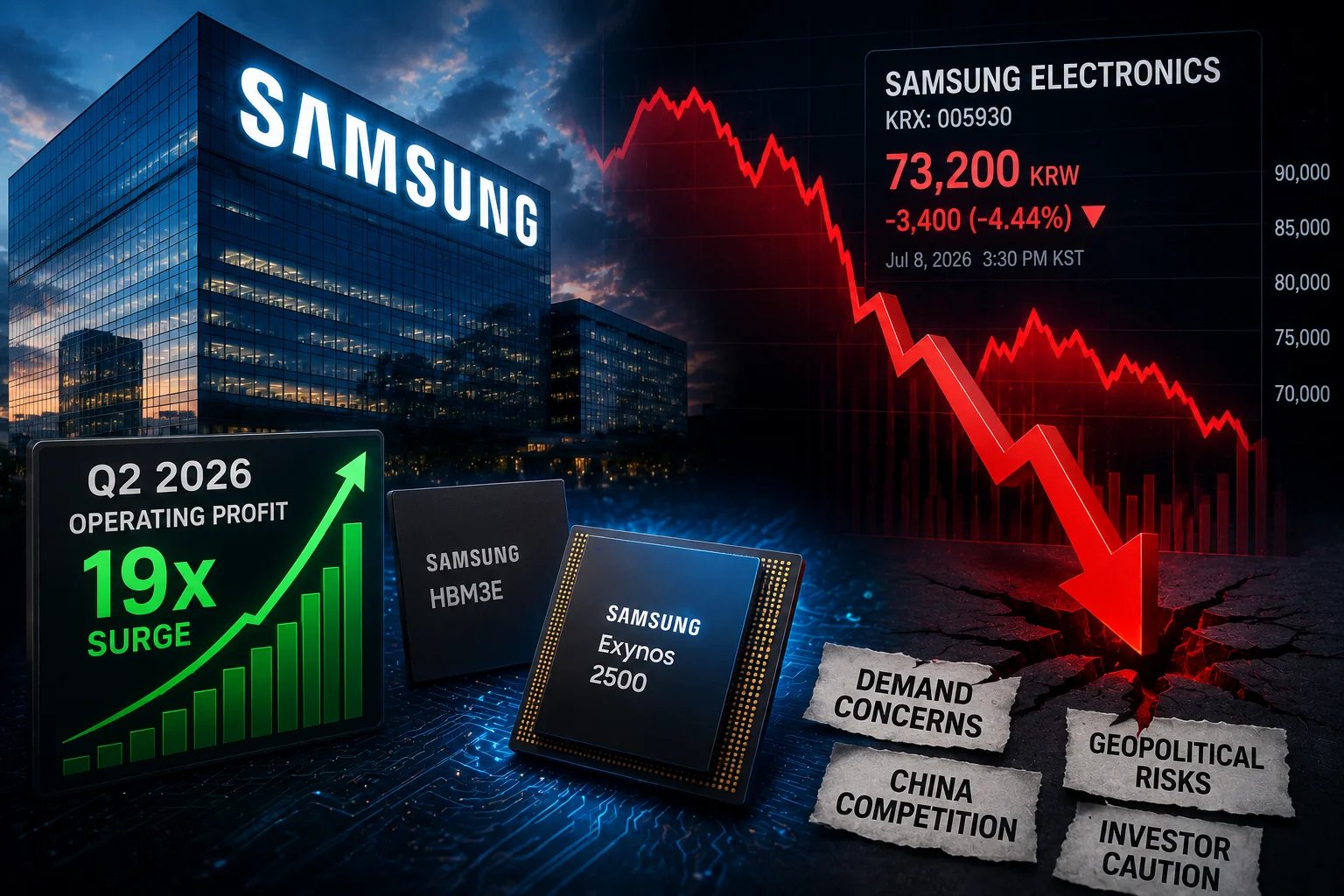
- Samsung estimates a massive Q2 2026 operating profit of $58.44 billion, which is a 19-fold increase compared to the same period in 2025.
- Total revenue for the quarter is expected to hit $111.7 billion, marking a staggering 129% year-on-year growth driven by the AI chip boom.
- Despite these record-breaking numbers, Samsung’s stock dropped by over 5% as investors worry about peak performance and competition.
- For Indian consumers, this surge signals that memory-related products like SSDs and RAM might see price fluctuations in the coming months.
The Samsung Rollercoaster: Success That Scares Investors
Samsung is currently having a moment that most companies can only dream of. Imagine waking up to find your profits have grown 19 times larger than they were last year. That is exactly what Samsung just announced in its Q2 2026 earnings estimate. We are talking about an operating profit of roughly $58.44 billion. To put that into perspective, that is more than the entire market valuation of some major global tech firms. The revenue side is just as wild, hitting $111.7 billion, which is a 129% jump compared to last year. You would think the stock market would be celebrating with fireworks, right? Well, the reality is quite the opposite. Samsung’s stock actually took a 5% hit immediately after the news.
So, why is the market reacting like this? It is the classic case of 'sell the news.' Investors have been riding the AI hype for months, and now that the numbers are out, there is a fear that Samsung might have reached its peak for this cycle. There are also whispers about whether they can maintain this lead as competitors like SK Hynix and Micron catch up in the high-end memory space. At TamilTech, we have been watching this closely, and it is clear that while the numbers look like a victory lap, the pressure to keep this momentum going is immense. Let us break down exactly how Samsung pulled off these monster numbers and what it means for you.
How We Got Here: From the 2025 Slump to the 2026 AI Peak
To understand why a 19-fold jump is possible, we have to look back at where Samsung was in early 2025. The tech industry was coming out of a massive post-pandemic slump. There was an oversupply of memory chips, prices were crashing, and Samsung’s semiconductor division was actually losing money in some quarters. It was a dark time for the South Korean giant. However, the explosion of Generative AI changed everything. Suddenly, every data center from Silicon Valley to Bengaluru needed high-performance chips to run LLMs (Large Language Models) like ChatGPT and its successors.
Samsung pivoted hard. They didn't just focus on making chips for phones; they poured resources into HBM (High Bandwidth Memory). This is the specialized RAM that sits right next to AI processors to feed them data at lightning speeds. As we moved into 2026, the demand for these chips didn't just grow; it skyrocketed. This supply-demand mismatch allowed Samsung to charge premium prices, turning their struggling chip business into a literal gold mine. This is not just a recovery; it is a complete transformation of their business model from a consumer-first company to an infrastructure-first powerhouse.
Breaking Down the $111.7 Billion Revenue: Where is the Money Coming From?
The $111.7 billion revenue figure is not just coming from one place. While the semiconductor division (DS Division) is the star of the show, Samsung’s mobile business has remained surprisingly resilient. The Galaxy S26 series, which launched earlier this year, has seen strong adoption in markets like India and the US, thanks to deeply integrated AI features that actually feel useful rather than gimmicky. People are finally seeing a reason to upgrade their three-year-old phones because the new ones can handle on-device AI tasks like real-time video translation and advanced photo editing without breaking a sweat.
Then there is the display business. Samsung remains the king of OLED. With almost every major smartphone manufacturer—including their biggest rival in Cupertino—relying on Samsung Display, they get a cut of every high-end phone sold globally. But the real 'hero' of Q2 2026 is the DRAM and NAND flash market. Prices for memory have surged by nearly 50% year-on-year because of the AI server demand. When you control a huge chunk of the world's memory supply and prices go up, your profit margins go from thin to massive overnight. That is how you get a 19-fold jump in profit.
The India Impact: Will Your Next Phone Cost More?
Whenever Samsung makes this much money from chips, it usually means one thing for us in India: prices are going up. If memory chip prices are high enough to give Samsung a 19-fold profit, it means the cost of making a smartphone, a laptop, or even a smart TV has increased. We expect to see a ripple effect in the Indian market by the festive season sales later this year. Brands that operate on thin margins might have to hike prices by ₹1,000 to ₹3,000 for mid-range devices to compensate for the higher cost of RAM and storage.
On the flip side, Samsung’s massive profits mean they have more 'war chest' money to spend on manufacturing in India. We are already seeing their Noida plant becoming a global hub. This could lead to better localized offers and more 'Make in India' specific models that are priced aggressively to take on Chinese competitors. If you are planning to buy a high-end SSD for your gaming PC or looking to upgrade your phone's RAM, our advice at TamilTech is to do it sooner rather than later. The current trend suggests that component prices won't be coming down anytime soon as long as the AI hunger persists.
Understanding High Bandwidth Memory (HBM): The Secret Sauce
If you keep hearing the term 'HBM' and wondering what the big deal is, let us explain it simply. Traditional RAM is like a two-lane road connecting your processor to your data. It works fine for basic tasks. But AI is like a massive city that needs a 20-lane highway to function. HBM (High Bandwidth Memory) is that 20-lane highway. It stacks memory chips vertically, which saves space and allows data to move much faster while using less power.
Samsung was slightly behind in the HBM3e race initially, but by Q2 2026, they have ramped up production significantly. They are now supplying these chips to major AI chipmakers. This is the 'secret sauce' behind that $58.44 billion profit. Every time a big tech company builds a new AI server farm, Samsung gets a massive check. For the average user, this technology will eventually trickle down to our laptops and phones, making them incredibly fast, but for now, it is the engine driving these record-breaking corporate earnings.
Samsung vs. The World: Pros and Cons of This Growth
While the numbers are great, it is not all sunshine and roses. Let's look at the pros and cons of Samsung's current position. On the pro side, they have unmatched vertical integration. They make the screen, the battery, the memory, and the processor. This allows them to optimize their devices better than almost anyone else. They also have the cash flow to outspend anyone on R&D. If a new technology emerges, Samsung can simply buy their way into the lead or build it from scratch.
The cons? Over-reliance on the chip cycle. Samsung has seen this before—when the memory market is hot, they make billions. When it cools down, their profits vanish. This volatility is exactly why the stock dropped 5%. Investors are worried that the AI bubble might show signs of fatigue. There is also the 'China factor.' Chinese chipmakers are being funded heavily by their government to reduce reliance on Samsung. If they succeed in making even decent-quality memory chips at half the price, Samsung's margins will get squeezed. It is a high-stakes game where one wrong move in chip yield or tech transition can cost billions.
TamilTech’s Honest Take: What Should You Do?
At TamilTech, we believe this is a classic 'good news, bad vibes' situation. Samsung is fundamentally stronger than it was two years ago. They have successfully navigated the transition into the AI era. However, the stock drop tells us that the market is looking for the next big thing. If you are a consumer, don't worry about the stock price—focus on the tech. The innovations Samsung is funding with these profits will lead to some incredible gadgets in 2027 and beyond.
If you are an investor or someone tracking the tech economy, keep an eye on the HBM4 development. That will be the next battleground. For everyone else, just be prepared for slightly higher prices on gadgets that use a lot of memory. Samsung is currently the king of the hill, but as we always say, in the tech world, the hill is made of sand and it is always shifting. What do you think? Is Samsung's profit jump sustainable, or is this just a temporary AI boom? Let us know your thoughts!



Comments (0)
Be the first to comment!