


What just happened?
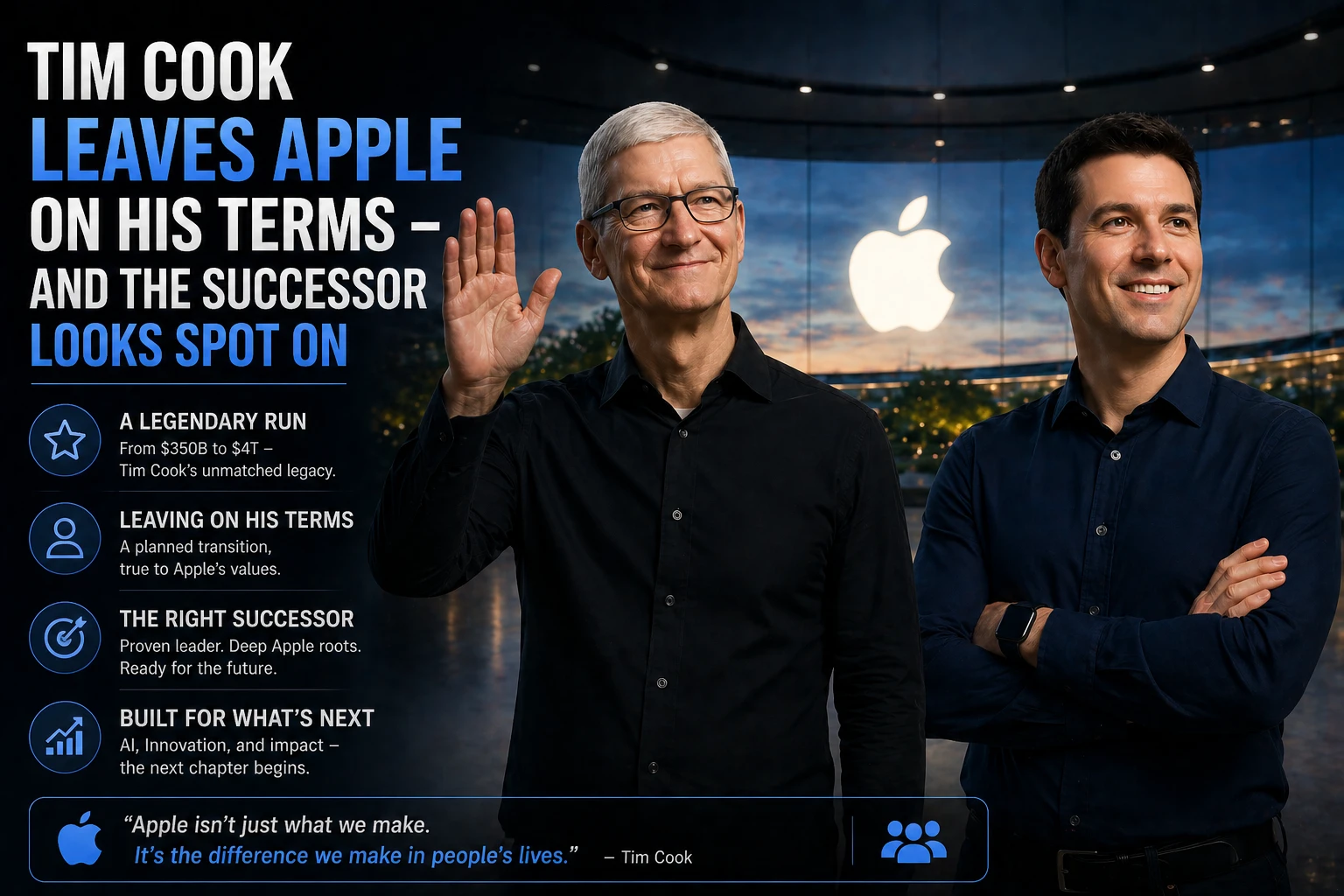
Tim Cook, who turned Apple into the world’s most valuable company, announced he’s stepping down as CEO. He’s not being forced out – he’s leaving on his own terms, after a decade of record‑breaking revenue and a massive push into services, chips and sustainability. The board has already named John Ternus, the current SVP of Hardware Engineering, as the next chief executive.
Why this matters
Cook’s era was all about scaling. He kept the iPhone line fresh, built the Apple Watch, rolled out Apple TV+, launched Apple Pay and turned the Mac into a powerhouse with the M‑series silicon. Now the baton is passing to a guy who grew up designing those very chips and devices. That continuity could mean a smoother transition than the often‑chaotic founder‑to‑successor hand‑offs we’ve seen elsewhere.
The numbers behind the exit
When Cook took over in 2011, Apple’s market cap was roughly $350 billion. By 2024 it’s hovering around $2.9 trillion – a nearly nine‑fold jump. Revenue grew from $108 billion to $383 billion, and services crossed the $80 billion mark, now a 30 % share of total sales. Those are the stats that let Cook walk out with a golden parachute and the board’s full confidence.
Who is John Ternus?
John is the guy behind the iPhone 15, the M2 MacBook Pro and the latest Apple Watch. He joined Apple in 2001, climbed the hardware ladder, and became SVP of Hardware Engineering in 2021. His résumé reads like a hardware‑first playbook: better battery life, tighter integration of silicon and software, and a push for sustainability (the new 100 % recycled aluminum frames).
India angle – what does this mean for us?
Apple’s Indian market is now the company’s third‑largest after the US and China. iPhone sales grew 40 % YoY in FY 2024, driven by the 14‑Pro and the new iPhone 15 series. With John at the helm, we can expect a few things:
- More localized hardware. Expect Apple to double‑down on dual‑SIM, better 5G bands for Indian carriers, and maybe a “Made‑in‑India” iPhone variant, similar to the iPhone 12 Mini’s recent assembly shift.
- Pricing strategy. Cook kept Indian iPhone prices high, but John might push for a wider “budget‑friendly” line – perhaps a $599 iPhone SE 3.0 with M2‑lite silicon.
- Services push. Apple Music, Apple TV+ and iCloud will get deeper integration with local OTT platforms and UPI‑based payments, making subscriptions easier for the average Indian user.
TamilTech‑ஓட கருத்து
Honestly, this feels like a win‑win. Cook proved you can run a hardware‑centric company like a services platform, and John’s engineering pedigree means the next iPhone won’t just be a “new camera” – it’ll be a true silicon‑software harmony. For Indian users, that could translate to longer‑lasting batteries, faster AI on‑device processing (think better Siri in Tamil), and maybe a cheaper entry‑level iPhone that finally competes with OnePlus and Xiaomi on price.
What could go wrong?
John’s a hardware guy, not a services guru. If Apple’s services revenue stalls, the board might pressure him to hire a “services chief” – a move that could create internal friction. Also, the supply‑chain crunch in Taiwan and the rising cost of chips could bite the margins, especially if Apple tries to slash prices for the Indian market.
What’s next for Apple?
In the next 12‑months we’ll see:
- Launch of the “M3” chip family, likely built on a 3‑nm process, promising 25 % performance uplift.
- First Apple AR/VR headset – rumored to debut at WWDC 2025, with India getting a beta rollout via Jio‑partnered trials.
- Expansion of Apple Pay to support UPI Direct, making contactless payments at every Indian shop a reality.
If John can keep the hardware pipeline humming while the services team keeps the cash flowing, Apple could stay the world’s most valuable brand for another decade.
Bottom line
Tim Cook’s exit is less of a shock and more of a well‑orchestrated hand‑off. By picking John Ternus, Apple is betting on continuity, engineering excellence and a fresh take on price‑sensitive markets like India. For us TamilTech readers, that means more powerful iPhones that finally make sense for the ₹30 k‑₹40 k bracket, better integration with UPI, and a chance to see Apple’s AI truly speak Tamil. Keep an eye on the next WWDC – the real story will unfold there.




Comments (0)
Be the first to comment!