


Key Takeaways
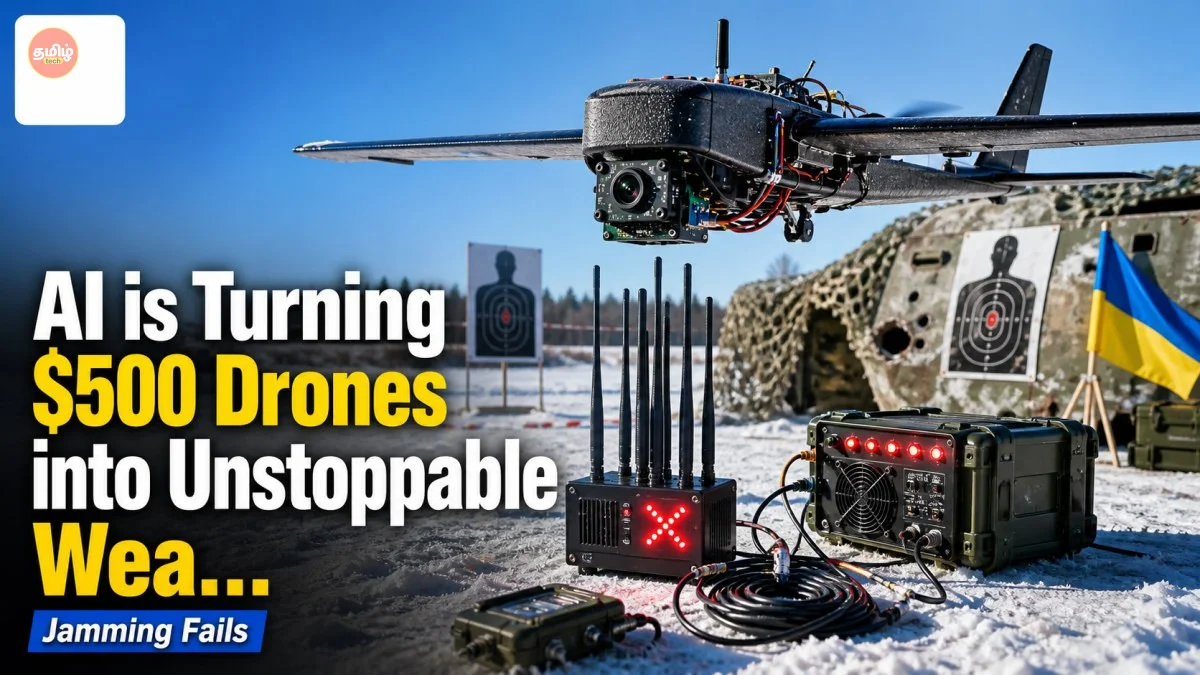
- Low-cost FPV drones are being upgraded with AI software that allows them to 'lock on' to targets and strike even after losing pilot connection.
- Traditional Electronic Warfare (EW) jammers, which cost millions, are becoming ineffective against these $500 drones.
- The technology uses Computer Vision to identify shapes like tanks or soldiers in real-time on the drone's local processor.
- Indian defense startups are already testing similar 'Edge AI' solutions for border surveillance and tactical operations in 2026.
- Bottom line: We are entering an era of 'Software-Defined Warfare' where the smartest algorithm wins, not just the biggest missile.
The Game Has Changed: AI Takes the Pilot's Seat
Imagine a small, buzzing drone, the kind you might see at a wedding or a tech vlog, but carrying a lethal payload. Until recently, these FPV (First Person View) drones were entirely dependent on a human pilot sitting miles away with a VR headset. If the enemy used a signal jammer—a device that floods the airwaves with noise—the drone would simply lose its connection and fall out of the sky or miss its target. But as of August 2026, that era is officially over. A US company has successfully integrated high-end AI into these budget drones, giving them a 'brain' of their own.
This isn't just a minor upgrade; it is a fundamental shift in how modern conflicts are fought. We’re talking about drones that cost less than a high-end smartphone taking out multi-million dollar tanks. The secret sauce isn't in the motors or the plastic frame; it’s in the code. By using advanced computer vision, these drones can now 'see' and 'understand' their environment. Once a pilot points the drone toward a target, the AI takes over. Even if the radio link is completely cut off by the most advanced jamming equipment, the drone continues its path, tracking the target with terrifying precision until impact.
How Does This 'Terminal Guidance' AI Actually Work?
To understand this, you have to look at what's happening inside the drone's flight controller. Usually, these drones use a basic chip to manage balance and motor speed. However, the new system uses 'Edge AI'—basically a small but powerful processor capable of running neural networks locally. It doesn't need to talk to a cloud server or a remote computer. It’s all happening right there on the drone. The software is trained on thousands of hours of footage of tanks, trucks, and armored vehicles. When the camera feed sees a shape that matches its 'target profile,' the AI draws a digital box around it.
Once the pilot 'locks' the target, the AI calculates the trajectory in real-time. If the target moves, the AI adjusts the drone's fins and motor speeds to follow. This is called 'Terminal Guidance.' The most impressive part? The frame rate. These systems are now processing images at 60 frames per second, making them faster and more reactive than any human pilot could ever be. In 2026, we are seeing this tech being deployed at scale, moving away from experimental prototypes to standard-issue equipment for frontline units. It’s essentially a 'fire and forget' system for the masses.
The End of the Jammer Era?
For the past few years, the biggest defense against drones was Electronic Warfare (EW). Governments spent billions on massive jamming towers and portable 'drone guns' that disrupt the 2.4GHz or 5.8GHz signals used by operators. It was a cat-and-mouse game: pilots would change frequencies, and jammers would block those too. But AI renders this entire multi-billion dollar industry almost obsolete. Since the AI drone doesn't need a constant signal to hit its mark, jamming the radio waves is like trying to stop a bullet by shouting at it. It just doesn't matter.
This has sent shockwaves through the global defense industry. If a $500 drone can bypass a $2 million jamming system, the return on investment for traditional heavy armor is plummeting. We are seeing a massive shift in military budgets away from 'big steel' like tanks and toward 'smart silicon.' In our view at TamilTech, this is the 'iPhone moment' for military hardware—everything is becoming software-driven, and the hardware is just a disposable carrier for the algorithm.
What This Means for India and Local Startups
Now, let's bring this home to India. Our borders, especially in high-altitude regions like Ladakh, are perfect testing grounds for this kind of tech. The Indian Army has been very vocal about its 'Drone Core' and is actively looking for local solutions through the iDEX (Innovations for Defence Excellence) program. In 2026, we are seeing Indian startups like NewSpace Research and Garuda Aerospace working on similar autonomous 'swarm' technologies. The goal is to create drones that can operate in 'GPS-denied' environments, which is exactly what this US-based AI provides.
For Indian techies and engineers, this is a massive opportunity. The barrier to entry isn't building the drone itself—you can buy those parts anywhere. The real value is in the Computer Vision models and the optimization of AI to run on low-power chips. We expect to see a surge in 'Defence-Tech' as a career path in India, with more software engineers moving from Bengaluru's IT hubs to defense labs. The government's push for 'Atmanirbhar Bharat' in defense means there is plenty of funding for anyone who can build a reliable target-tracking AI that works on cheap hardware.
TamilTech’s Take: The Scary Reality
While the technology is fascinating from an engineering perspective, we have to talk about the 'Terminator' in the room. Giving machines the autonomy to track and strike targets on their own raises massive ethical questions. What happens if the AI misidentifies a civilian vehicle as a military truck? When the link is broken, there is no 'human in the loop' to abort the mission. This is a slippery slope toward fully autonomous lethal weapons that the UN has been debating for years.
In our opinion, while this tech is inevitable for national security, it needs strict guardrails. For now, the focus is on 'cheap and effective,' but as these algorithms become more common, we might see them being used by non-state actors or in criminal activities. The same AI that tracks a tank could, in theory, be programmed to track anything else. As we always say at TamilTech, technology is a tool—it’s the intent behind the user that determines if it’s a boon or a bane. Expect to see more 'Anti-AI' tech emerging soon to counter these smart drones, perhaps using high-energy lasers or kinetic interceptors. The race is just beginning!





Comments (0)
Be the first to comment!