


Key Takeaways
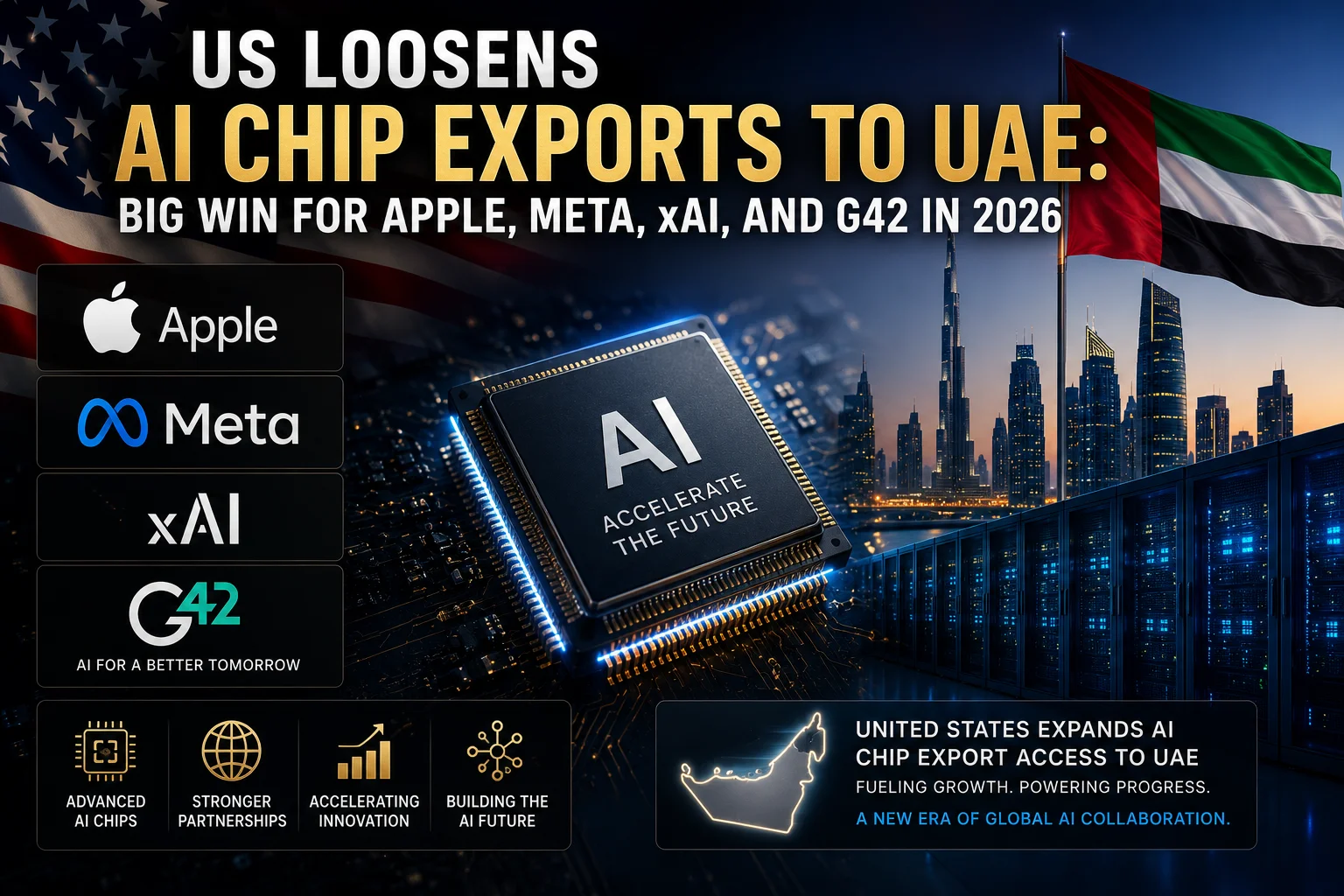
- The US Department of Commerce has granted 'Validated End-User' (VEU) status to key entities in the UAE, effectively removing the need for individual export licenses for advanced AI chips.
- Major tech players including Apple, Meta, xAI, and Microsoft-backed G42 can now export NVIDIA H200 and Blackwell B200 chips to the region more freely.
- This move is a strategic shift to pull the UAE closer to the US orbit and away from Chinese AI infrastructure and investment.
- For India, this could mean faster AI service rollouts and a potential reduction in the cost of regional cloud computing as the Middle East becomes a massive AI hub.
The Big Shift in Global AI Power
So, here is the thing — the global AI race just took a massive turn today, July 11, 2026. For the past couple of years, the US was playing it very safe, almost paranoid, about where their high-end NVIDIA and AMD chips were going. They were terrified that these powerful GPUs would end up in the hands of China through middle-men in the Middle East. But today, everything changed. The US Department of Commerce has officially loosened the strings for the UAE. Now, companies like Apple, Meta, and Elon Musk’s xAI can ship their AI hardware and chips to the UAE without jumping through the hoops of individual licenses for every single shipment.
This isn't just about business; it is about who controls the future of intelligence. By letting the UAE access the latest Blackwell B200 and H200 chips, the US is essentially saying, "We trust you." But let's be real — this trust comes with massive strings attached. The UAE has had to distance itself significantly from Chinese tech giants like Huawei to get this deal. For us in the tech world, this means the UAE is about to become an absolute powerhouse for data centers, and we are going to see some wild AI models coming out of that region very soon.
How We Got Here: From Ban to Open Doors
If you remember back in 2024 and 2025, the US was tightening the noose. They added several Middle Eastern countries to a restricted list, meaning if NVIDIA wanted to sell a high-end chip to a company in Dubai or Abu Dhabi, they had to wait months for government approval. The fear was simple: China. The US didn't want the UAE to become a "laundry mat" where chips go in and then secretly get shipped to Beijing. However, the UAE, led by the massive AI firm G42, started making some big moves. They partnered with Microsoft, they promised to rip out Chinese hardware from their systems, and they agreed to strict US monitoring.
Now in 2026, those promises have paid off. The Department of Commerce has introduced a new framework where certain UAE companies and data centers are classified as 'Validated End-Users.' It’s like a VIP pass for tech. Once you are on this list, you don't need to ask for permission every time you want to buy a thousand GPUs. This is a massive win for G42, which is trying to build the world's largest AI supercomputer, and for US companies that want to use UAE's cheap energy and massive capital to train their models.
The Players: Apple, Meta, xAI, and the G42 Connection
Why does this matter for companies like Apple or Meta? Well, Meta is constantly training its Llama models (we are probably looking at Llama 5 or 6 by now in 2026). Training these requires tens of thousands of chips and a lot of electricity. The UAE has both the money to buy the chips and the energy infrastructure to run the data centers. By loosening these controls, Meta can now build out massive clusters in the UAE to power its global AI features. Similarly, xAI, Elon Musk’s venture, is always hungry for more compute power for Grok. This move allows them to diversify their data center locations outside of the US.
Apple is the interesting one here. We’ve seen Apple Intelligence evolve from a basic helper to a core part of the ecosystem. To keep everything fast and private, Apple needs localized data centers. With these new rules, Apple can set up high-end server farms in the UAE to serve the entire Middle East and even parts of South Asia with lower latency. The UAE’s G42 is the middleman in a lot of this, acting as the local host and partner for these US giants. They are essentially becoming the world's AI landlord.
What This Means for India and the Region
Now, let's talk about the India angle because that’s what we care about most at TamilTech. India and the UAE have a very close strategic partnership. Many of the AI services we use in India are actually hosted in regional hubs. When the UAE gets access to better chips, the cost of compute in our region goes down. This could lead to cheaper AI subscriptions for Indian startups and faster response times for AI tools. We might even see Indian companies partnering with UAE-based data centers to train models that are specific to Indian languages, using the hardware that is now flowing freely into Dubai.
Moreover, this sets a precedent. If the UAE can get these controls loosened by complying with US standards, India might be next. We are already seeing massive investments in semi-conductors in Gujarat and Tamil Nadu. If India can secure a similar 'Validated End-User' status or a special trade status for AI chips, it would be a game-changer for our local tech ecosystem. We wouldn't have to wait for the 'watered-down' versions of chips; we could get the full-power NVIDIA gear right here.
The Technical Side: VEU and Security Protocols
You might be wondering, "How does the US ensure these chips don't actually go to China?" The answer is in the VEU (Validated End-User) program. This isn't just a pinky promise. The UAE has agreed to what we call 'Remote Verification' and 'On-site Inspections.' US officials can literally walk into a data center in Abu Dhabi and count the chips to make sure they are all there. They also use software-level locks. NVIDIA can geo-fence these chips so that if they are moved outside of a specific data center, they basically become expensive bricks.
There is also a lot of talk about 'Air-gapping' certain systems. This means the most sensitive AI training happens on networks that are not even connected to the public internet, reducing the risk of state-sponsored hacking from adversaries. The UAE has invested billions into cybersecurity firms to ensure that they are the safest place in the world to host data. In 2026, security isn't just about firewalls; it's about physical and geopolitical trust.
TamilTech’s Take: Is this a Good Move?
We think this is a double-edged sword, but mostly positive for the tech industry. On one hand, it ends the 'chip famine' for one of the most well-funded regions in the world. On the other hand, it creates a massive dependency on US-made hardware. If the US decides to change its mind in 2027, the UAE's entire AI infrastructure could be at risk. But for now, the winners are clear: NVIDIA's stock will likely climb, and we will get more powerful AI tools faster.
What we are looking forward to is how this affects the 'AI for everyone' mission. If compute becomes cheaper because of these massive UAE hubs, then AI tools should become more affordable for the common man. We don't want AI to be something only big corporations can afford. This move by the US Department of Commerce is a step toward making massive compute power a global commodity, rather than a hoarded resource. Keep an eye on G42 — they are the ones to watch this year.






Comments (0)
Be the first to comment!