


Key Takeaways
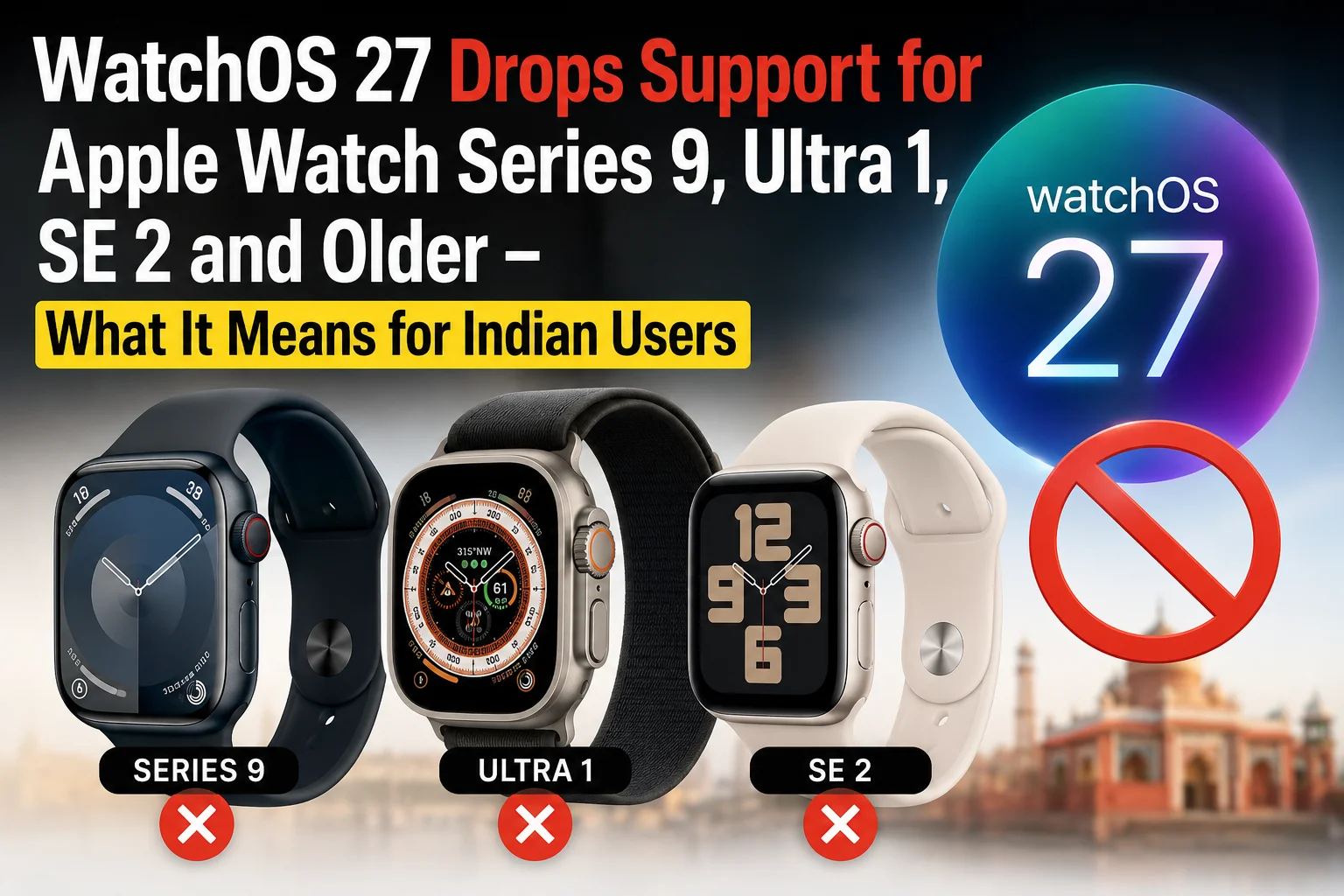
- WatchOS 27 will be the last OS for Apple Watch Series 9, Ultra 1, SE 2 and any watch older than 2023.
- Users of these models will stop receiving new features after September 2026, though security patches will continue for six months.
- In India, the affected watches still fetch ₹30,000‑₹45,000 on the resale market, making an upgrade to WatchOS 28‑compatible models a cost‑consideration.
- Upgrade paths include buying Apple Watch Ultra 2 (₹69,900) or the 2024 Series 10 (₹59,900) – both fully compatible with WatchOS 28 and future releases.
Opening Hook – Why You Should Care
Imagine waking up, checking your wrist for the latest health stats, and the watch tells you it can’t install the newest OS. That’s exactly what’s happening to owners of Apple Watch Series 9, Ultra 1 and SE 2. Apple’s WatchOS 27, released this week, is the final stop for these devices. If you’re one of the millions in India sporting an older watch, it’s time to understand what you lose, what you keep, and whether it’s worth upgrading now.
Background – How We Got Here
Apple has a habit of supporting its wearables for about three‑to‑four years with major OS releases. The original Series 4 launched in 2018 and received WatchOS 10 in 2023 – a five‑year span. Fast‑forward to 2026: Series 9, Ultra 1 and SE 2 were introduced in 2023, so they’re hitting the three‑year mark. Historically, Apple stops adding feature‑rich updates once a device is three generations old, but it still pushes critical security patches for a few months. This pattern mirrors iPhone support cycles and is meant to keep the ecosystem secure without over‑burdening older hardware.
Why now? WatchOS 27 is a major overhaul – it brings a redesigned Control Center, deeper health AI, and a brand‑new watch face editor. Those features demand more RAM and a newer S‑chip architecture. The S9 chip inside Series 9 and Ultra 1 simply can’t keep up with the real‑time AI calculations Apple wants to run. Hence the cut‑off.
Full Details – What WatchOS 27 Brings and What Gets Left Behind
WatchOS 27’s headline features include:
- AI‑driven Health Insights that predict sleep quality based on heart‑rate variability.
- New “Focus” watch faces that change colors based on calendar events.
- Enhanced Siri with on‑device language models for faster response.
- Battery‑saving “Eco Mode” that throttles background tasks.
All of these run best on the S10 chip found in the 2024 Series 10 and Ultra 2. For Series 9, Ultra 1 and SE 2, Apple will still push WatchOS 27.0.x for a few weeks, but the 27.1 and later incremental builds (which contain the AI health models) will be blocked.
Security-wise, Apple promises a six‑month window of critical patches after the feature freeze. After September 2026, even those patches stop. That means any newly discovered vulnerability will remain unpatched on the older watches – a real risk if you use Apple Pay, health data, or third‑party apps that rely on network communication.
India Impact – Prices, Availability and Who’s Affected
India’s Apple Watch market is still niche but growing fast, especially in metros. According to local resale data, a used Series 9 in good condition sells for about ₹32,000, while an Ultra 1 goes for ₹45,000. The SE 2, being the budget model, fetches around ₹18,000. Those numbers are still decent, but they’re dropping as newer models enter the market.
For a first‑time buyer, the price gap between a used Series 9 and a brand‑new Ultra 2 (₹69,900) is narrowing. Moreover, Apple’s Indian store now offers financing for the 2024 Series 10 at ₹4,999 per month for 12 months, making the upgrade financially viable for many.
Another Indian‑specific angle: many users rely on the watch for UPI payments via Apple Pay. Losing security updates could expose their payment credentials. While Apple Pay in India still requires a linked debit/credit card, the risk of a man‑in‑the‑middle attack rises without the latest OS patches.
Real‑World Use Cases – Step‑by‑Step How to Check Your Compatibility
If you’re unsure whether your watch will get the full WatchOS 27 experience, follow these steps:
- Open the Watch app on your iPhone.
- Tap General > Software Update.
- If you see “WatchOS 27.0.x available”, tap Download and Install.
- After installation, go back to General > About and look for the version number. If it reads 27.1 or higher, your watch is compatible. If it stays at 27.0, you’re on the cut‑off version.
For those stuck on 27.0, you can still enable essential security patches by turning on Automatic Updates in Settings – Apple will push any remaining fixes until September 2026.
Comparison – Should You Upgrade Now?
Here’s a quick side‑by‑side of the three affected models versus the newest options:
| Model | Launch Year | Chip | WatchOS 27 Full Support | Current Indian Price (New/Resale) |
|---|---|---|---|---|
| Series 9 | 2023 | S9 | No (stops at 27.0) | ₹30,000 – ₹32,000 (used) |
| Ultra 1 | 2023 | S9 | No (stops at 27.0) | ₹45,000 – ₹48,000 (used) |
| SE 2 | 2023 | S9 (lite) | No (stops at 27.0) | ₹16,000 – ₹18,000 (used) |
| Series 10 | 2024 | S10 | Yes (full) | ₹59,900 (new) |
| Ultra 2 | 2024 | S10 | Yes (full) | ₹69,900 (new) |
Pros of upgrading:
- Access to AI health insights and new watch faces.
- Longer security support – up to 2028 for WatchOS 28 and beyond.
- Better battery life thanks to Eco Mode.
Cons:
- Higher upfront cost – even used Ultra 1 is pricey.
- Transition to a new band size may require accessories.
If you mainly use the watch for notifications, basic fitness, and Apple Pay, staying on 27.0 might be acceptable for a few more months. But if you want the latest health AI or plan to rely on Apple Pay for daily transactions, upgrading is the safer bet.
TamilTech’s Honest Take – What to Expect Next
Our verdict: Apple’s decision is logical from a hardware standpoint, but it puts a chunk of Indian users in a tough spot. The resale market will absorb the older models, but the real value lies in the newer Ultra 2 and Series 10 – especially for health‑conscious users who want AI‑driven insights.
Looking ahead, Apple is expected to launch WatchOS 28 in early 2027, which will likely require the S10 chip or newer. That means if you’re buying a watch in 2026, aim for a model with at least 64 GB storage and the S10 chip, otherwise you’ll be left behind again in a year.
Bottom line for Indian consumers: if you’re already paying for an Apple Watch SE 2 or Series 9, consider selling it on platforms like Olx or Quickr before September 2026, and put that money toward an Ultra 2 or Series 10. The upgrade cost is offset by the longer software lifespan and the peace of mind that your health data stays secure.





Comments (0)
Be the first to comment!