


முக்கிய விஷயங்கள்
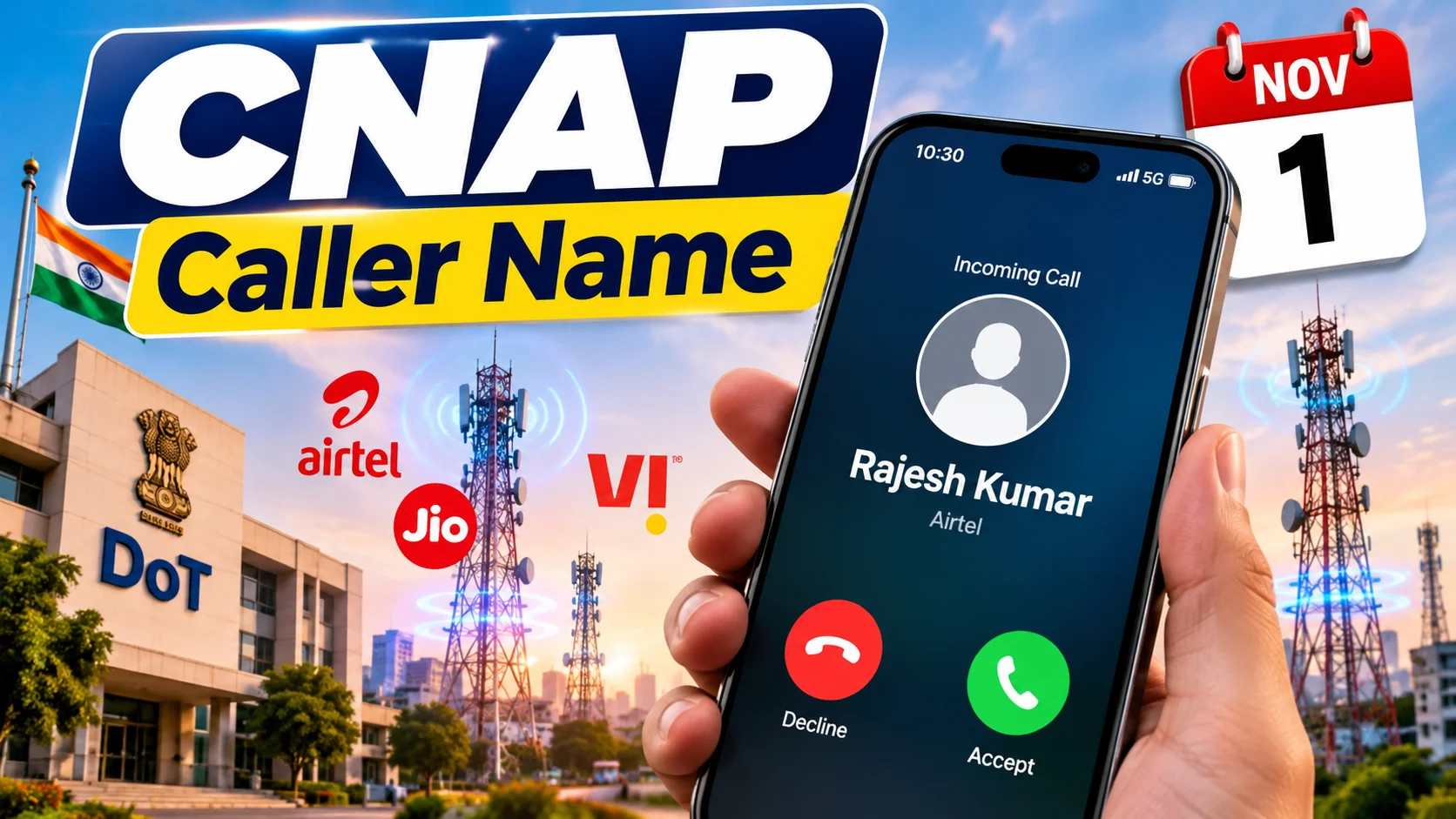
- DoT has directed all telecom operators to roll out CNAP (Calling Name Presentation) nationwide starting November 1.
- CNAP shows the caller's registered name directly on your screen, pulled from the KYC details given while buying the SIM — no app needed.
- This is separate from Truecaller or any crowd-sourced caller ID app. It works at the network level.
- The idea has been in the works since 2022 and got delayed more than once before this latest deadline.
- Goal is simple — cut down spam, scam and fraud calls that flood Indian phones every day.
What just happened?
Here's the thing. You know that moment when an unknown number flashes on your screen and your brain instantly goes into "is this a scam" mode? The Ministry of Communications, through the Department of Telecommunications (DoT), just told every telecom operator in the country to fix that problem for good.
The order is straightforward — telcos have to switch on CNAP, or Calling Name Presentation, across their networks from November 1. Once it's live, when someone calls you, the name they registered with their SIM card shows up on your screen. Not a guess. Not what some random user typed into a crowd-sourced app. The actual name on file.
This isn't a brand-new idea DoT suddenly cooked up. CNAP has been discussed since around 2022, TRAI gave it the green light a while back, and pilot runs happened in patches. But like a lot of telecom rollouts in India, deadlines kept sliding. This time, November 1 is being treated as the real date.
How does this actually work?
Simple way to put it — your phone number is already tied to an identity document when you bought the SIM, right? Aadhaar, PAN, whatever KYC document you submitted at the store. CNAP basically takes that registered name and pushes it to the receiver's screen the moment a call connects.
So if your friend Arjun calls you from a new number he just bought, you'll see "Arjun" (or whatever name is on his SIM registration), not some unsaved digits. It happens at the network level, meaning Jio, Airtel, Vi and BSNL have to build this into their core calling infrastructure, not as some optional add-on.
Compare this to Truecaller, which most of us already have on our phones. Truecaller works off a massive database that users themselves fed over the years — people uploaded their contacts, and that's how names got matched to numbers. It's clever, but it's also patchy. Wrong names, outdated entries, privacy concerns about how that data got collected in the first place — all of that comes with it.
CNAP skips all of that mess. The source is official KYC data sitting with the telecom operator, not some third-party app scraping your contact list. In theory, that makes it more accurate and a lot less creepy from a privacy angle, since it's not pulling from everyone's saved contacts without consent.
What changes for people in India?
For the average person, the biggest shift is obvious — spam and scam calls get a lot harder to hide behind. Right now, fraud callers often use numbers that look legit or spoof identities. If a verified name pops up (or doesn't, which itself is a red flag), you've got one more layer of protection before you even pick up.
Think about how many calls a day go something like "Sir, your electricity bill is pending" or "Congratulations, you've won a lucky draw." A chunk of these are straight-up fraud attempts, and a lot of it works because the caller ID shows nothing useful. With CNAP, that blind spot shrinks.
There's also a business angle here. Delivery agents, bank reps, customer service calls — all of this becomes a little more trustworthy when a verified name shows up instead of just a number. For elderly users especially, who are often the softest target for phone scams, this could genuinely help.
Now, it's worth being real about the limits too. CNAP isn't a magic fraud shield. Scammers using legally registered SIMs under fake-but-valid KYC, or using international numbers, won't be caught by this. It helps with a specific kind of problem — unknown domestic numbers — not every category of phone fraud out there.
And yes, there's a fair question about privacy. If your name shows up to literally anyone who calls — or who you call — some people might not be thrilled about that visibility. DoT and TRAI have talked about opt-out provisions in earlier discussions around this feature, so expect some settings-level control once it's actually live, rather than it being forced on every single user with zero choice.
What should you do now?
Honestly, nothing drastic right now. This is a network-side change, so you don't need to download anything new or change your SIM. Once telcos push it live around November 1, it should start showing up on calls automatically, assuming your operator has it ready on their end.
If you're someone who relies heavily on Truecaller, you probably don't need to delete it immediately — CNAP and Truecaller can coexist, and honestly Truecaller's database still covers a lot of businesses and bulk-call numbers that CNAP's pure KYC-based system might not flag the same way.
Keep an eye on your operator's app or SMS updates around late October. Jio, Airtel, Vi, and BSNL usually send out notices when a network feature like this flips on for users in a particular circle. If by mid-November you're still not seeing any names pop up, it might just be a staggered rollout — these telecom-wide switches rarely go live everywhere on day one, even with a government deadline attached.
One genuinely good habit either way — don't let a name on screen be the only reason you trust a call. Scammers have gotten smarter, and even a legit-looking name doesn't mean the person on the other end has good intentions. Use CNAP as one more signal, not the whole decision.
How will this actually roll out across Jio, Airtel, Vi and BSNL?
Here's where things get a bit messy, in a very India-telecom way. A directive from DoT doesn't mean every tower and every billing system flips a switch at the same second on November 1. Telcos have to update their core network software, test it against their existing caller ID and billing systems, and then push it circle by circle — Delhi, Mumbai, Tamil Nadu, and so on don't necessarily go live together.
Jio has the advantage of a newer, more unified network stack, so it could move faster. Airtel and Vi are juggling a mix of legacy infrastructure in some circles, which usually means a slower, patchier rollout. BSNL, being a government-run operator with its own pace of upgrades, might take the longest of the four. None of this means the deadline is fake — it just means your friend in Chennai might see caller names a week before your cousin in a smaller town does, and that's normal for a change this size.
There's also the practical question of cost. Building CNAP into the network isn't free for telcos — it needs backend changes, storage for KYC-linked name data, and processing at call-setup time for every single call, which is a massive scale when you think about how many calls happen across India daily. Whether that cost eventually shows up anywhere in your bill isn't clear yet, and DoT hasn't said anything about this being a paid feature, so for now, assume it's bundled in as a basic service, not an add-on you'll be charged extra for.





Comments (0)
Be the first to comment!