


What’s the buzz?
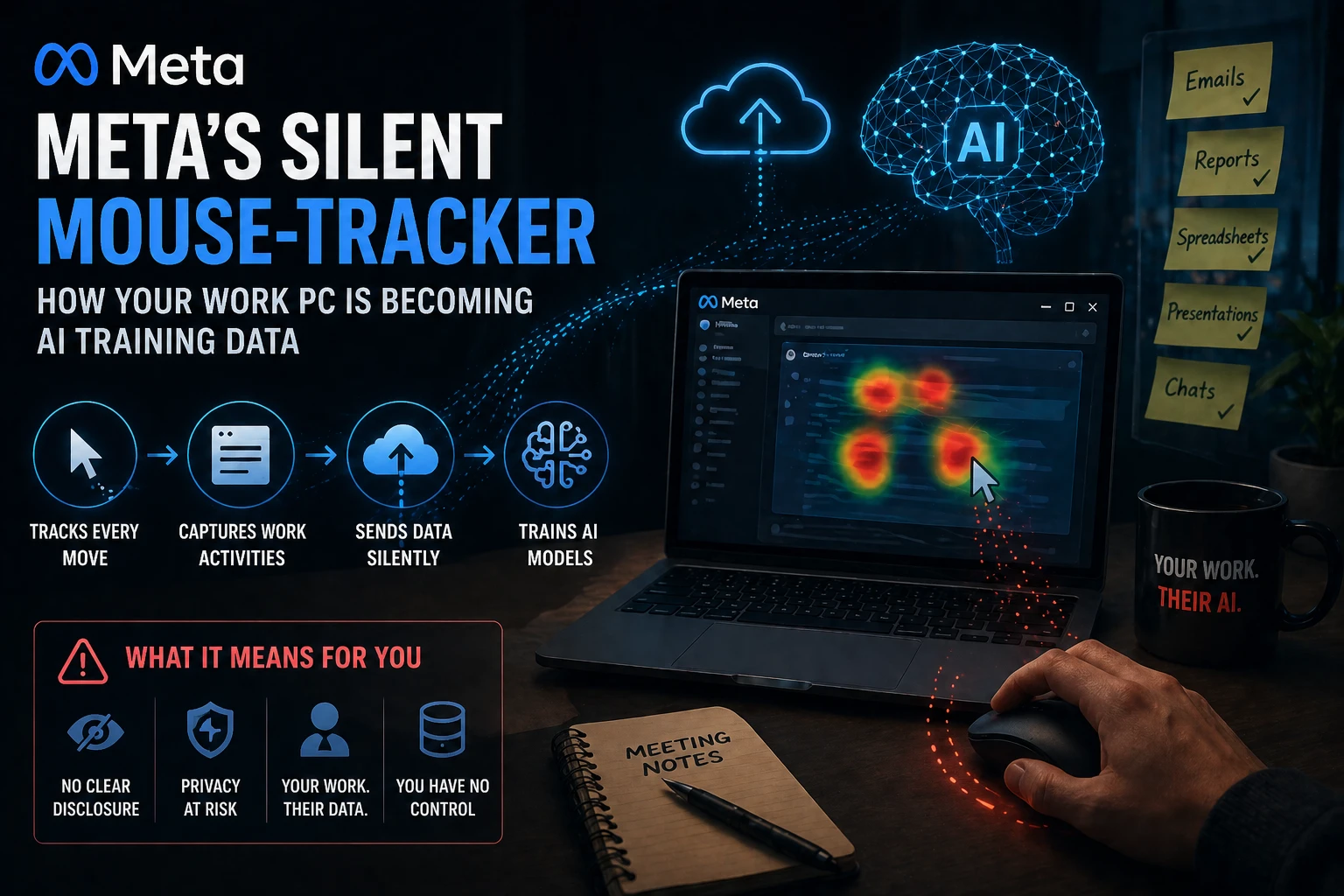
Imagine you’re typing an email to a client, scrolling through a spreadsheet, or copy‑pasting a design spec. Behind the scenes, a tiny piece of software silently watches every mouse move, every click, and every key you press – but only inside the apps that Meta says are “work‑related”. The goal? Turn those raw interactions into training data for the company’s upcoming AI models.
How does it work?
Meta’s internal IT team has rolled out a background agent on the laptops of its US staff. The agent is not a traditional key‑logger that captures everything you type. Instead, it is scoped to specific “productivity” applications – think Slack, Google Docs, Jira, and internal Meta tools. When you open one of those apps, the agent starts recording:
- Mouse cursor trajectories (how you move the pointer, speed, pauses)
- Click patterns (single‑click, double‑click, right‑click, drag‑and‑drop)
- Keystroke timing (how fast you type, dwell time on each key)
- Window focus changes (when you switch between tabs or apps)
All this data is packaged into anonymised event streams and shipped to Meta’s data lake, where it will be fed into large language models (LLMs) and multimodal AI systems. The company claims the data helps the AI understand “real‑world work flows”, making future tools more helpful for tasks like drafting emails, summarising meetings, or auto‑generating code snippets.
Why is this a big deal?
First, it’s a shift from the usual “telemetry” you see in consumer apps (like usage stats for a video game). This is deep behavioural telemetry, captured at the granularity of each mouse wiggle. Second, it raises privacy red flags because the data, even when anonymised, can be reverse‑engineered to infer personal habits, work rhythms, and even sensitive content if the employee types it into a “work‑related” app.
Numbers you should know
Meta says the pilot involves roughly 5,000 US employees across its advertising, engineering and design divisions. The agent logs an average of 150 events per minute per user, amounting to about 1.5 GB of raw data per employee per week. After compression and anonymisation, the dataset shrinks to roughly 250 MB per user per week – still a massive amount when you multiply it across thousands of workers.
What does this mean for Indian users?
Even though the rollout is limited to the US, the ripple effects are global:
- AI models trained on this data will be rolled out worldwide. The next version of Meta’s AI assistants (think Meta AI Chat) will likely be smarter about workplace tasks, and Indian professionals will be the end‑users.
- Data‑privacy expectations may tighten. Indian tech firms are already grappling with the Personal Data Protection Bill (PDPB). If a US giant can collect such granular data, regulators may push local companies to disclose similar practices.
- Job market impact. Companies hiring for AI‑training roles may start looking for candidates with experience in “behavioral telemetry” – a niche skill set that didn’t exist a year ago.
How does it compare to other giants?
Google, Microsoft and Amazon already collect usage analytics from their enterprise suites, but they usually aggregate at the feature‑level (e.g., “how many users opened Docs”). Meta’s approach is more invasive – it watches the process of using the tool, not just the outcome. That’s why privacy advocates are sounding the alarm.
TamilTech‑ஓட கருத்து
We get that Meta wants better AI. Training an LLM on real‑world work patterns is a logical step. However, the trade‑off between product improvement and employee privacy feels lopsided. In India, where many workers already worry about surveillance from employer‑provided laptops, this could set a worrying precedent.
From a practical standpoint, Indian startups could learn two things:
- If you’re building AI‑assistants, consider opt‑in data collection with clear consent – it builds trust.
- Invest in internal privacy‑by‑design frameworks now, before regulators catch up.
What can you do right now?
If you’re an employee of a company that uses Meta’s tools (or any similar telemetry), here are quick steps:
- Check your device’s Task Manager or Activity Monitor for unknown background processes.
- Read the company’s data‑privacy policy – look for mentions of “behavioral analytics” or “mouse tracking”.
- If you’re uncomfortable, raise the issue with HR or the IT security team. In many US firms, you have the right to opt‑out of non‑essential monitoring.
What’s next?
Meta plans to expand the pilot to other regions later this year, possibly including its offices in Europe and Asia‑Pacific. Expect more detailed “AI‑assistant” features in Workplace and the broader Meta ecosystem. For Indian users, the first visible change will be smarter auto‑suggestions in tools like Meta Business Suite and WhatsApp Business – powered by the very data being collected today.
Bottom line: the AI arms race is now being fought not just with GPU clusters, but with the tiny movements of your mouse. Stay informed, ask questions, and protect your digital footprint.





Comments (0)
Be the first to comment!