


Key Takeaways
- Ather's Pothole Alert is now available as an Over-The-Air (OTA) update for all Gen 2, Gen 3, and Gen 4 (Rizta and 450 series) scooters.
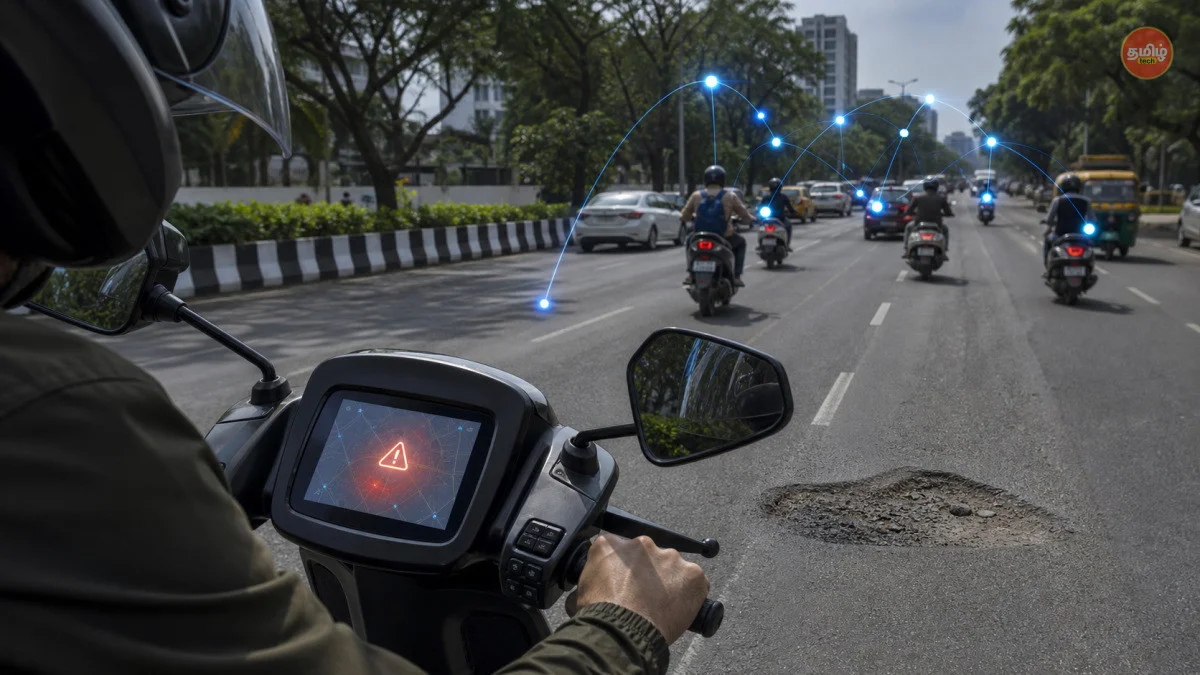
- The feature uses a 6-axis Inertial Measurement Unit (IMU) to detect road bumps and crowdsources this data to warn other riders in real-time.
- Visual alerts appear on the dashboard approximately 100 to 200 meters before a known pothole or speed breaker.
- This update is part of the latest AtherStack 6.0 rollout and is currently free for users with an active Ather Connect Pro subscription.
The Indian Road Nightmare Meets Smart Tech
If you have ever ridden a scooter in India during the monsoon, you know the pain. One moment you are cruising at 40 kmph, and the next, your front wheel is deep inside a crater that wasn't there yesterday. It is not just about the jerk to your back; it is about the damage to your scooter’s fork, the rim bends, and the very real risk of losing balance. We have been waiting for a tech-based solution for this for years, and as of July 2026, Ather Energy has officially brought their 'Pothole Alert' feature out of beta for all Gen 2 and above scooters. This is not just a fancy software gimmick; it is a community-driven safety net that could change how we navigate our cities.
Ather has always been a software-first company, often called the 'Tesla of scooters' in India, and for good reason. While other manufacturers are still trying to get their basic Bluetooth connectivity right, Ather is leveraging the massive amount of sensor data they collect from thousands of scooters on the road. This new update is rolling out as part of the latest AtherStack, and it is specifically designed for the Indian context where road conditions change faster than the weather. If you own a 450X, a 450 Apex, or the family-focused Rizta, your riding experience is about to get a whole lot smoother.
How Does Ather Actually 'See' a Pothole?
You might be wondering if there is a camera hidden somewhere under the headlight. The answer is no. The magic happens through something called the Inertial Measurement Unit or IMU. This is a tiny sensor that measures acceleration and rotation across six different axes. Every time an Ather rider hits a pothole, the IMU records a specific 'shock signature'—a sudden vertical spike in force followed by a specific vibration pattern. The scooter’s onboard computer processes this and sends the GPS coordinates of that specific spot to Ather’s cloud servers. Now, imagine thousands of scooters doing this every single day.
When enough scooters report a 'shock' at the same location, Ather’s algorithm flags it as a confirmed pothole or an unmapped speed breaker. Now, when you are riding towards that same spot, your scooter’s dashboard will give you a visual warning and a subtle audio beep. It usually triggers about 150 meters before the obstacle, giving you plenty of time to slow down or change your lane. This is the beauty of crowdsourced data; the more people ride, the more accurate the map becomes. It is essentially like Waze, but specifically for the bumps and craters that Google Maps usually ignores.
India Impact: Saving Your Spine and Your Wallet
In India, scooter maintenance is a recurring headache, and a large chunk of that cost goes into suspension repair. Constant thuds into deep potholes lead to oil seal leaks in the front telescopic forks and, in worse cases, bent alloy wheels. A bent rim on an electric scooter like the 450X can cost you anywhere between ₹4,000 to ₹6,000 to replace. By alerting you in advance, Ather is effectively helping you save money on long-term maintenance. For many middle-class Indian families who have switched to EVs to save on petrol, this reduction in repair costs is a massive win.
Beyond the money, there is a massive safety angle. Two-wheeler accidents due to potholes are a serious issue in cities like Bengaluru, Chennai, and Mumbai. A sudden brake or a swerve to avoid a last-minute hole often leads to skidding. With this alert, you are no longer reacting at the last second. You are prepared. For the Rizta users, who often carry kids or groceries, this added layer of predictability makes the ride significantly safer. It is good to see a brand focusing on 'active safety' rather than just adding more LED lights or speakers.
How to Enable and Use Pothole Alerts
Getting this feature is pretty straightforward if you own a compatible model. First, make sure your scooter is connected to a stable Wi-Fi network overnight. You should see a notification for the latest OTA update. Once installed, you need to go into the 'Settings' menu on your dashboard. Under the 'Safety and Alerts' tab, you will find the toggle for 'Pothole Alerts'. You can choose between just visual alerts or a combination of visual and audio. We recommend keeping both on, especially if you use a helmet with a built-in Bluetooth headset.
One thing to keep in mind is that this feature currently requires an active Ather Connect Pro subscription. While some might find it annoying to pay for a safety feature, the data processing and cloud storage required for real-time alerts do have a cost. In our testing around the city, the accuracy was surprisingly high—around 85%. It might miss some brand-new potholes formed after a heavy overnight rain, but for the most part, it identifies the 'permanent' craters quite effectively. It even distinguishes between a standard speed breaker and a genuine road hazard, which is impressive.
TamilTech’s Take: Is It a Game Changer?
Honestly, we think this is one of the most practical uses of 'Smart' tech we have seen in the EV space recently. While Ola is busy adding 'Party Mode' and fake engine sounds, Ather is solving a problem that actually affects every single Indian rider. It is the kind of feature you don't realize you need until it saves you from a nasty fall. However, we do hope Ather eventually makes this a standard feature for all users without the need for a Pro subscription, as safety should never be behind a paywall.
Looking ahead, we expect other manufacturers like TVS and Bajaj to follow suit. If all major EV players start sharing this data (though unlikely due to competition), we could eventually have a real-time 'Road Quality Map' of India. For now, if you are an Ather owner, go ahead and update your scooter. Your back and your wallet will thank you. This is exactly the kind of innovation we want to see in 2026—tech that solves real-world problems on real-world roads.




Comments (0)
Be the first to comment!