


Key Takeaways
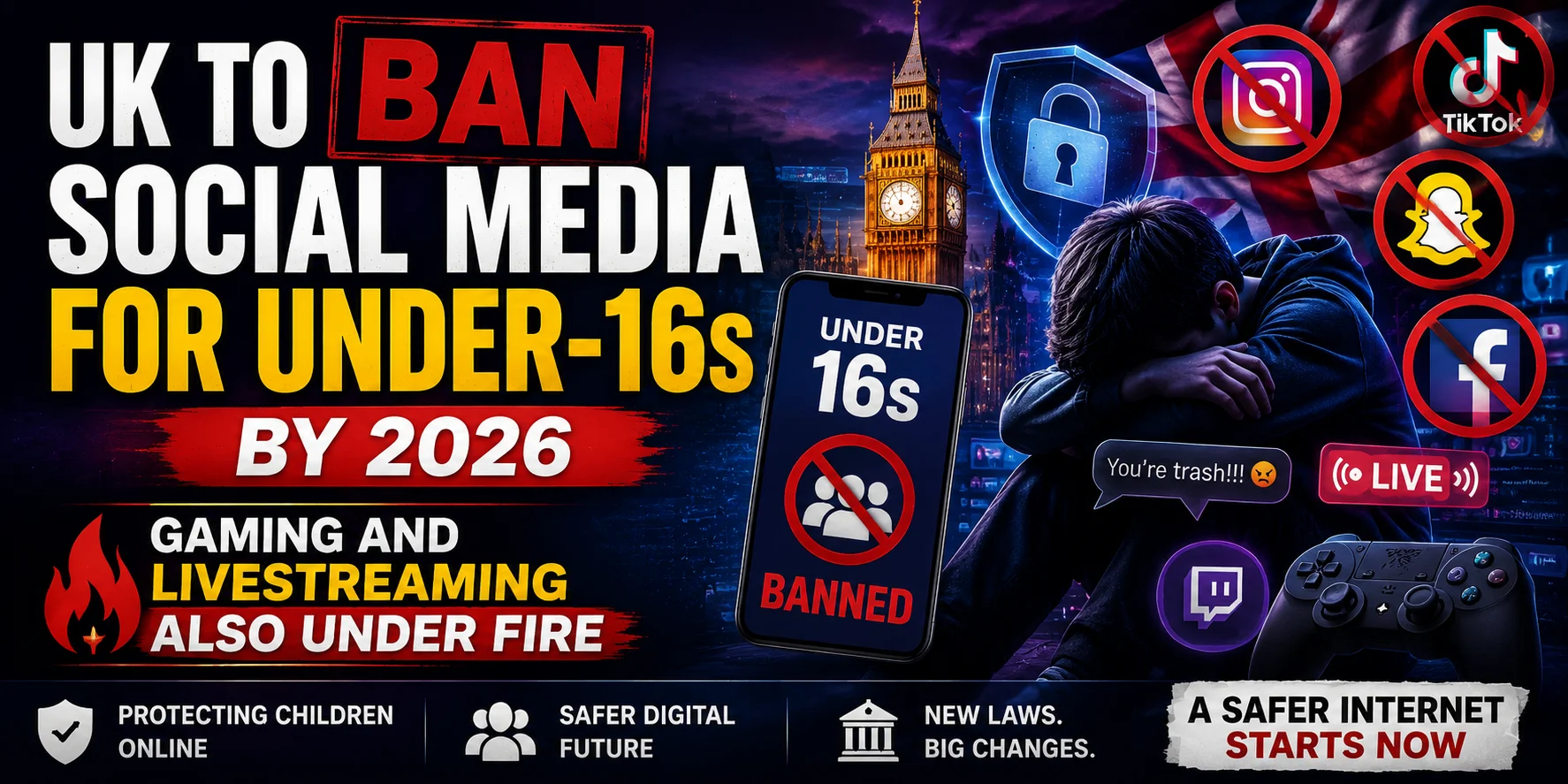
- The UK government is officially moving to ban social media access for everyone under the age of 16 by late 2026.
- New regulations will specifically target livestreaming platforms like Twitch and online gaming environments to prevent predatory behavior.
- Tech companies will face multi-billion pound fines if they fail to implement robust age-verification systems like AI face-scanning or ID checks.
- In India, the government is already observing these global trends, with the Digital India Act likely to introduce similar 'verifiable parental consent' rules soon.
- The bottom line: The era of unrestricted internet access for children is coming to an end globally, and parents need to prepare for stricter digital boundaries.
The Big News from 10 Downing Street
It’s finally happening. After years of debates, protests from parents, and warnings from mental health experts, the UK government has decided to pull the plug on social media for children. Prime Minister Keir Starmer just made it clear: by the end of 2026, if you are under 16, you are officially off the grid on platforms like Instagram, TikTok, and Snapchat. This isn't just a 'suggestion' or a set of guidelines for parents; it is going to be a hard legal ban backed by the full force of the law. As we sit here in June 2026, this is easily the biggest tech policy shift we’ve seen this decade, and it’s going to send shockwaves across the globe, including right here in India.
We’ve seen smaller attempts at this before, but this is different. The UK isn't just looking at Facebook or X (formerly Twitter). They are going after the entire ecosystem where kids spend their time. This includes gaming giants like Roblox and Fortnite, and livestreaming hubs like Twitch. The logic is simple: the current 'self-regulation' by tech giants has failed miserably. Kids are being exposed to harmful content, addictive algorithms, and online predators at an alarming rate. Starmer’s government is basically saying, 'Enough is enough.' If the tech companies won't protect the kids, the government will step in and do it for them.
How Did We Get Here? The Road to 2026
To understand why this is happening now, we have to look at the mess that was 2024 and 2025. Over the last two years, dozens of studies have linked excessive social media use to a massive spike in teen anxiety, depression, and self-harm. We saw the UK pass the Online Safety Act earlier, but even that felt like it didn't go far enough. Parents were still struggling to monitor what their 13-year-olds were seeing in their 'For You' feeds. The pressure on the government reached a boiling point when several high-profile cases of online grooming and cyberbullying led to tragic outcomes. It became a political necessity to act decisively.
The tech giants, of course, have been lobbying against this for years. They argued that a ban would violate 'digital rights' and that age verification is too hard to implement without compromising privacy. But the UK government isn't buying it anymore. They’ve seen that when companies want to sell you something or target you with ads, their technology is incredibly precise. So, the government’s stance is: if you can target a kid with a specific toy ad, you can definitely figure out if that kid is under 16. The grace period until late 2026 is specifically given so these companies can build the tech required to comply.
The 'Triple Threat': Social Media, Gaming, and Livestreaming
This ban isn't just about scrolling through photos. It’s a three-pronged attack. First, the social media ban is the most visible part. Platforms will be required to verify the age of every single user. No more 'Enter your birth year' pop-ups that anyone can lie to. We are talking about biometric age estimation—where an AI scans your face to guess your age—or linking your account to a government-issued ID. If the platform can't prove you're 16, your account gets nuked. It’s that simple.
Second, let’s talk about gaming. This is where it gets interesting for us gamers. The UK is looking at 'loot boxes' and unmoderated chat rooms in games like Roblox. They want to restrict these features for minors because they mimic gambling and are often the primary way predators contact children. By 2026, games will have to implement 'Kid-Safe' modes that are mandatory for anyone under the age limit. This means no voice chat with strangers and no in-game purchases without a parent literally biometrically authorizing it every single time.
Third is livestreaming. Platforms like Twitch and YouTube Live are often the 'Wild West' of the internet. Real-time content is incredibly hard to moderate. The new rules will likely prevent under-16s from broadcasting themselves and will restrict who can comment on their streams. The goal is to stop the 'parasocial relationships' that form between young viewers and streamers, which often lead to kids spending thousands of pounds of their parents' money on 'donations' or 'bits'.
The India Impact: Will We See This in India Soon?
You might be thinking, 'This is in the UK, why should I care in India?' Well, here’s the reality: India is the largest market for almost all these tech companies. When the UK or the EU passes a law like this, the tech companies often find it easier to implement similar systems globally rather than having different rules for every country. Moreover, our own Ministry of Electronics and Information Technology (MeitY) has been very vocal about 'Online Safety' lately. With the Digital India Act currently being refined, we are already seeing whispers of 'verifiable parental consent' for anyone under 18.
In India, we have a massive population of 'first-time internet users' who are kids. They get a cheap smartphone, a Jio SIM, and they are suddenly exposed to the entire world without any filters. If the UK model succeeds in reducing teen suicide rates or improving mental health, you can bet your last rupee that the Indian government will follow suit. We might see a version of this where the age limit is 14 or 15, but the direction is the same. Parents in India are already asking for more control over YouTube Kids and Instagram, and the government is listening.
How Will Age Verification Actually Work?
This is the trillion-dollar question. How do you check someone's age without being a 'Big Brother' state? There are three main technologies being discussed for the 2026 rollout. The first is 'Age Estimation' using AI. Companies like Yoti already have tech that can look at a selfie and tell if you're a child or an adult with 99% accuracy. It doesn't 'recognize' who you are; it just analyzes facial features to estimate age. The UK government is leaning heavily toward this because it's fast and doesn't require uploading a passport.
The second method is 'Hard ID' verification. This involves uploading a photo of your Aadhaar card (in India's case) or a Passport. This is the most secure but also the most controversial because of privacy hacks. The third is 'Credit Card Verification'. Since you usually need to be 18 to have a credit card, platforms assume that if a card is linked, an adult is involved. However, kids are smart—they just take their parents' cards. That’s why the UK wants to move away from this and toward biometrics.
TamilTech’s Honest Take: Is This a Good Move?
Look, at TamilTech, we love technology. We love the freedom the internet gives us. But we also see the comments on our videos and the emails we get from worried parents. The 'Wild West' era of the internet has caused real harm. Do I think a total ban is the perfect solution? Maybe not. Kids are tech-savvy; they will find ways to use VPNs or fake IDs. It’s like telling a teenager not to smoke—it often makes them want to do it more. However, by making it harder to access, we protect the majority of kids who aren't tech-wizards.
The real challenge will be enforcement. If the UK manages to fine a company like Meta or Google 10% of their global turnover, they will listen. But if the fines are small, they will just treat it as a 'cost of doing business'. My concern is that this might push kids into 'darker' corners of the internet that are even less regulated than Instagram. But overall, something had to be done. The current situation where a 12-year-old can see extreme content just by scrolling is unacceptable. We expect 2026 to be the year the 'Digital Childhood' officially changes forever.
What Should Parents Do Right Now?
You don't have to wait for 2026 or for a law to be passed in India. If you have kids under 16, start using the tools that are already there. On Android, set up 'Google Family Link'. It lets you see exactly what apps they are downloading and set time limits. On iPhone, use 'Screen Time' and 'Family Sharing'. You can literally block apps like Instagram or Snapchat with a single toggle. Most importantly, talk to your kids. Explain why these rules are coming. If they understand the 'why'—the dopamine loops, the privacy risks—they are much more likely to follow the rules than if you just snatch the phone away.




Comments (0)
Be the first to comment!